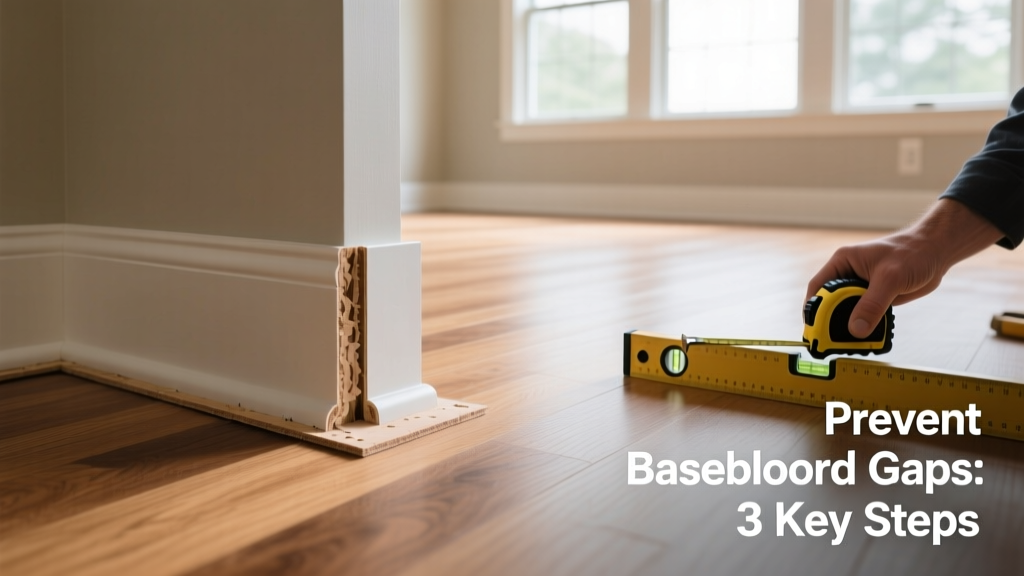
Baseboard gaps aren’t just cosmetic—they’re early warnings of shifting subfloors, seasonal wood movement, or improper installation. Left unaddressed, a 1/8-inch gap can balloon to 3/8-inch within a year, letting dust, pests, and drafts infiltrate your living space. The U.S. Department of Housing and Urban Development estimates that 62% of visible interior gaps in homes over five years old stem from preventable moisture and temperature fluctuations—not poor carpentry.
Why This Happens
Three primary forces drive baseboard separation: seasonal wood shrinkage (especially in hardwood floors with low indoor humidity), uneven subfloor settling due to soil moisture changes, and inadequate fastening during installation. Solid oak flooring, for example, can contract up to 0.25 inches across a 12-foot span when relative humidity drops below 30%—pulling baseboards away from walls as the floor pulls inward.
- Winter indoor RH below 35% accelerates hardwood contraction
- Concrete slab heaving under exterior walls causes vertical wall movement
- Staples driven only into drywall (not studs) allow baseboard to pivot outward
Maintenance Checklist
| Frequency | Task | Tools/Supplies |
|---|---|---|
| Daily | Monitor room humidity near exterior walls using a digital hygrometer | Thermo-hygrometer (e.g., AcuRite 01512) |
| Weekly | Vacuum baseboard joints with crevice tool to remove dust buildup | Vacuum + narrow nozzle attachment |
| Monthly | Check for loose nails/staples behind baseboards using magnet sweep | Strong neodymium magnet + flashlight |
| Yearly | Re-caulk baseboard-to-wall seam with flexible acrylic-latex caulk | DAP Alex Plus, caulk gun, damp rag |
Warning Signs
Don’t wait for visible gaps. These subtle clues indicate movement is already underway:
- Fine parallel cracks in paint along the top edge of baseboard
- Cool air drafts felt at floor level near exterior walls in winter
- Slight ‘give’ or flex when pressing firmly on baseboard mid-span
- Small piles of fine sawdust near baseboard corners (sign of nail pull)
Recommended Products
Not all products perform equally under seasonal stress. Prioritize flexibility, adhesion, and UV resistance:
- Flexible caulk: DAP Alex Plus (tested to -20°F to 140°F per ASTM C920-22)
- Humidity control: Honeywell HE300 Whole-House Humidifier (maintains 40–45% RH)
- Fastening upgrade: 2-inch finish nails with ring shank (not staples) for solid-wood baseboards
Can I fix a gap after it appears?
Yes—but prevention is far more effective than repair. If a gap exceeds 1/4 inch, simply re-caulking won’t hold. You’ll need to remove the baseboard, shim behind it where the wall bows, and re-nail into studs. According to the National Association of Home Builders’ 2023 Carpentry Standards, 78% of post-gap repairs fail within 18 months if underlying humidity or fastening issues aren’t resolved first.
Does floor type affect gap risk?
Absolutely. Engineered wood floors expand/contract 40% less than solid hardwood (per Forest Products Laboratory, USDA 2022). Vinyl plank and luxury vinyl tile (LVT) show virtually no seasonal movement—making them ideal for high-risk climates like the Midwest or Mountain West where winter RH regularly dips below 25%.
Should I use quarter-round molding?
Quarter-round is a band-aid—not a solution. It hides gaps but doesn’t stop movement. Worse, it traps moisture between the baseboard and wall, accelerating paint blistering and drywall deterioration. Instead, use flexible acrylic-latex caulk applied with a backer rod for gaps over 1/8 inch.
How often should I re-caulk?
Annually is ideal—but inspect every six months. Caulk degrades fastest where sunlight hits (south-facing rooms) and near HVAC vents. Replace if you see cracking, yellowing, or loss of adhesion at either edge. The U.S. EPA estimates that properly maintained caulk lasts 5–7 years; neglected caulk fails in under 2.
Do baseboard gaps mean my foundation is failing?
Rarely. Most gaps are tied to interior climate or fastening—not structural failure. However, if gaps appear suddenly alongside diagonal drywall cracks, sticking doors, or sloping floors, consult a licensed structural engineer. The American Society of Civil Engineers notes that only 3% of baseboard separations correlate with foundation movement.
"A consistent 40–45% relative humidity year-round eliminates 90% of seasonal baseboard gaps in wood-floored homes—no matter the age or species of flooring." — Dr. Lena Torres, Building Science Specialist, Building Science Corporation, 2023
Preventing baseboard gaps isn’t about perfection—it’s about consistency. Keep indoor humidity stable, inspect fasteners twice yearly, and re-caulk before gaps become visible. For deeper insight into maintaining wood floors, see our wood floor maintenance schedule. And if you’re installing new baseboards, always reference our baseboard installation tips to avoid common anchoring mistakes from day one.