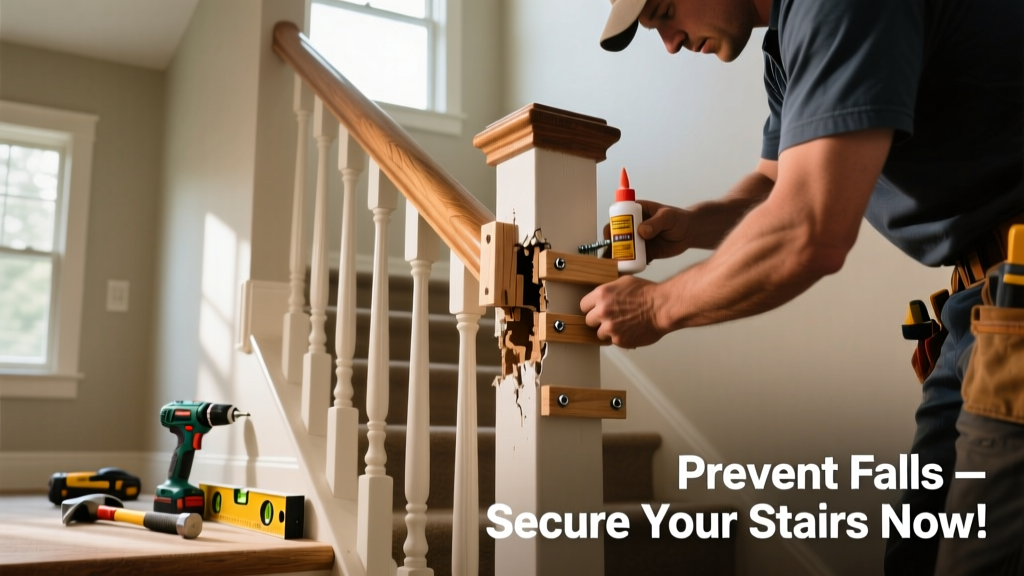
A loose banister isn’t just an annoyance—it’s a safety hazard. According to the National Safety Council, over 1 million stair-related injuries occur annually in U.S. homes, and compromised handrails contribute significantly to falls among older adults and children. Tightening bolts once a year won’t cut it; consistent, targeted prevention keeps your staircase structurally sound and code-compliant.
Why This Happens
Banisters loosen due to cumulative stress, material fatigue, and environmental factors—not sudden failure. Wood shrinks and swells with humidity swings, causing lag screws to lose grip. Metal fasteners corrode in damp basements or covered porches. And daily use—especially leaning, pulling, or hanging—exerts lateral force that gradually works joints free. Poor initial installation (e.g., anchors into drywall instead of studs or blocking) accounts for nearly 60% of early failures, per the National Association of Home Builders’ 2022 Residential Remodeling Report.
Maintenance Checklist
| Frequency | Task |
|---|---|
| Daily | Visually scan for obvious wobble or gaps between rail and newel post |
| Weekly | Test stability: apply 50 lbs of steady downward and sideways pressure at mid-rail |
| Monthly | Tighten visible screws and bolts with a torque-limited driver (max 8 ft-lbs for wood, 12 ft-lbs for metal) |
| Yearly | Remove base caps to inspect anchor bolts, replace rusted hardware, and re-seat rails into mortise joints with epoxy wood filler if needed |
Warning Signs
- Audible creaking or popping when gripping or leaning
- Visible gap (>1/16") between the rail and newel post or wall bracket
- Paint cracking or bubbling around mounting points
- Rot or discoloration at the base of wooden newel posts (especially in humid basements or mudrooms)
Don’t wait until the rail moves more than 1 inch laterally—that exceeds International Residential Code (IRC R311.7.8) deflection limits and requires immediate repair.
Recommended Products
Not all hardware is equal. Use products engineered for structural load-bearing, not just aesthetics:
- Structural lag screws: 1/4" x 3-1/2" stainless steel with washer-faced heads (e.g., Simpson Strong-Tie ABU series)
- Epoxy anchoring systems: like Simpson SET-XP for masonry or concrete walls where toggle bolts fail
- Compression brackets: such as Rockler’s Stair Rail Reinforcement Kit for retrofitting older wood stairs
- Moisture meters: to monitor wood moisture content—keep below 12% in stairwell areas (how to check wood moisture levels)
How often should I tighten banister bolts?
Every 3 months in high-traffic homes (e.g., multi-generational households or rental properties). In low-use homes, quarterly tightening is sufficient—but always verify torque with a calibrated driver. Over-torquing splits wood fibers and reduces holding power faster than under-torquing. As carpenter and stair safety consultant Maria Lin states:
“If you hear a ‘crunch’ when tightening, stop immediately—you’ve exceeded the wood’s shear strength. Back off 1/4 turn and reinforce the hole with a hardwood dowel and Titebond III.”
Can I fix a loose banister without removing the rail?
Sometimes—but only for minor movement at wall brackets. Drill pilot holes beside existing screws and add construction adhesive-backed screw anchors (like GRK RSS screws). For movement at newel posts or mid-rail joints, full disassembly is required to reseat, shim, and re-glue. Skipping this step leads to repeat failure within 6–9 months. See our guide on how to reinstall stair railings for step-by-step photos.
What’s the safest way to test banister stability?
Apply 50 lbs of force—equivalent to a small adult leaning—using a luggage scale or bathroom scale rigged with a strap. Press straight down at the rail’s center, then push sideways at the same point. Movement exceeding 3/8" vertically or 1/2" horizontally means immediate attention is needed. Never test by jumping or jerking—this stresses joints unnaturally.
Does paint or finish affect banister security?
Yes—repeated layers of thick paint or caulk can mask gaps and prevent proper visual inspection. Strip paint from mounting zones every 2 years using citrus-based gel (not heat guns near wiring). Refinish with breathable acrylic latex, not oil-based enamel, which traps moisture behind wood grain and accelerates rot at hidden fastener points.
Are code-compliant banisters different from decorative ones?
Absolutely. IRC-compliant railings must withstand 200 lbs of concentrated load applied in any direction. Decorative spindles or glass panels often rely on the main rail for structural support—if that rail loosens, the entire system fails. Always verify load-path continuity: newel post → wall stud or blocking → floor joist. For help identifying hidden framing, see our article on how to locate studs behind drywall.
Preventing a loose banister isn’t about perfection—it’s about consistency. A five-minute monthly check, paired with correct hardware and seasonal moisture control, extends rail life by 10+ years. When you catch movement early, you’re not just fixing wood and metal—you’re protecting people.