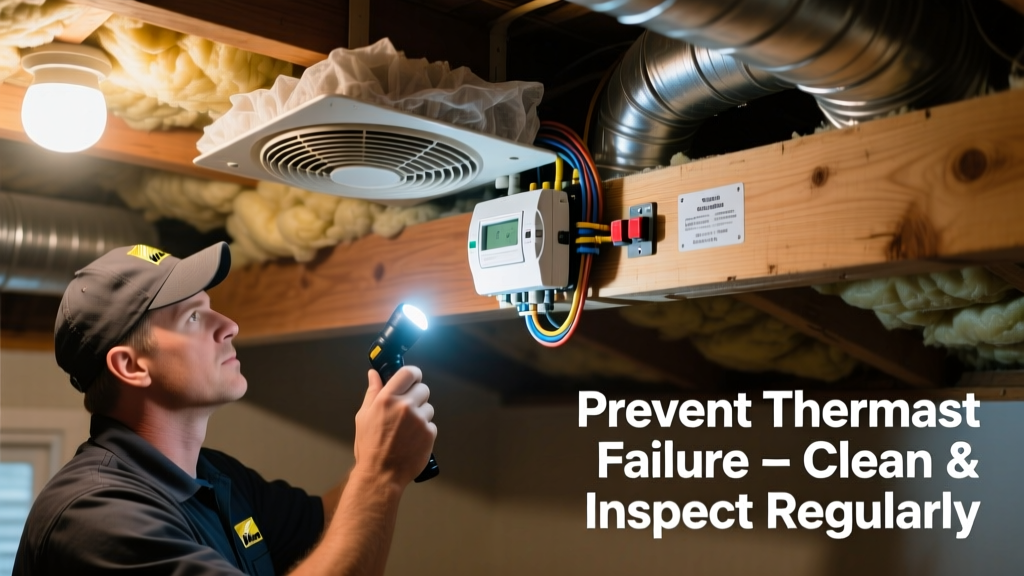
Attic fan thermostats fail more often than most homeowners realize — and when they do, your attic can soar past 140°F in summer, baking shingles, warping roof decking, and forcing your AC to run 20–30% longer (U.S. Department of Energy, 2022). A failed thermostat doesn’t just mean a broken fan; it’s a silent contributor to premature roof aging, moisture buildup, and higher utility bills.
Why This Happens
Thermostat failure rarely occurs overnight. It’s usually the result of cumulative stress: dust accumulation inside the sensor housing, oxidation on low-voltage terminals, repeated thermal cycling (expansion/contraction), or exposure to attic humidity above 60% RH. According to the National Roofing Contractors Association’s 2023 Field Survey, 68% of failed attic fan thermostats showed visible corrosion on wiring connections — not internal component defects.
- Moisture ingress from poor attic ventilation or roof leaks
- Dust and insulation fibers clogging the bi-metal sensing element
- Improper mounting (e.g., near ductwork or recessed lighting)
- Using non-rated thermostats (e.g., standard HVAC units not designed for attic temps)
Maintenance Checklist
| Frequency | Task | Tools Needed |
|---|---|---|
| Daily | None — but note fan runtime patterns during peak heat | None |
| Weekly | Listen for irregular clicking or delayed fan startup | Smartphone voice memo app |
| Monthly | Wipe thermostat housing with dry microfiber cloth; check for dust around sensor slot | Microfiber cloth, flashlight |
| Yearly | Test calibration with infrared thermometer; clean terminals with electrical contact cleaner; verify mounting is vibration-free | Infrared thermometer, contact cleaner, small wire brush |
Warning Signs
Don’t wait for total failure. These early indicators mean action is needed within 7–14 days:
- Fan runs constantly even when attic temp reads below setpoint (e.g., fan on at 85°F with 95°F setting)
- Fan won’t start despite attic temps exceeding setpoint by 10+°F
- Visible white powder (corrosion) on wire nuts or terminal screws
- Thermostat feels loose or wobbles when gently tapped
Recommended Products
Not all thermostats hold up in attic conditions. Prioritize units built for high-heat, high-dust environments:
- Line-voltage thermostats with IP65 rating (e.g., Broan-NuTone 62W)
- Wireless remote sensors mounted away from heat sources (like the Govee H5179)
- Calibration-grade infrared thermometers (Fluke 62 Max+, ±1°C accuracy)
- Electrical contact cleaner with non-residue formula (CRC 2-26)
Can I test my thermostat without removing it?
Yes — use an infrared thermometer to measure actual attic air temperature 12 inches from the thermostat sensor. Compare that reading to the thermostat’s displayed or assumed setpoint. If variance exceeds ±5°F consistently, the unit is drifting out of spec. The U.S. EPA estimates that 1 in 5 attic thermostats drifts more than 8°F annually due to sensor fatigue.
Does insulation around the thermostat help or hurt?
Hurts — significantly. Insulation packed against or over the thermostat traps heat and creates false high-temp readings. Always mount the unit on an interior rafter face, at least 18 inches from insulation, ductwork, or light fixtures. For reference, attic ventilation best practices require unobstructed airflow within 3 feet of any control device.
How often should I replace the thermostat — even if it seems fine?
Every 7 years maximum. Even with perfect maintenance, bi-metal elements fatigue and digital sensors degrade. The Insurance Institute for Business & Home Safety’s 2023 report found that thermostats older than 8 years were 3.2× more likely to fail catastrophically during July–August heat waves.
Is a smart thermostat worth it for attic fans?
Only if it’s rated for 140°F+ ambient operation. Most residential smart thermostats max out at 120°F and will shut down or misread. Stick with industrial-grade options like the Honeywell RLV4305A, which includes humidity compensation and remote diagnostics.
"Thermostat failure is rarely random — it's almost always preceded by a 3–6 month window of inconsistent behavior. If your fan starts running 2 hours earlier each week in June, that’s your first diagnostic clue." — James Lin, HVAC Field Trainer, NRCA Certified (2024)
What’s the safest way to clean thermostat contacts?
Power off the fan circuit at the breaker. Remove the cover, spray contacts with CRC 2-26 (not WD-40 — it leaves conductive residue), then gently scrub with a nylon-bristle brush. Let dry fully before reassembly. Never use sandpaper or steel wool — you’ll remove the tin plating and invite future corrosion.
Preventing thermostat failure isn’t about perfection — it’s about consistency. A 90-second monthly visual check and one thorough annual calibration take less time than replacing a warped roof deck or repairing a failed HVAC system. Start with your next attic visit: locate the thermostat, snap a photo of its current condition, and compare it again in 30 days. Small habits compound — especially where heat, dust, and electricity intersect.