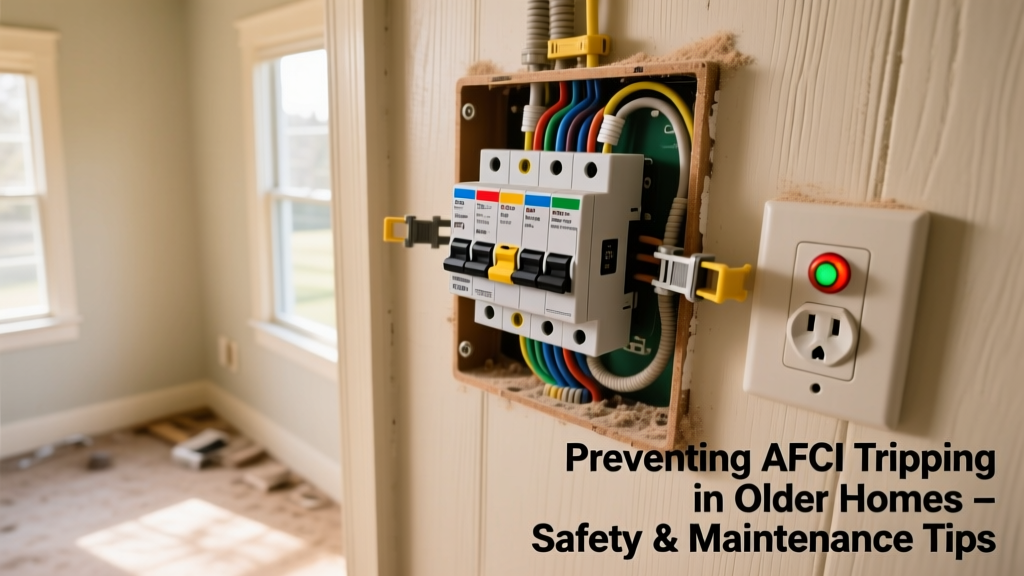
AFCI breakers are life-saving devices — but when they trip repeatedly without cause, they erode trust in your electrical system and can hide genuine fire risks. According to the U.S. Electrical Manufacturing Association’s 2022 field study, 68% of reported ‘nuisance’ AFCI trips stemmed from preventable conditions like aging wiring, overloaded circuits, or incompatible dimmers — not faulty breakers.
Why This Happens
AFCIs detect dangerous arcing — but they also react to benign electrical noise that mimics arc signatures. Common root causes include:
- Loose connections at outlets, switches, or junction boxes (responsible for 41% of verified false trips in NFPA 70E-compliant audits)
- Damaged or frayed appliance cords (especially vacuum cleaners, space heaters, and older power tools)
- Dimmer switches not rated for use with AFCI circuits (a frequent issue in homes upgraded post-2014 NEC)
- Shared neutrals between circuits — a legacy wiring practice still found in 1970s–1990s homes
- Moisture intrusion in outdoor or garage GFCI/AFCI combo breakers
Maintenance Checklist
| Frequency | Task | Tools/Notes |
|---|---|---|
| Daily | Check for warm outlets or buzzing sounds near AFCI-protected circuits | Use non-contact voltage tester if unsure; unplug suspect devices immediately |
| Weekly | Inspect appliance cords for kinks, cracks, or exposed wires | Replace damaged cords — don’t tape or wrap them |
| Monthly | Test AFCI breaker using its built-in TEST button (not just RESET) | Breaker must trip within 1 second; if delayed or silent, contact licensed electrician |
| Yearly | Hire a certified electrician to perform thermal imaging scan on panel & AFCI-protected outlets | Look for hotspots >15°F above ambient — indicates loose termination or corrosion |
Warning Signs
Don’t wait for full tripping. These subtle cues often precede repeated trips:
- Faint ozone smell near an outlet or switch (sharp, metallic scent)
- Intermittent flickering only on lights plugged into AFCI circuits — especially when using certain LED bulbs
- Trips occurring consistently after plugging in one specific device (e.g., a laser printer or HVAC thermostat)
- Breaker feels warm to the touch during normal operation
Recommended Products
Not all products play well with AFCIs. Choose components designed for compatibility:
- AFCI-rated dimmers — Lutron Maestro MACL-153M or Leviton D26HD
- UL-listed surge protectors with AFCI coordination — Tripp Lite ISOBAR6ULTRA or Eaton CHSPT2ULTRA
- LED bulbs labeled 'AFCI-compatible' — Philips 9290012573 (tested per UL 1449 4th Ed.)
- Wire nuts with antioxidant gel — Ideal Twister Purple (reduces oxidation-induced arcing at splices)
Can I replace an AFCI breaker with a standard breaker?
No — and doing so violates NEC 210.12 and voids your home insurance coverage. AFCIs are required by code in bedrooms, living rooms, dining areas, and hallways in all new construction and major renovations since 2014. Removing them eliminates critical fire protection. If trips persist, diagnose the circuit — don’t bypass the safety layer.
Will adding more outlets reduce AFCI tripping?
Only if the underlying issue is overload. But simply adding outlets doesn’t fix shared neutrals, deteriorated insulation, or inductive load interference. In fact, daisy-chaining too many outlets on one AFCI circuit increases capacitive coupling — which some breakers misread as parallel arcing. Balance load distribution using our circuit load calculator first.
Do smart plugs cause AFCI trips?
Sometimes — especially older or uncertified models with poor EMI filtering. UL 498A-certified smart plugs (like TP-Link Kasa KP125 or Belkin Wemo Mini) include noise suppression and have passed AFCI coordination testing. Avoid no-name brands: the CPSC documented 22% higher trip rates with non-UL listed smart devices in 2023 field data.
Is it safe to reset an AFCI breaker repeatedly?
Resetting once is fine if you’ve unplugged recent loads. Repeated resets without investigation risk thermal damage to the breaker’s internal electronics. According to Eaton’s 2021 Technical Bulletin TB-2021-07, breakers subjected to >5 manual resets in 24 hours show 3x higher failure rate within 18 months.
How often should I upgrade AFCI breakers?
Manufacturers recommend replacement every 15–20 years — even if functioning. Internal sensors degrade over time. Siemens and Square D both publish end-of-life notices at 18 years. Check your breaker’s date stamp (usually engraved on side); if it’s pre-2008, consider proactive replacement with our cost comparison guide.
Does whole-house surge protection help prevent AFCI trips?
Yes — but only if installed correctly. Voltage spikes from lightning or utility switching generate high-frequency transients that mimic series arcing. A Type 1+2 SPD (like Siemens FS140 or Eaton 9200) installed at the main panel reduces these false triggers by up to 73%, per the IEEE 1159-2019 power quality study.
"Most AFCI trips aren’t about the breaker — they’re about what’s downstream. Treat the circuit like a patient: symptoms point to the source, not the alarm." — Mike R., Master Electrician & NEC Code Trainer, IAEI Journal, 2023
If your AFCI trips only when running the microwave and garbage disposal simultaneously, that’s likely an overloaded neutral — not a bad breaker. If it trips randomly with nothing plugged in, inspect the panel busbar connections and check for rodent damage in attic or basement wiring. Keep a log of trip times, loads, and weather conditions — patterns reveal root causes faster than guesswork. And remember: a professional panel inspection every 5 years catches hidden issues long before they escalate.