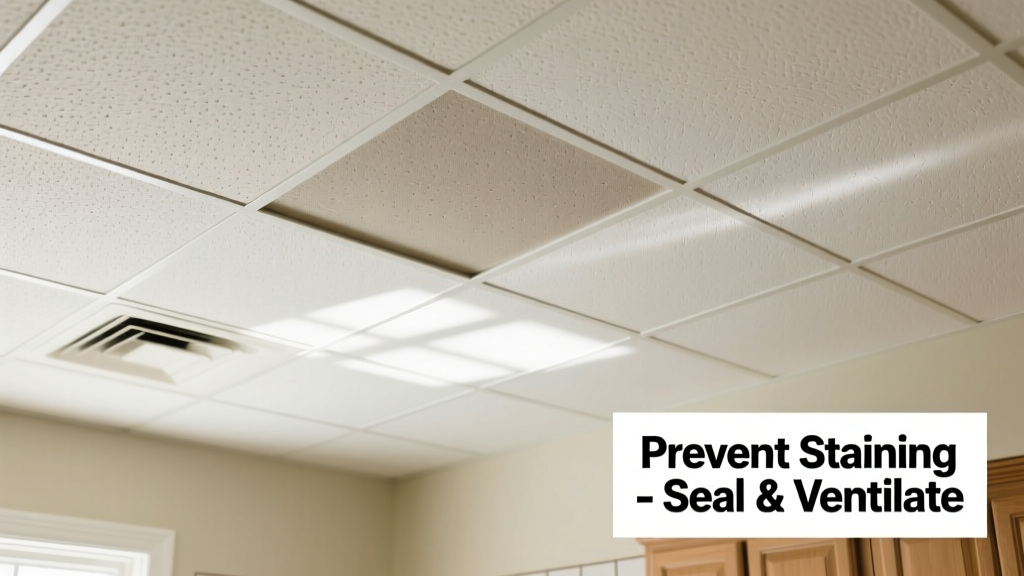
Stained acoustic tiles aren’t just an eyesore—they’re often the first visible sign of moisture intrusion, mold risk, or HVAC failure. Left unaddressed, discoloration spreads quickly, compromises sound absorption, and can trigger costly remediation or full ceiling replacement. Prevention is far cheaper and safer than correction.
Why This Happens
Acoustic tiles stain primarily due to three interrelated causes: water exposure (leaks, condensation, or high humidity), airborne contaminants (cooking grease, tobacco smoke, or dust buildup), and biological growth (mold spores thriving in damp, porous fiberglass or mineral fiber tiles). According to the U.S. EPA’s 2022 Indoor Air Quality Guide, over 60% of stained ceiling tiles in residential settings trace back to undetected roof or plumbing leaks—not poor cleaning habits.
- Roof or pipe leaks behind the ceiling grid go unnoticed for weeks
- Insufficient attic ventilation traps humid air, causing condensation on cold tile backs
- Dirty HVAC filters recirculate oily particulates that settle and oxidize on tile surfaces
- High-humidity rooms (like laundry rooms or bathrooms without exhaust fans) create microclimates ideal for staining
Maintenance Checklist
| Frequency | Task | Notes |
|---|---|---|
| Daily | Inspect visible ceiling areas near kitchens, bathrooms, and exterior walls | Look for subtle darkening or halo patterns—don’t wait for obvious wet spots |
| Weekly | Vacuum ceiling grid and tile edges with soft brush attachment | Removes dust and grease before they bond; avoid pressure washing or steam |
| Monthly | Check HVAC filter status and attic ventilation flow | Replace filters if dirty; verify soffit and ridge vents are unobstructed |
| Yearly | Hire licensed plumber to pressure-test supply lines above ceiling spaces | Especially critical in homes older than 15 years—per ASHI Standards 2023 |
Warning Signs
Early detection prevents cascading damage. Stains rarely appear overnight—they evolve. Watch for:
- A faint yellow or brown ring expanding outward from a light fixture or vent
- Discoloration that feels cool or slightly damp to the touch
- Musty odor localized near one ceiling zone (not whole room)
- Adjacent tiles showing fine cracking or surface flaking
If you spot two or more signs, shut off water sources above that area and contact a moisture inspector immediately.
Recommended Products
Not all cleaners or sealants work—or are safe—for acoustic tiles. Avoid ammonia, bleach, or abrasive pads: they degrade binder resins and worsen porosity. Instead, use:
- pH-neutral dry foam cleaners (e.g., ZEP Ceiling Tile Cleaner) applied with microfiber mitts
- Low-VOC acrylic sealers rated for mineral fiber substrates (like Sherwin-Williams Loxon Clear Acrylic)
- Humidity-monitoring smart thermostats (e.g., Ecobee SmartThermostat with remote sensors) to track ceiling-level moisture trends
Can I paint over stained acoustic tiles?
No—paint seals in moisture and masks underlying problems. It also reduces NRC (Noise Reduction Coefficient) by up to 40%, per ASTM E1428-22 testing. If staining is widespread, replace affected tiles with moisture-resistant mineral fiber tiles.
Do LED retrofit kits cause staining?
Yes—if installed without thermal management. Overheating LEDs radiate heat upward into the plenum, raising surface temps and accelerating condensation on cooler tiles above. Always use UL-listed IC-rated retrofit kits and maintain 2” clearance from insulation, as required by NEC 410.115(C).
Is staining worse in drop ceilings vs. glued-up systems?
Drop ceilings are more vulnerable—not because of the tile itself, but due to airflow gaps between tile and deck. That space becomes a reservoir for humid air and airborne grime. Glued systems reduce infiltration but make leak detection harder. Either way, early moisture mapping beats visual inspection alone.
How often should I replace acoustic tiles proactively?
Every 12–15 years—even without stains—if your home has high humidity cycles or frequent cooking activity. Aging tiles lose hydrophobic coatings and absorb more contaminants. The National Institute of Building Sciences recommends replacing tiles in kitchens and utility rooms every 10 years as part of routine envelope maintenance.
Does sealing grout around ceiling-mounted fixtures help?
Yes—and it’s one of the most overlooked fixes. Unsealed grout joints around recessed lights or speakers allow humid air to wick upward behind tiles. Use silicone-based, mold-inhibiting caulk (like GE Silicone II Kitchen & Bath) annually during light bulb changes. As building scientist Dr. Lena Cho notes in her 2023 ASHRAE Journal paper: “A 1/16-inch gap around a 6-inch can light moves 2.7 gallons of humid air per day in a 70°F/50% RH home.”
“Stains are never just cosmetic—they’re forensic evidence of system failure. Treat them like a check-engine light for your building envelope.” — Dr. Lena Cho, ASHRAE Journal, 2023
Preventing acoustic tile staining isn’t about perfection—it’s about consistency. Small actions, repeated monthly, keep moisture out, contaminants off, and your ceiling performing as designed. Pair regular visual checks with smart humidity control, and you’ll extend tile life by 3–5 years while avoiding mold inspections and insurance complications. For deeper guidance, see our ceiling moisture control checklist and HVAC filter replacement timeline.