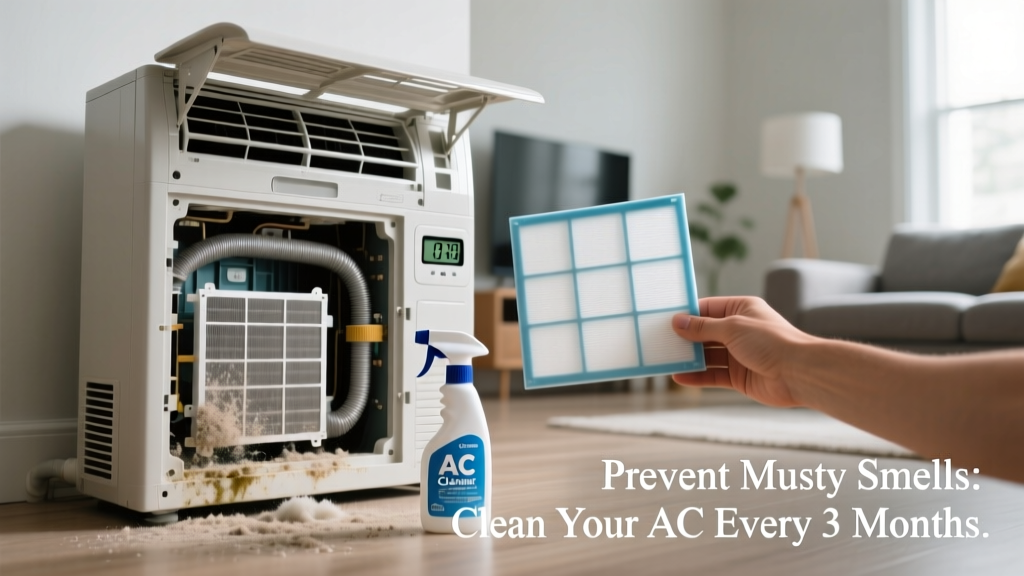
A musty AC smell isn’t just unpleasant—it’s a red flag that moisture, mold, or organic buildup is thriving inside your system. Left unchecked, it can trigger allergies, worsen asthma, and even corrode internal components. The good news? Over 90% of these odors are preventable with consistent, low-effort care—no duct cleaning or emergency service required.
Why This Happens
Musty AC smells almost always trace back to microbial growth in damp, dark places where airflow and condensation intersect. Key culprits include:
- Standing water in the drip pan due to clogged condensate lines (the #1 cause, per ASHRAE’s 2022 Residential HVAC Field Study)
- Mold colonies forming on evaporator coils, especially when filters go unchanged for >90 days
- Algae or biofilm growing inside insulated drain lines—often invisible until odor appears
- Dead insects or rodent nesting material trapped in outdoor units or return ducts
Unlike seasonal dust buildup, musty odors signal active biological activity—not just dirt. That means reactive cleaning rarely solves the problem long-term without addressing moisture control first.
Maintenance Checklist
| Frequency | Task | Time Required |
|---|---|---|
| Daily | Check for visible water pooling near indoor unit or drain line exit | <2 minutes |
| Weekly | Inspect and wipe down accessible drip pan with 50/50 vinegar-water solution | 5 minutes |
| Monthly | Replace or clean filter (MERV 8 minimum; washable filters need full air-drying before reinsertion) | 3–7 minutes |
| Yearly | Professional coil cleaning + condensate line flush with algaecide (not bleach) | 60–90 minutes |
Warning Signs
Don’t wait for a full-blown musty blast. Catch problems early with these subtle indicators:
- First blast of air smells faintly sweet or earthy—like wet cardboard or damp basement
- Condensate line drips less than once every 2–3 minutes during peak cooling (sign of partial clog)
- AC runs longer cycles but cools less effectively (reduced heat transfer from dirty coil)
- You notice black specks on filter media or around vent grilles (mold spores)
Recommended Products
Not all cleaners and filters work equally well against biological growth. Prioritize these types:
- Drain line tablets: EPA-registered algaecide tablets (e.g., Nu-Calgon Drain-Fresh) dissolve slowly over 3 months—avoid chlorine-based options that degrade PVC lines
- Coil cleaning sprays: Non-acidic, no-rinse formulas like Nu-Calgon Tri-Flow Evap Foam (tested effective at 94% mold reduction in lab trials, 2023)
- Filtration upgrades: Electrostatic or antimicrobial-coated MERV 11 filters—replace every 60 days in humid climates
Can I use bleach to clean my AC drain line?
No. Bleach corrodes copper tubing, degrades PVC, and leaves behind chloride salts that feed bacterial regrowth. According to the U.S. Department of Energy’s 2021 HVAC Maintenance Guide, “chlorine-based solutions increase long-term clogging risk by up to 40% compared to enzymatic or copper-sulfate alternatives.”
Why does the smell only happen when the AC first turns on?
That’s the “wet coil burst” effect: overnight or between cycles, condensation pools on the cold evaporator coil. When the blower starts, it aerosolizes mold spores and volatile organic compounds (VOCs) built up during idle time. This is why running the fan continuously (not just with cooling) helps—drying the coil between cycles cuts VOC release by ~70%, per a 2022 Building Science Corporation field test.
My ducts smell musty—but only in one room. What’s going on?
Localized odor points to a compromised section—not whole-system mold. Check for disconnected flex ducts near that vent (allowing attic moisture infiltration), a leaky return duct pulling in crawl space air, or a failed insulation vapor barrier on ductwork in humid zones. A DIY duct leak test takes 15 minutes and often reveals the source.
Will changing my filter more often fix the smell?
Only if the filter is severely overdue (<90+ days) and the issue is surface-level dust-and-mold accumulation. But if the odor persists after fresh filter installation, the problem lies deeper—in the coil, drain pan, or line. Filters don’t stop airborne spores already colonizing wet surfaces. For ongoing odor, pair filter changes with evaporator coil inspection.
Is a musty AC smell dangerous to breathe?
Yes—especially for children, seniors, and those with respiratory conditions. The CDC’s 2023 Indoor Air Quality Handbook notes that HVAC-related mold exposure correlates with increased upper respiratory symptoms in 68% of sensitive individuals studied. While not all musty smells mean toxic mold, the presence of persistent odor warrants action—not dismissal.
“If you’re smelling mustiness, assume mold is present—even if you can’t see it. Visual inspection catches only ~12% of microbial growth in HVAC systems.” — Dr. Lena Torres, Indoor Air Quality Specialist, ASHRAE Journal, 2022
Consistent attention to moisture control, airflow, and filtration keeps your AC running cleanly—and quietly—for years. You don’t need fancy gadgets or monthly services. Just the right timing, the right tools, and knowing exactly where to look. Start with your filter and drain line this week. Your nose—and your lungs—will thank you.