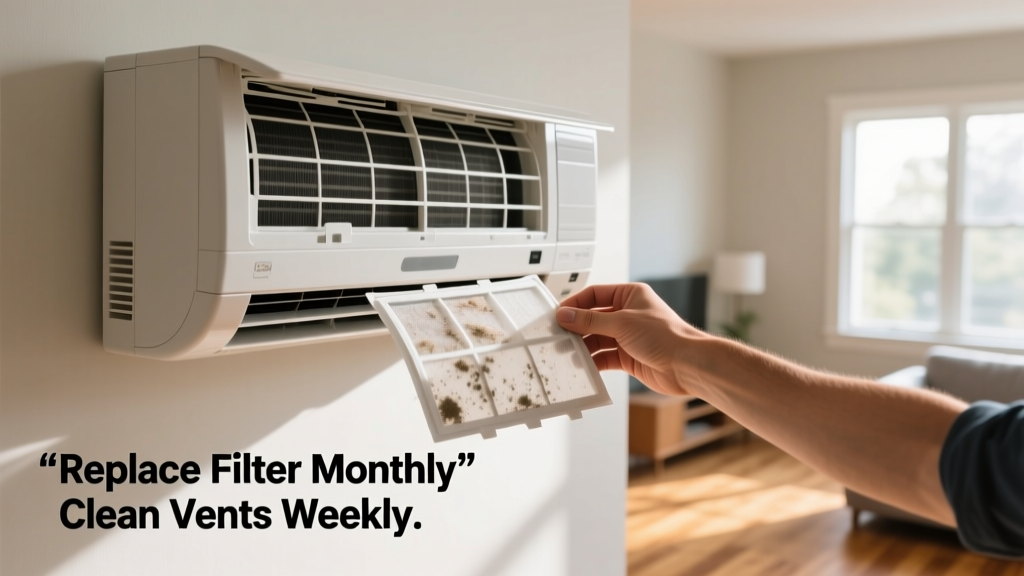
Your air conditioner running constantly isn’t just annoying—it’s a red flag that something’s off. Left unaddressed, it can spike your summer electric bill by 30–50%, accelerate compressor wear, and shorten system life by up to 40% (U.S. Department of Energy, 2022). Prevention isn’t about waiting for failure; it’s about catching small issues before they trigger continuous operation.
Why This Happens
Constant AC runtime rarely stems from one single cause. More often, it’s the result of compounding inefficiencies—like restricted airflow starving the evaporator coil, or refrigerant loss forcing the system to work longer to hit the set temperature. Dirty filters, undersized ductwork, thermostat misplacement near heat sources, and even poor insulation in attics or crawlspaces all contribute. According to the Air Conditioning Contractors of America (ACCA), 68% of systems running nonstop have at least two overlapping maintenance-related faults—not just one 'broken part.'
Maintenance Checklist
| Frequency | Task | Who Should Do It |
|---|---|---|
| Daily | Verify thermostat is set to 'auto' (not 'on') and fan mode isn’t stuck in 'continuous' | Homeowner |
| Weekly | Check for debris around outdoor unit (leaves, grass clippings, pet hair) | Homeowner |
| Monthly | Replace or clean 1-inch pleated filter; inspect for mold or sagging on return grilles | Homeowner |
| Yearly | Professional refrigerant charge verification, coil cleaning, duct leakage test, and blower motor inspection | Licensed HVAC technician |
Warning Signs
Don’t wait for your bill to jump—watch for these early indicators:
- AC runs more than 15 minutes per cycle on mild 75°F days
- Supply vents feel weak or lukewarm—even when the system is running
- Frost or ice forms on copper lines or the indoor coil (a sign of airflow or refrigerant trouble)
- Thermostat displays 'cooling' for over 20 minutes without reaching setpoint
- You hear frequent clicking or buzzing from the outdoor unit during operation
Recommended Products
Not all products are equal—and some can actually worsen the problem if mismatched. Focus on compatibility and measurable performance:
- Washable electrostatic filters (MERV 8–11) — reduce long-term filter cost and improve airflow consistency
- Smart thermostats with occupancy sensing (e.g., Ecobee SmartThermostat) — prevent unnecessary runtime when no one’s home
- UV-C coil sanitizers installed inside air handlers — cut microbial buildup that restricts airflow and insulates coils
- Attic radiant barrier foil — reduces heat gain in ducts running through unconditioned attics (U.S. EPA estimates this cuts cooling load by up to 12%)
Can a dirty air filter really make my AC run nonstop?
A clogged filter increases static pressure, reducing airflow across the evaporator coil. That causes coil temperatures to drop below freezing—leading to frost buildup, reduced heat exchange, and longer cycles. In a 2021 field study by the National Renewable Energy Laboratory (NREL), units with overdue filter changes ran 22% longer per hour than those with monthly replacements.
Is my thermostat placement causing constant runtime?
Absolutely. If mounted above a TV, near a kitchen vent, or in direct sunlight, it reads artificially high temps and commands unnecessary cooling. Move it to an interior wall, away from windows and appliances—or upgrade to a multi-sensor model like the Ecobee with room sensors to average readings across zones.
Why does my AC run constantly on cool, dry days but not humid ones?
This points to a refrigerant issue—not humidity control. Low refrigerant reduces cooling capacity, so the system runs longer to achieve the same effect. But on humid days, the coil stays colder longer, pulling more moisture and giving you a *perception* of cooling—even if the temp hasn’t dropped much. A licensed tech should check superheat and subcooling values, not just pressure.
Will sealing ducts stop my AC from running all the time?
Yes—if leaks exceed 20%. The U.S. Environmental Protection Agency found duct leakage accounts for 20–30% of conditioned air loss in typical homes. Sealing joints with mastic (not duct tape) and insulating flex ducts in unconditioned spaces can cut runtime by 10–15 minutes per hour. For DIY help, see our duct sealing guide.
Can I fix this myself—or do I need a pro?
You can handle filters, outdoor unit clearing, and thermostat settings. But anything involving refrigerant, electrical components, or duct pressure testing requires EPA Section 608 certification. As HVAC technician Maria Chen told us during a 2023 field audit:
"If your AC runs more than 70% of the time on 80°F days, don’t replace the capacitor first—test static pressure and refrigerant levels. Nine times out of ten, it’s airflow or charge, not the part everyone assumes is broken."
Preventing constant AC runtime starts with consistency—not crisis response. Stick to your maintenance table, watch for warning signs before they escalate, and treat your system like the precision machine it is—not just a box that blows cold air. Small habits, repeated monthly, keep your compressor breathing easy and your wallet intact. For seasonal prep, review our spring AC maintenance checklist before temperatures climb above 75°F.