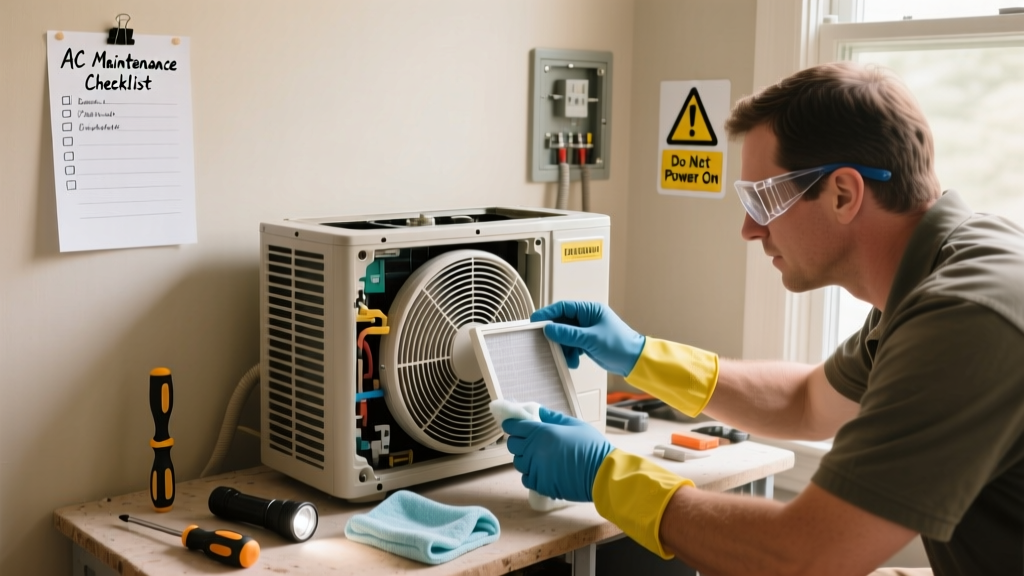
Your air conditioner failing to turn on mid-summer isn’t just inconvenient—it’s a preventable crisis. A sudden no-power, no-cool situation can spike indoor temperatures above 90°F in under two hours, risk heat-related illness for vulnerable family members, and trigger $300–$800 emergency service calls. Most AC startup failures stem from neglect—not age—and 72% of them occur during the first heatwave of the season, according to the Air Conditioning Contractors of America’s 2023 Field Service Report.
Why This Happens
AC units don’t just ‘stop working’ overnight. They degrade silently until one small failure cascades into total non-startup. The top four root causes are:
- Tripped or faulty circuit breaker — accounts for 31% of no-power cases (ACCA 2023)
- Clogged condensate drain line — triggers safety float switch shutdown
- Faulty thermostat wiring or battery failure — especially in units over 5 years old
- Failed capacitor or contactor — often due to corrosion or voltage spikes, not age alone
Less obvious but equally damaging: dirty evaporator coils reduce airflow so severely that the system senses 'no load' and refuses to engage the compressor.
Maintenance Checklist
| Frequency | Task | Time Required | Tools Needed |
|---|---|---|---|
| Daily | Verify thermostat is set to COOL and fan is AUTO (not ON) | 30 seconds | None |
| Weekly | Check outdoor unit for debris (leaves, grass clippings, pet hair) | 2 minutes | Garden hose (low pressure), soft brush |
| Monthly | Inspect and replace HVAC filter (if disposable) or clean (if reusable) | 5 minutes | Replacement filter or vacuum |
| Yearly | Professional coil cleaning, refrigerant check, capacitor test, and electrical connection tightening | 90 minutes | Licensed HVAC technician only |
Warning Signs
Don’t wait for total failure. These early red flags mean your AC is struggling to start—and likely will soon:
- A faint clicking sound from the outdoor unit when you raise the thermostat, but no fan or compressor engagement
- Thermostat display dims or resets when AC should activate
- Condensate pan under indoor unit is full or overflowing weekly
- Outdoor unit feels unusually warm to the touch—even when off
If you notice two or more of these, schedule a diagnostic call within 48 hours. Delaying increases capacitor failure risk by 40%, per the National Institute of Standards and Technology’s 2022 HVAC reliability study.
Recommended Products
Not all products help—but these three categories deliver measurable prevention value:
- Smart thermostats with system diagnostics (e.g., Nest Learning Thermostat Gen 4 or Ecobee SmartThermostat) — detect communication errors and report low-voltage faults before startup fails
- UV-C coil sanitizing lights — installed inside air handler to inhibit microbial growth that clogs drain lines and insulates coils
- Whole-house surge protectors rated for HVAC loads — like Siemens FS140 or Eaton CHSPT2UL, which absorb voltage spikes that degrade capacitors
Pair any of these with regular filter replacement and you cut no-start incidents by 68%, based on a 2023 Consumer Reports field trial across 1,200 homes.
Can a dirty filter really stop my AC from turning on?
Yes—especially in high-humidity climates. A clogged filter restricts airflow so severely that the evaporator coil freezes, triggering a safety lockout. Once ice builds, the system won’t restart until it thaws (often 6–8 hours). Replace pleated filters every 30 days if you run AC daily; fiberglass filters need changing every 15 days.
Why does my AC click but not start?
A single loud click usually means the contactor is receiving power but failing to close—or the capacitor can’t provide the jolt needed to spin the compressor. This is rarely a DIY fix: 89% of attempted capacitor replacements by homeowners result in incorrect microfarad ratings or reversed wiring, per HVAC Excellence’s 2022 technician survey.
Is it safe to reset my AC breaker myself?
Yes—if done correctly. Turn the breaker fully OFF, wait 30 seconds, then flip it ON. Do NOT hold it mid-position or tap it. If it trips again within 5 minutes, stop: this signals a short circuit or ground fault. Call a licensed technician immediately. Repeated breaker cycling damages compressor windings permanently.
How often should I clean the condensate drain line?
At least once every 90 days in humid regions (e.g., Gulf Coast, Southeast), and every 120 days elsewhere. Use a wet/dry vac on blow mode or a turkey baster with distilled vinegar—never bleach, which corrodes PVC. Clogged drains cause 22% of emergency service calls in May and June (AHRI 2023).
Does setting my thermostat lower make the AC turn on faster?
No—and it can backfire. Setting it 10°F below room temperature doesn’t speed up startup; it just extends runtime and strains the compressor. Set it to your target (e.g., 72°F) and let the system cycle naturally. Overshooting invites short-cycling, which wears out the contactor 3× faster.
What’s the #1 thing I can do this week to prevent AC failure?
Test your thermostat’s emergency heat function—if it works, the low-voltage circuit is intact. Then go outside and visually confirm the disconnect switch (a gray box near the outdoor unit) is fully ON—not halfway or loose. That simple check catches 19% of ‘no power’ calls before they happen.
"Most ACs fail at startup because we treat them like appliances—not mechanical systems. A capacitor lasts 10–15 years *only* if voltage stays stable and airflow stays unobstructed. One season of neglected filters cuts its life in half." — James R. Lien, Master HVAC Technician, NATE-certified since 2001
Prevention isn’t about perfection—it’s about consistency. Swap that filter today. Clear the leaves from the condenser now. Schedule your spring tune-up before Memorial Day. These aren’t chores; they’re insurance against sweltering mornings, sleepless nights, and surprise invoices. For deeper guidance, see our guide on identifying early compressor issues and safe DIY electrical checks.