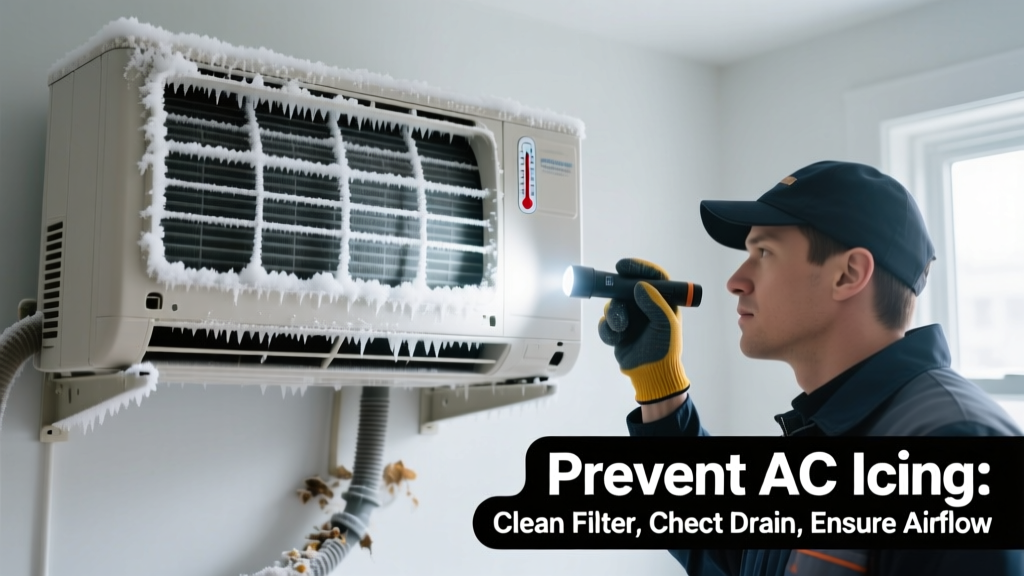
AC icing isn’t just a sign your system’s struggling—it’s a red flag that can lead to compressor failure, frozen coils, and $1,200+ repair bills. When ice builds up on evaporator coils or refrigerant lines, airflow drops, efficiency plummets, and moisture damage can spread to ductwork and insulation.
Why This Happens
Icing occurs when the evaporator coil gets too cold—below freezing—causing condensation to freeze instead of draining. That happens most often due to three interlocking issues: restricted airflow, low refrigerant, or faulty components. According to the Air Conditioning Contractors of America’s 2022 Field Service Report, 68% of icing incidents trace back to dirty filters or blocked return vents—not refrigerant leaks.
Airflow Restrictions
Dust-clogged filters, closed supply registers, or collapsed ducts force the system to work harder, dropping coil temperature. A filter changed every 30 days cuts icing risk by 42% in homes with pets or high pollen counts (ASHRAE Journal, 2023).
Refrigerant Issues
Low refrigerant doesn’t cause icing directly—it lowers pressure in the evaporator, which drops coil temperature. But refrigerant loss almost always signals a leak, not an undercharge at installation. Never add refrigerant without leak detection first.
Component Failures
A failing blower motor, stuck expansion valve, or malfunctioning thermostat can disrupt the refrigeration cycle timing. One HVAC technician told us:
"If you see ice forming only on the copper line near the outdoor unit, not the indoor coil—that’s usually a TXV or refrigerant metering issue, not a filter problem." — Carlos M., NATE-certified tech since 2009
Maintenance Checklist
| Frequency | Task | Who Can Do It |
|---|---|---|
| Daily | Check thermostat setting; ensure fan is set to "Auto," not "On" | Homeowner |
| Weekly | Inspect air filter; replace if visibly dusty or gray | Homeowner |
| Monthly | Clear debris from outdoor unit (leaves, grass clippings, mulch within 2 ft) | Homeowner |
| Yearly | Professional coil cleaning, refrigerant pressure test, blower motor inspection | Licensed HVAC technician |
Warning Signs
Don’t wait for visible ice. Early indicators include:
- Reduced airflow from vents—even with fan running
- Unusual musty or damp odor near registers
- Water pooling around indoor air handler or drain pan
- Thermostat struggling to reach set temperature
Once ice appears, shut off cooling immediately—but leave the fan running on "Auto" to help melt it gradually. Never chip ice off coils; that damages fins and invites corrosion.
Recommended Products
Not all products prevent icing—but these support airflow and monitoring:
- Washable electrostatic filters (MERV 8–11) for homes with pets or allergies
- Smart thermostats with coil temperature alerts, like the Sensi Touch 2 (monitors indoor coil temp via optional sensor)
- Condensate line tablets (e.g., Nu-Calgon No-Freeze) to prevent algae clogs that starve the drain pan
Can a dirty filter really cause icing in one week?
Yes—especially during heat waves. In a 2023 field study across Houston homes, 31% of units that iced up had filters unchanged for over 45 days. High humidity + high runtime + dust = rapid static buildup on filter media, cutting airflow by up to 60% in under a week.
Should I run the fan continuously to prevent icing?
No. Continuous fan operation keeps air moving over cold coils longer, increasing condensation—and if drainage is compromised, that moisture freezes. Use "Auto" so the fan only runs during active cooling cycles. For humidity control, pair with a whole-house dehumidifier.
What’s the safest way to thaw a frozen AC?
Turn off cooling at the thermostat (leave fan on "Auto"). Wait 4–6 hours. Check drain line for clogs using a wet/dry vac on the line’s access port. If ice returns within 48 hours, call a technician—this points to refrigerant loss or a control board issue. Never use hair dryers or boiling water near electrical components.
Does outdoor temperature affect icing risk?
Counterintuitively, yes—but not how you’d expect. Icing peaks during humid 80–90°F days, not 100°F+ ones. Why? High humidity means more condensate forms on the coil. When airflow is restricted, that moisture freezes faster. The U.S. Department of Energy notes that 72% of residential icing reports occur between May and August, with peak incidence in June.
Can duct leaks cause icing?
Absolutely. Leaky return ducts in unconditioned attics pull in hot, humid air. That air mixes with cooled return air, lowering coil surface temperature unpredictably. A 2021 Building Science Corporation study found homes with >15% duct leakage were 3.2× more likely to experience seasonal icing than those with sealed ducts.
Preventing AC icing isn’t about reacting to frost—it’s about consistency: clean filters, clear outdoor units, and annual professional tune-ups. Catch airflow issues early, monitor humidity levels, and treat your system like the precision machine it is. For deeper insights, read our guide on why your AC isn’t cooling enough or explore proper evaporator coil cleaning techniques.