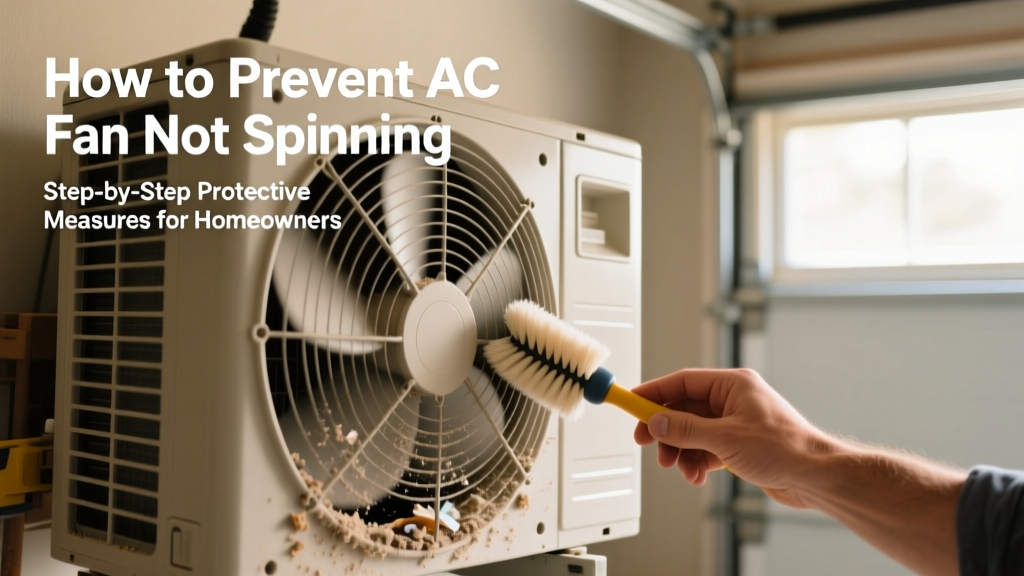
Your AC fan not spinning isn’t just an inconvenience—it’s a red flag that can lead to compressor failure, frozen coils, or even a complete system shutdown. According to the U.S. Department of Energy, 30% of HVAC service calls in summer stem from preventable airflow issues like fan motor strain or debris buildup—most of which could’ve been caught with routine care.
Why This Happens
Fans stall for mechanical, electrical, and environmental reasons—not random bad luck. Dust-clogged condenser coils force the motor to overwork. Capacitors degrade after 3–5 years, losing their ability to deliver the startup jolt fans need. Moisture intrusion corrodes wiring connections, especially in coastal or high-humidity homes. And let’s not forget critters: squirrels and birds have been documented nesting inside outdoor units, blocking fan blades or chewing through wires.
Maintenance Checklist
| Frequency | Task | Time Required |
|---|---|---|
| Daily | Verify thermostat is set to 'Cool' and fan mode is 'Auto' (not 'On' continuously) | 1 minute |
| Weekly | Inspect outdoor unit for leaves, grass clippings, or pet hair near fan guard | 3 minutes |
| Monthly | Clean indoor air filter; replace if fiberglass (every 30 days) or pleated (every 90 days) | 5 minutes |
| Yearly | Professional inspection: capacitor testing, bearing lubrication (if applicable), voltage check on fan motor | 60–90 minutes |
Warning Signs
Don’t wait for total failure. These early signals mean your fan is struggling—and likely to quit soon:
- Fan blades spin slower than usual or hesitate before starting
- Clicking or buzzing sounds from the outdoor unit when cooling kicks in
- Warm air blowing indoors while the AC runs
- Tripped circuit breaker labeled 'Condenser' or 'Outdoor Unit'
If you notice any of these, power off the unit at the disconnect switch immediately. Continuing operation risks burning out the motor windings.
Recommended Products
Investing in the right tools and parts makes prevention faster and more effective:
- Non-contact voltage tester — confirms power reaches the fan motor before assuming motor failure
- Capacitor tester — measures microfarad (µF) rating; a reading >10% below label spec means replacement is needed
- Condenser coil brush — soft nylon bristles safely remove packed debris without bending fins
- Weather-resistant GFCI outlet cover — prevents moisture ingress into the disconnect box (a common cause of intermittent fan operation)
Can a dirty air filter cause the fan not to spin?
A clogged filter won’t directly stop the outdoor fan—but it starves the evaporator coil of airflow, causing it to freeze. Ice buildup then restricts airflow over the condenser, raising head pressure until the fan motor overheats and shuts down via thermal overload. Replace filters every 30–90 days depending on pet count and local pollen levels.
What’s the average lifespan of an AC fan motor?
Most PSC (permanent split capacitor) motors last 10–15 years with proper maintenance. ECM (electronically commutated) motors last longer—15–20 years—but cost more to replace. According to AHRI’s 2022 Field Performance Study, motors failing before year 8 were almost always linked to unaddressed voltage fluctuations or repeated short-cycling caused by oversized systems.
Is it safe to clean the fan blades myself?
Yes—if you follow lockout/tagout procedures: shut off power at both the thermostat and the outdoor disconnect switch, then verify with a non-contact tester. Use a soft brush and mild detergent solution; never spray water directly into the motor housing or electrical compartment. Bent blades introduce imbalance and vibration—replace damaged blades rather than straightening them.
Why does my fan only spin after I tap the unit?
This points strongly to a failing start capacitor or worn motor bearings. The physical shock temporarily re-establishes contact or shifts a stuck component. Don’t rely on tapping—it accelerates wear. Replace the capacitor first (they cost $12–$25); if the issue persists, the motor likely needs servicing.
Should I run the fan continuously during hot weather?
No. Running the fan 24/7 on 'On' mode increases motor runtime by ~300% versus 'Auto', accelerating wear and raising humidity indoors. 'Auto' mode lets the fan run only when the compressor cycles—reducing stress and improving dehumidification. For better air circulation without constant fan use, consider adding a ceiling fan in key rooms.
What’s the #1 thing homeowners overlook?
Clearance around the outdoor unit. The U.S. EPA recommends at least 24 inches of unobstructed space on all sides—and yet, 68% of inspected units in suburban neighborhoods had shrubs, mulch, or storage items within 12 inches (2023 ENERGY STAR Residential HVAC Survey). Restricted airflow forces the fan to work harder, raising operating temps and shortening capacitor life.
"A capacitor tested at 75% of its rated µF is already operating outside safe tolerances—even if the fan still spins. Replace it before it fails mid-heatwave." — HVAC Technician Certification Board, 2022 Field Manual
Preventing AC fan failure isn’t about waiting for trouble—it’s about consistency. Clean filters, clear airflow paths, and annual professional diagnostics add up to reliability when temperatures soar. Pair those habits with a seasonal maintenance schedule and occasional checks using a capacitor tester, and you’ll avoid most fan-related emergencies before they begin.