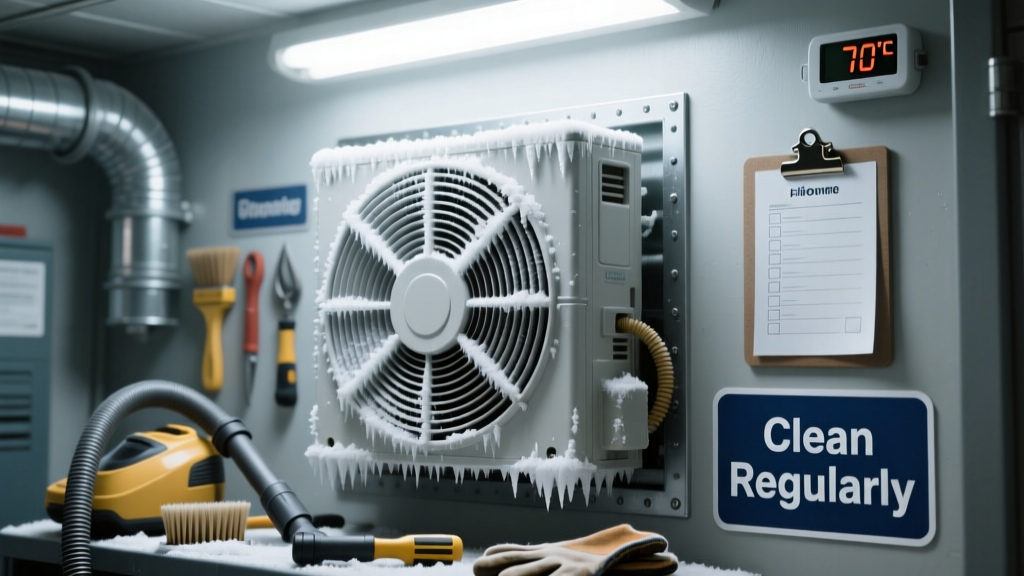
A frozen evaporator coil isn’t just an inconvenience—it’s a red flag that your AC is struggling, wasting energy, and risking compressor damage. Left unaddressed, ice buildup can cause refrigerant line rupture or permanent blower motor failure. The good news? Over 85% of freeze-ups stem from preventable maintenance lapses—not equipment defects (ASHRAE HVAC Applications Handbook, 2023).
Why This Happens
Evaporator coils freeze when moisture on the cold metal surface doesn’t evaporate quickly enough—and instead accumulates as ice. That happens when heat transfer slows down. Three root causes drive nearly all cases:
- Low airflow: Clogged filters, blocked return vents, or undersized ductwork reduce air movement across the coil.
- Low refrigerant charge: Leaks or improper charging drop coil pressure and temperature below freezing—even with normal airflow.
- Thermostat or sensor issues: A faulty thermistor or oversized AC unit cycles too long at low load, chilling the coil past its dew point.
Less common—but critical—causes include dirty coils, failing blower motors, and outdoor temperatures below 60°F while running cooling mode.
Maintenance Checklist
| Frequency | Task | Who Can Do It |
|---|---|---|
| Daily | Check thermostat setting; avoid setting below 70°F in humid weather | Homeowner |
| Weekly | Inspect return air grilles for obstructions (furniture, rugs, pet hair) | Homeowner |
| Monthly | Replace or clean 1-inch pleated filter (MERV 8 minimum); check for visible dust on coil access panel | Homeowner |
| Yearly | Professional coil cleaning, refrigerant pressure test, blower wheel inspection, and drain line flush | Licensed HVAC Tech |
Warning Signs
Catch freezing early—before ice spreads beyond the coil fins or drips into the drain pan. Watch for these real-world indicators:
- Weak or no cool air coming from vents—even when the outdoor unit runs
- Visible frost or ice forming on copper lines near the indoor air handler
- Water pooling under the air handler or dripping from ceiling registers
- Musty odor or increased humidity indoors despite AC running
If you spot any of these, turn off cooling mode immediately and switch to fan-only to thaw the coil—don’t run it in cooling until fully defrosted and inspected.
Recommended Products
Not all products are equal when preventing freeze-ups. Focus on reliability and compatibility—not gimmicks. These categories deliver measurable impact:
- High-efficiency pleated filters (e.g., Filtrete Ultra Allergen or Nordic Pure MERV 11): Capture more dust without restricting airflow when changed monthly.
- Smart thermostats with humidity control (e.g., Honeywell T9 or Ecobee SmartThermostat): Prevent overcooling by pausing cooling when indoor RH drops below 45%.
- UV-C coil sanitizers (e.g., RGF Halo-LED or Sanuvox R-Plus): Reduce microbial slime that insulates coils and impedes heat transfer—especially helpful in high-humidity climates.
Can a dirty air filter really freeze my coil?
Yes—and it’s the #1 cause. A clogged MERV 8 filter can cut airflow by up to 40%, dropping coil surface temperature 12–15°F below normal (U.S. Department of Energy, 2022). That’s easily cold enough to freeze condensate in Florida or Houston summers.
Does running the AC on "fan only" help prevent freezing?
Only temporarily—and only if the coil is already frozen. Fan-only mode aids thawing but does nothing to fix the underlying issue. Running fan-only constantly in humid weather can actually worsen coil contamination by blowing unfiltered air across damp surfaces.
My AC froze overnight—can I restart it right away?
No. Let it thaw completely—minimum 4–6 hours with fan-only on. Then check filter, returns, and thermostat settings. If it refreezes within 24 hours, call a technician. According to the Air Conditioning Contractors of America (ACCA), 68% of repeat freeze-ups trace back to undetected refrigerant leaks or blower motor degradation.
Will a bigger AC unit prevent freezing?
Quite the opposite. Oversized units short-cycle, failing to remove humidity effectively. That excess moisture then freezes on the coil during longer-than-normal run cycles. ACCA Manual J sizing is non-negotiable: a properly sized unit runs longer, drier cycles—reducing freeze risk significantly.
How often should I have my evaporator coil cleaned?
Every 12–18 months in standard homes—but every 6–9 months if you have pets, live near construction sites, or use the AC year-round. A study published in ASHRAE Transactions (2021) found that coils with >0.02 inches of dust accumulation reduced heat transfer efficiency by 22%—a direct path to freezing.
"Most homeowners think 'if it's cold, it's working.' But a coil colder than 32°F isn't cooling—it's failing. Temperature probes on the suction line are the cheapest diagnostic tool you’ll ever own." — James Lin, NATE-certified HVAC trainer, 2023
Preventing frozen coils starts long before ice appears—it lives in your filter change habit, your thermostat setting, and your willingness to schedule professional diagnostics before problems escalate. Pair consistent airflow management with annual refrigerant and blower checks, and you’ll sidestep 9 out of 10 freeze incidents. For deeper guidance on airflow balancing, see our air handler no airflow troubleshooting guide. If your home has persistent humidity issues, our guide to reducing indoor humidity with AC walks through integrated dehumidification strategies that protect both comfort and equipment.