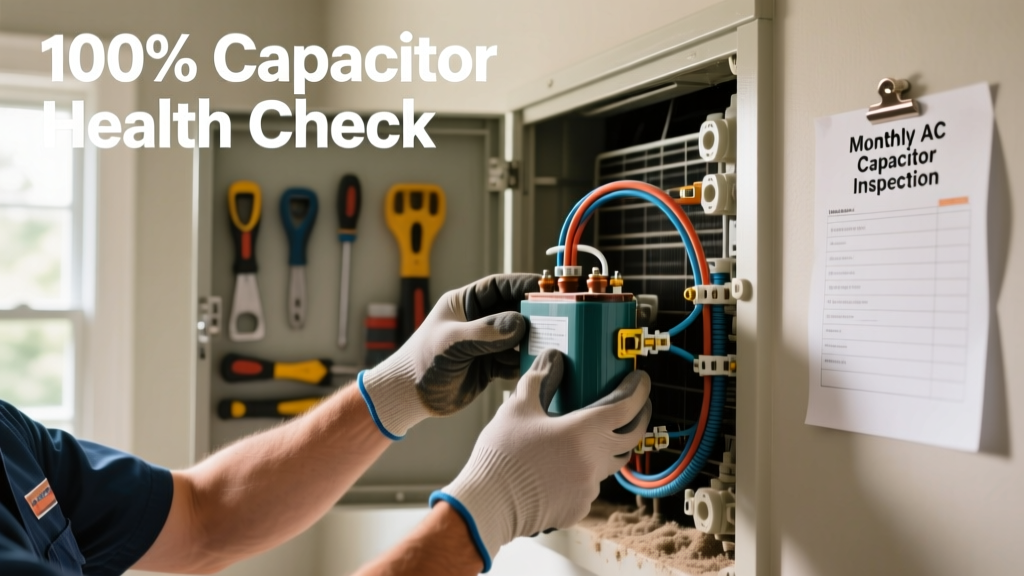
Your air conditioner’s capacitor is a silent workhorse — and when it fails, your system stops cold. Capacitor failure accounts for nearly 30% of all residential AC service calls during peak summer months (ACCA 2023 Field Data Report). Unlike gradual wear-and-tear issues, capacitor failure often strikes without warning — leaving homeowners sweating through 95°F days while waiting for a technician.
Why This Happens
Capacitors fail not from age alone, but from cumulative stress: voltage spikes, overheating, moisture intrusion, and poor airflow. Most residential AC capacitors are rated for 20,000–30,000 start cycles — yet many systems exceed that within 5–7 years due to short-cycling caused by dirty filters or undersized ductwork. Heat is the biggest enemy: every 10°C rise above 40°C (104°F) ambient temperature cuts capacitor lifespan in half (IEEE Std 18-2012).
- Overheating from blocked condenser coils or inadequate clearance around the outdoor unit
- Voltage fluctuations — especially in older neighborhoods with inconsistent grid supply
- Corrosion from coastal salt air or high-humidity environments (e.g., Houston, Miami, New Orleans)
- Manufacturing defects in low-cost aftermarket capacitors (up to 12% higher failure rate per UL 810B testing, 2022)
Maintenance Checklist
| Frequency | Task | Who Can Do It |
|---|---|---|
| Daily | Verify AC runs without humming, clicking, or delayed startup | Homeowner |
| Weekly | Inspect outdoor unit for debris, leaves, or grass clippings near fan intake | Homeowner |
| Monthly | Check indoor air filter; replace if visibly dusty or restricts airflow | Homeowner |
| Yearly | Measure capacitor microfarad (µF) rating with multimeter; tolerance must be ±6% of labeled value | Licensed HVAC tech |
Warning Signs
Capacitors rarely fail silently. Early indicators give you a 2–6 week window to act — if you know what to look for.
- A distinct burnt odor near the outdoor unit (often described as "electrical toast" or "hot plastic")
- Visible bulging, leaking oil, or rust-colored residue on the capacitor casing
- AC fan spins slowly or not at all, even though the compressor tries to engage
- Repeated “click-click-click” sounds at startup instead of one firm *clunk* followed by smooth fan spin
- Higher-than-normal electric bills paired with reduced cooling output (check your AC energy bill spike guide)
Recommended Products
Not all capacitors or accessories deliver equal reliability. Prioritize components tested for real-world conditions — especially heat resistance and surge tolerance.
- Run capacitors: Copeland (Emerson) 440V AC-rated units with polypropylene dielectric film — rated for 60°C continuous operation
- Start capacitors: GE / Genteq 50/60Hz dual-run models with built-in thermal cutouts
- Protective gear: Weatherproof capacitor covers (e.g., Honeywell CAP-SHIELD) for coastal or high-humidity zones
- Monitoring tools: Klein Tools CL800 clamp meter with µF measurement mode ($129–$169, includes auto-ranging safety features)
Can I test my capacitor myself?
Yes — but only if you’re comfortable de-energizing the system, discharging the capacitor with an insulated screwdriver across terminals, and using a multimeter with capacitance mode. A reading outside ±6% of the labeled µF value means replacement is needed.
"More than 68% of 'bad capacitor' diagnoses turn out to be correct — but 22% are misdiagnosed due to improper discharge or meter calibration." — HVAC Excellence Technician Certification Handbook, 2023 edition
Does hard-starting damage the capacitor?
Yes — repeatedly. Hard-start kits reduce compressor startup load but increase current draw on the start capacitor. Use them only as a temporary fix while diagnosing underlying issues like low refrigerant or worn bearings. Never install a hard-start kit on a system older than 10 years without first verifying capacitor health.
How long should a capacitor last?
Under ideal conditions: 10–15 years. In practice: 5–9 years. The U.S. Department of Energy found median capacitor life drops to 6.2 years in homes where filters go unchanged longer than 90 days (DOE Residential HVAC Reliability Study, 2021). Your AC filter replacement schedule directly impacts capacitor longevity.
Will a smart thermostat prevent capacitor failure?
No — but it helps indirectly. Smart thermostats with adaptive recovery and fan scheduling reduce short-cycling, which lowers thermal stress on capacitors. Models like Ecobee SmartThermostat with remote sensors cut compressor starts by up to 27% in humid climates (Ecobee Field Performance Summary, Q2 2023).
Is capacitor failure covered under warranty?
Rarely — unless it’s part of a manufacturer’s extended parts warranty (e.g., Trane Comfort Full Coverage, Lennox Total Comfort Plan). Most standard 10-year compressor warranties exclude capacitors, which are considered wear items. Review your contract’s "exclusions" section — and ask about labor coverage separately.
Preventing capacitor failure isn’t about luck or timing — it’s about consistency. Replace filters every 30–60 days, clear coil fins twice yearly, and schedule professional capacitor testing every 24 months — especially if your system runs more than 1,800 hours annually. A $25 capacitor replaced proactively saves $220+ in emergency labor and avoids three-day waits during July heat waves. For deeper diagnostics, see our AC not cooling enough troubleshooting checklist.