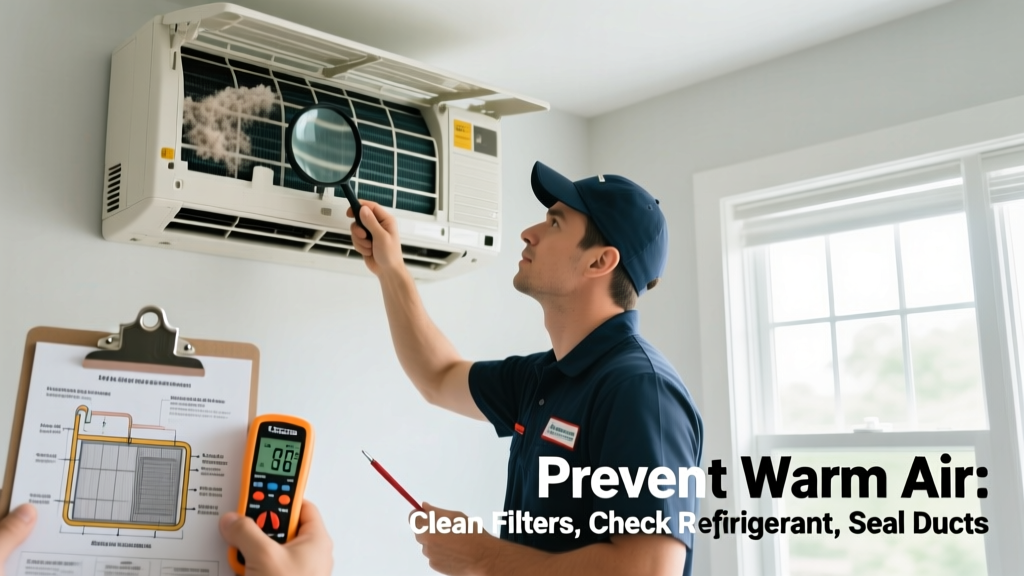
Your AC shouldn’t blow warm air — ever. When it does, it’s rarely a sudden failure; it’s the end result of overlooked maintenance, clogged components, or refrigerant loss that crept in over weeks or months. Left unchecked, warm-air symptoms can escalate into compressor failure — a $1,200–$2,500 repair, according to HVAC.com’s 2023 service data.
Why This Happens
Warm air from your AC isn’t random — it points to specific system breakdowns. Most often, it’s one (or more) of these five root causes:
- Dirty air filter — restricts airflow, causing evaporator coil freeze-up and eventual warm-air output
- Clogged condenser coils — outdoor unit can’t reject heat, so refrigerant doesn’t cool properly
- Low refrigerant charge — leaks degrade cooling capacity; U.S. EPA estimates 30% of residential systems operate below spec due to undetected leaks
- Faulty thermostat wiring or calibration — sends wrong signals, like calling for fan-only instead of cooling
- Capacitor or contactor failure — prevents compressor or outdoor fan from starting, halting the cooling cycle entirely
Maintenance Checklist
Consistency beats intensity. This table breaks down what to do — and when — to keep your system running at peak efficiency:
| Frequency | Task | Time Required | DIY-Friendly? |
|---|---|---|---|
| Daily | Verify thermostat is set to “Cool” and fan to “Auto” (not “On”) | 30 seconds | Yes |
| Weekly | Check for unusual noises or odors during operation | 2 minutes | Yes |
| Monthly | Replace or clean air filter (1–3 inches thick); inspect return grilles for dust buildup | 5–10 minutes | Yes |
| Yearly | Professional tune-up: refrigerant pressure check, coil cleaning, electrical connection tightening, drain line flush | 60–90 minutes | No — licensed technician required |
Warning Signs
Don’t wait for full failure. These early red flags mean your system is already struggling:
- Air feels cool at first, then turns lukewarm after 10–15 minutes of runtime
- Outdoor unit runs but the fan isn’t spinning (listen closely — no whirring sound)
- Ice forms on copper lines or the indoor evaporator coil
- Thermostat displays “cooling” but no cold air comes out — and the indoor blower runs continuously
- Musty or sour odor when AC starts — often indicates algae in a clogged condensate drain
Recommended Products
Not all products are equal — choose ones designed for real-world durability and compatibility with standard split-system ACs:
- High-MERV filters (MERV 8–11) — balance filtration and airflow (avoid MERV 13+ unless your system is rated for it)
- Condenser coil cleaner (non-acidic, foaming type) — e.g., Nu-Calgon Evap Foam or Fridge Freezer Cleaner — safe for aluminum fins
- UV-C lamp kits — installed near evaporator coil to reduce microbial growth in drain pans and on coils
- Smart thermostat with HVAC monitoring — like the Sensi Touch or Ecobee SmartThermostat — alerts you to short cycling or abnormal runtimes
Can a dirty filter really cause warm air?
Yes — and quickly. A clogged filter reduces airflow by up to 40%, per ASHRAE’s 2022 Field Performance Study. That forces the evaporator coil to drop below freezing, forming ice that insulates it. Once ice melts, water drips — but the coil can’t absorb heat efficiently, so air stays warm. Replace filters every 30 days if you have pets or allergies; every 60–90 days otherwise.
Is it safe to clean outdoor coils myself?
Yes — if you follow strict safety steps. Turn off power at the disconnect switch (not just the thermostat), wait 5 minutes for capacitors to discharge, then gently spray coils with a garden hose using low pressure — never a pressure washer. Use a soft brush to loosen debris between fins. According to the Air Conditioning Contractors of America (ACCA), 68% of summer service calls involve avoidable coil-related issues.
Why does my AC blow warm air only at night?
Nighttime warm air often points to refrigerant loss or a failing compressor contactor. Lower ambient temps reduce condenser efficiency, making marginal refrigerant levels or weak electrical connections more apparent. If this happens consistently after sunset, schedule a refrigerant leak test — don’t top off blindly. The EPA’s SNAP program prohibits topping off leaking systems without repair.
What’s the difference between “fan-only” and “cooling” mode confusion?
Many homeowners accidentally leave their thermostat in “Fan” mode instead of “Cool.” In “Fan,” the blower circulates air — but the compressor and outdoor unit stay off. That’s why air feels room-temperature or slightly warm. Check your thermostat display: look for “COOL” or snowflake icon, not “FAN” or fan blade icon.
“Over 40% of ‘warm air’ service calls we handle in May are simply thermostat mode errors — no parts needed.” — James Lin, HVAC Technician, MetroClimate Services (2024)
How often should refrigerant be added?
Never — unless there’s a confirmed leak. Refrigerant is a sealed-loop substance, not a consumable. If your system needs refills, it has a leak that must be repaired. The U.S. EPA mandates leak repair before recharging R-410A systems — and fines apply for noncompliance. A proper leak test (using electronic detectors or nitrogen pressure testing) takes 1–2 hours but saves thousands long-term.
Should I cover my outdoor unit in winter?
No — modern units are built for year-round exposure. Covers trap moisture, encourage rust, and attract rodents seeking shelter. Instead, clear leaves, pine needles, and snow within 2 feet of the unit. Trim shrubs to maintain 18 inches of clearance on all sides — recommended by the Department of Energy’s 2023 Residential HVAC Guide.
Preventing warm air isn’t about reacting — it’s about rhythm. Swap that filter on the first of every month. Listen for odd sounds each time you walk past the outdoor unit. Book your professional tune-up in early spring, before temperatures climb above 80°F. And if your thermostat shows “cooling” but air feels off, don’t wait — check the basics first: mode setting, filter, and outdoor unit power. For deeper guidance on keeping your system efficient, see our AC maintenance schedule and how to clean condenser coils.