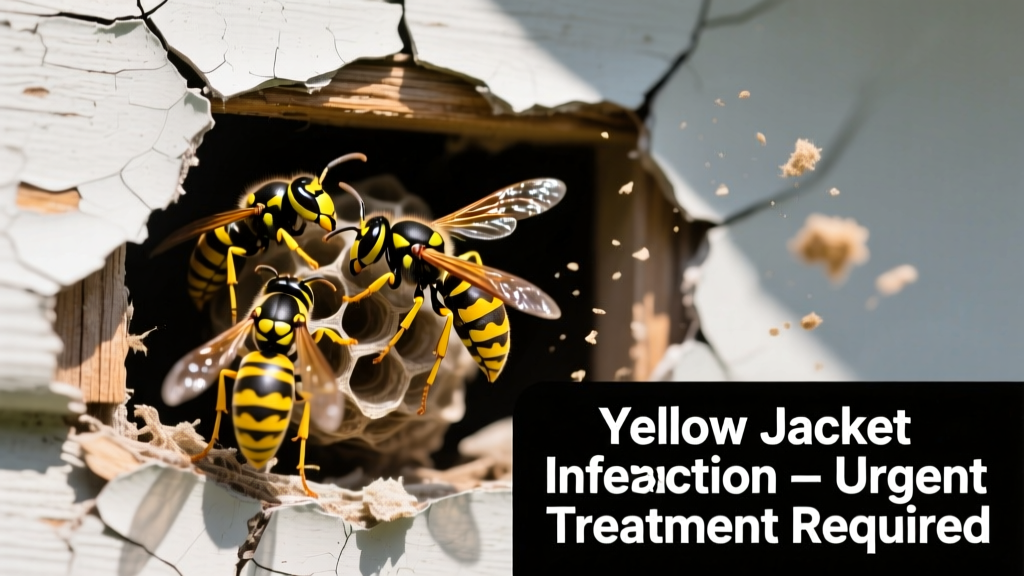
Yellow jackets in wall voids are not just a seasonal nuisance—they’re a serious structural and safety hazard. Unlike solitary wasps, yellow jackets are social insects that build paper nests capable of housing 1,000–5,000 individuals by late summer. Their aggressive defense of nests means even minor vibrations (like drilling or knocking) can trigger mass stinging incidents indoors.
Identification
Yellow jackets (genus Vespula and Dolichovespula) are often mistaken for honey bees or paper wasps—but key physical and behavioral traits set them apart. They have sleek, hairless bodies with vivid black-and-yellow banding, narrow waists, and fold their wings lengthwise at rest. Most importantly, they enter and exit walls through small openings—often near soffits, siding seams, or gaps around utility lines.
| Insect | Body Texture | Nest Location | Aggression Level | Typical Entry Point |
|---|---|---|---|---|
| Honey Bee | Fuzzy, oval, golden-brown | Inside wall cavities (rarely), often in hollow trees or attics | Low unless hive is disturbed | Cracks near eaves or chimney flues |
| Yellow Jacket | Smooth, shiny, bold black/yellow | Wall voids, attics, crawl spaces—often built downward from entry point | High; defends nest aggressively | 1/4"–3/8" holes near trim, vents, or soffit gaps |
| European Hornet | Large (1"+), reddish-brown head/thorax, yellow abdomen | Wall voids, tree cavities, barns | Moderate—more active at night | Loose bricks, rotten wood, or gaps near windows |
Look for these signs: a steady stream of wasps entering/exiting one spot on exterior siding; buzzing sounds behind drywall (especially on warm days); or yellowish stains on interior walls from nest moisture or frass. According to the University of Kentucky Entomology Department’s 2022 field guide, 68% of confirmed yellow jacket wall infestations were first detected by audible buzzing—not visible insects.
What Attracts Them
Yellow jackets don’t randomly pick walls—they’re drawn by specific conditions that mimic natural nesting sites. They prefer dark, sheltered, insulated cavities with easy access to food and water. Key attractants include:
- Unsealed gaps >1/4" around windows, doors, soffits, or utility penetrations
- Abandoned rodent burrows or old insulation voids that offer dry, undisturbed space
- Proximity to outdoor food sources: uncovered trash, compost bins, pet food bowls, or flowering shrubs within 100 feet
- Moisture issues like roof leaks or condensation inside walls—providing humidity needed for nest paper production
They rarely nest in walls during winter—but queens overwinter in leaf litter or soil cracks, then seek out suitable cavities in April–June. Once established, colonies grow rapidly: a single queen can produce 100–200 workers by mid-July, and up to 4,000 by September.
Treatment Methods
Natural First Steps
Do NOT attempt vacuuming, smoke bombs, or pouring boiling water into wall voids—these methods risk nest collapse, increased aggression, or structural damage. Instead, confirm activity first: tape a piece of white paper over the suspected entry point overnight. If you see fresh punctures or frass in the morning, activity is ongoing. Then try non-toxic deterrents:
- Hang decoy nests (commercial or DIY papier-mâché) near entry points—yellow jackets are territorial and avoid competing colonies
- Apply peppermint oil spray (10 drops per oz water) along baseboards and exterior gaps—repels but doesn’t kill
- Install motion-activated sprinklers near the wall’s exterior—disrupts foraging and discourages return
Chemical Options
If natural methods fail and the nest is accessible (e.g., via an attic hatch or removable soffit panel), targeted insecticides may be used—but only at dusk or dawn when most foragers are inside. The U.S. EPA recommends pyrethroid dusts (e.g., deltamethrin or cyfluthrin) applied directly into the nest entrance using a bulb duster. One application typically kills 90%+ of the colony within 24–48 hours. Never use aerosol sprays—pressure forces wasps deeper into walls and increases risk of indoor emergence.
"Dusting the entrance is effective only if done correctly: apply once, seal the hole after 48 hours, and monitor for 72 hours. Re-entry attempts mean the nest wasn’t fully treated—or there’s a secondary entrance." — Dr. Karen Frazier, Extension Entomologist, Penn State, 2023
Prevention
Sealing entry points *before* swarm season (March–May) is the single most effective long-term strategy. Focus on high-risk zones:
- Inspect all exterior trim, window frames, and soffit joints with a flashlight—caulk gaps >1/8" with silicone-based sealant
- Replace damaged or missing vent screens (use 1/8" mesh, not standard 1/4")
- Install metal flashing behind vinyl siding corners and around roofline intersections
- Trim tree branches >6 feet from the house—eliminates aerial bridges for scouting wasps
Also reduce outdoor attractants year-round: keep lids on garbage cans, rinse recyclables, and avoid planting sweet alyssum or Queen Anne’s lace within 20 feet of exterior walls—both are known nectar magnets for yellow jackets.
When to Call an Exterminator
Call a licensed pest professional immediately if:
- You hear persistent buzzing behind multiple walls or ceilings
- There’s visible swelling or staining on interior drywall
- The nest entrance is inaccessible (e.g., behind brick veneer or under stucco)
- Anyone in the household has a history of anaphylactic reactions to stings
According to the National Pest Management Association’s 2023 industry survey, 72% of yellow jacket wall infestations requiring structural repair involved delayed intervention—most occurring after DIY attempts worsened the problem.
Can yellow jackets chew through drywall?
No—they lack mandibles strong enough to penetrate gypsum board. However, they will exploit existing gaps, nail holes, or poorly sealed electrical outlets. If you find wasps emerging *through* drywall, it indicates either a large void behind it—or prior rodent damage that created passageways.
How long do yellow jacket nests last in walls?
Colonies die off naturally each fall after the first hard frost, but queens vacate before winter. The abandoned nest remains intact but inactive—and poses no stinging risk. However, its cellulose material attracts carpet beetles and silverfish, and residual pheromones can lure new queens the following spring. Removal is recommended, not optional.
Is it safe to remove a yellow jacket nest in winter?
Yes—if you’re certain it’s inactive. Confirm by checking for zero activity for at least 10 consecutive days below 40°F, and no audible buzzing. Wear gloves and goggles, and remove the nest at dawn when temperatures are coldest. Seal the cavity afterward—learn how to seal wall gaps properly.
Why do yellow jackets suddenly appear indoors?
Most indoor sightings occur in late summer/fall, when declining nectar sources force foragers to seek sugar indoors—soda spills, fruit bowls, or open drink containers. But if you see >3 wasps daily near one wall, it’s likely a nest nearby—not random foraging. Check your attic pest signs and soffit vents.
Do yellow jackets reuse old nests?
No. Each colony is annual. However, new queens often select the same favorable site—especially if entry points remain unsealed. That’s why post-removal sealing is essential. A study in the Journal of Economic Entomology (2021) found that 41% of homes with repeated yellow jacket infestations had identical entry points across two consecutive years.
Can I hear yellow jackets in the wall with my phone?
Yes—many smartphone audio apps (like Spectroid or Physics Toolbox) can detect frequencies between 200–400 Hz—the range of yellow jacket wing-beat buzz. Record for 30 seconds near suspect areas, then compare waveforms. A steady, rhythmic hum peaking at dusk is highly indicative. For confirmation, pair with thermal imaging—see how thermal pest detection works.
Yellow jackets in walls demand precision—not panic. Correct identification prevents dangerous missteps, like mistaking them for beneficial pollinators or assuming they’ll leave on their own. Whether you treat early with targeted dust or bring in a pro, act before the colony hits 1,000 members. And remember: sealing today stops next year’s queen from moving in before she even lays her first egg.