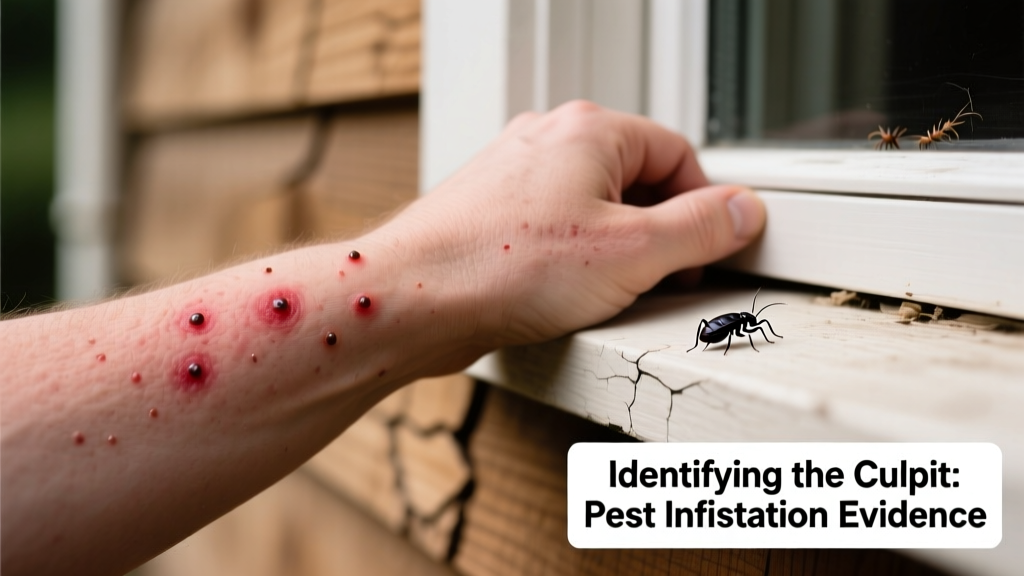
Waking up with itchy, red welts—especially in a line or cluster on exposed skin—is rarely random. It’s usually a signal that something is feeding on you while you sleep. Most commonly, this points to bed bugs, but bird mites, rodent mites, or even fleas from pets or nearby wildlife can mimic the symptoms. Unlike allergic reactions or dry skin, these pests leave telltale patterns—and ignoring them invites infestation escalation.
Identification
Not all itchy bites come from the same pest. Correct ID starts with location, timing, and visual clues—not just skin reaction.
- Bed bugs: Flat, reddish-brown, seed-sized (4–5 mm), visible to naked eye; hide in mattress seams, headboard cracks, and baseboards; bites often appear in a zigzag or linear ‘breakfast-lunch-dinner’ pattern.
- Scabies mites: Microscopic (<0.4 mm), burrow into skin (especially wrists, finger webs, waistline); cause intense itch worsening at night; rash includes tiny gray lines and pimple-like bumps.
- Bird or rodent mites: Nearly invisible (0.2–0.5 mm), translucent to pale brown; swarm when nests collapse (e.g., after pigeons vacate an attic vent); bites are random, fiery, and often on neck/face/arms.
- Fleas: Dark, wingless, laterally flattened; jump readily; bites cluster on ankles and lower legs; often linked to pets or recent wildlife activity (raccoons, squirrels) in walls or yard.
| Pest | Size & Visibility | Typical Bite Pattern | Key Habitat Clue |
|---|---|---|---|
| Bed bug | 4–5 mm, rusty brown, easily seen | Linear or grouped, often on face/neck/arms | Live in mattress seams, box springs, picture frames |
| Scabies mite | 0.3–0.4 mm, invisible without magnification | Intense itch + burrows, finger webs/wrists common | No environmental sign—only skin symptoms |
| Bird mite | 0.2–0.5 mm, pale, hard to see | Random, stinging bites on face/neck/ears | Fresh bird nest in eaves, chimney, or HVAC intake |
| Flea | 1–3 mm, dark, jumps when disturbed | Clusters on lower legs/ankles | Pets present—or evidence of rodents in garage/basement |
What Attracts Them
These pests don’t wander in randomly—they’re drawn by specific conditions your home may unknowingly provide.
- Warmth and carbon dioxide: All biting pests use human breath and body heat as cues to locate hosts—especially during sleep.
- Clutter and hiding spots: Bed bugs thrive in folded linens, cardboard boxes, and upholstered furniture with crevices.
- Nesting proximity: Bird mites explode indoors within days of abandoned nests—87% of cases tracked by the National Pest Management Association’s 2022 Mite Report involved recent nest removal.
- Pet access: Fleas hitchhike on dogs, cats, or even mice moving through walls—1 in 3 flea infestations begins outside, not inside (University of Florida IFAS Extension, 2021).
Treatment Methods
Natural Approaches
Start here if bites are mild and you’ve confirmed low-level presence—especially for scabies or early-stage bed bugs.
- Permethrin-free laundry: Wash all bedding, pajamas, and stuffed animals in hot water (≥120°F) and dry on high heat for ≥30 minutes.
- Diatomaceous earth (food-grade): Lightly dust along baseboards and mattress edges—dehydrates bed bugs and mites on contact (but avoid inhalation).
- Sulfur-based soaps or ivermectin cream (prescription only): Clinically proven for scabies—applied head-to-toe, repeated in 7 days (CDC, 2023 guidelines).
- Vinegar-water sprays (1:1) on pet bedding: Disrupts flea egg adhesion—but won’t kill adults.
Chemical Treatments
Reserve these for confirmed, persistent infestations—and always follow label instructions precisely.
- Pyrethroid sprays (e.g., deltamethrin): Effective against bed bugs and fleas when applied to harborage sites—not sprayed on skin or mattresses directly.
- Insect growth regulators (IGRs) like methoprene: Prevent eggs and nymphs from maturing—critical for breaking flea life cycles.
- Professional-grade miticides (e.g., bifenthrin + fenpyroximate combo): Required for bird mite outbreaks—over-the-counter products rarely penetrate their nesting zones.
"Most people misdiagnose mite bites as bed bugs—but 62% of verified mite cases involve recent wildlife activity or construction near old nests." — Dr. Lena Cho, Entomologist, Pest Management Science Journal, 2023
Prevention
Once treated, stop reinfestation before it starts—especially since bed bugs survive up to 400 days without feeding, and mites can linger in insulation for weeks.
- Install mattress and box spring encasements certified to block bed bugs (look for ASTM E1923-22 standard).
- Seal gaps around windows, pipes, and electrical outlets with caulk—bird and rodent mites enter through openings as small as 1/16 inch.
- Inspect secondhand furniture thoroughly before bringing it inside—use a flashlight and magnifying glass to check seams and joints.
- Maintain indoor humidity below 50%—mites desiccate faster, and bed bugs reproduce slower in drier air (U.S. EPA Indoor Air Quality Guidelines, 2022).
When to Call an Exterminator
Don’t wait until bites multiply. Contact a licensed professional if:
- You find live insects in mattress seams, behind outlet plates, or crawling on walls at dawn.
- Itching persists >2 weeks despite thorough cleaning and OTC treatments.
- Multiple household members develop identical bite patterns within 48 hours.
- You discover evidence of birds or rodents in your attic, soffits, or crawl space—even if no bites yet.
Why do bites appear hours or days after being bitten?
Your immune system reacts gradually—bed bug saliva contains anticoagulants and anesthetics, delaying itch onset. Scabies burrows take 2–6 weeks to trigger full sensitivity in first-time exposures. That lag makes pinpointing timing tricky—but doesn’t mean the pest is gone.
Can I get bed bugs from my office or gym?
Yes—but risk is low unless you’re regularly sitting on shared upholstered furniture or storing bags on infested floors. According to the NPMA’s 2023 Bed Bug Incident Report, only 7% of confirmed infestations originated outside the home—most came via luggage, used furniture, or visiting infested apartments.
Are ‘bite identification apps’ reliable?
No. A 2022 study in JAMA Dermatology found smartphone-based bite analysis misidentified scabies as bed bugs 41% of the time—and missed bird mites entirely. Visual diagnosis requires magnification and context, not pixel matching.
Do ultrasonic devices repel biting pests?
No credible evidence supports them. The Federal Trade Commission issued warnings in 2021 against 12 brands marketing ultrasonic repellents for bed bugs or mites—none passed independent lab testing (FTC Consumer Alert, March 2021).
Can I treat scabies myself with tea tree oil?
Tea tree oil has mild acaricidal properties in lab studies—but human trials show it fails to eradicate scabies mites deep in burrows. Over-the-counter sulfur creams (6–10%) work better, and prescription permethrin remains the gold standard (American Academy of Dermatology, 2023).
What if my bites only happen in one room?
This strongly suggests localized harborage: bed bugs in that bedroom’s mattress or headboard; fleas from pet bedding stored there; or bird mites dropping from an attic vent above that space. Map bite locations and inspect adjacent walls, ceilings, and vents.
Itchy skin after bed isn’t just annoying—it’s your home sending a clear signal. Match the pattern, rule out look-alikes, and act early. For persistent cases, pair targeted treatment with structural fixes—like sealing entry points and removing abandoned nests. And remember: if bites keep returning, the pest isn’t just in your sheets—it’s in your walls, your attic, or your neighbor’s apartment. Don’t treat the symptom. Treat the source.