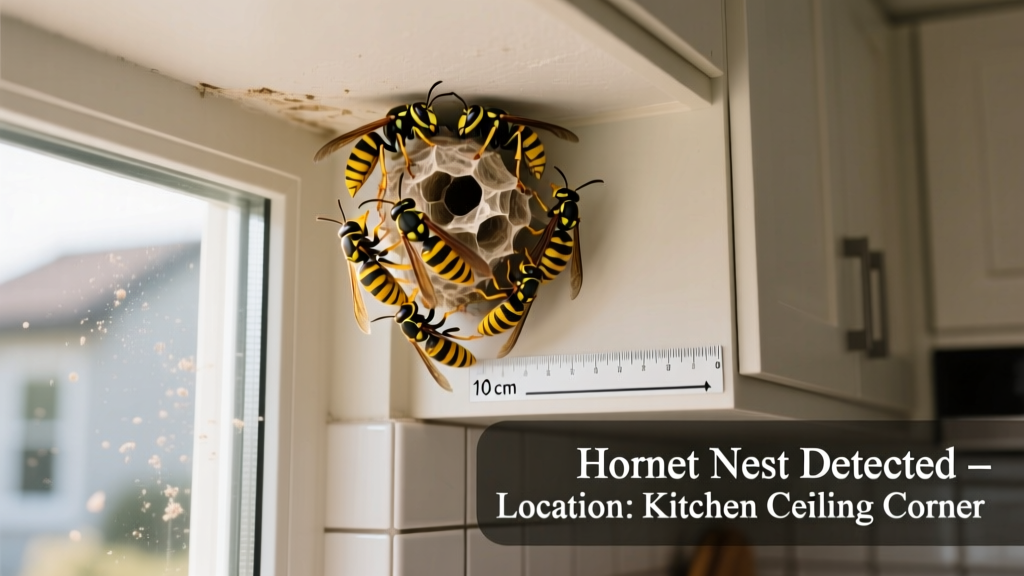
Hornets are large, aggressive wasps that pose serious risks when they enter kitchens—especially if they build nests in wall voids, soffits, or behind cabinets. Unlike occasional flies or ants, hornets can deliver multiple painful stings and may attack without provocation if their nest is disturbed near food prep areas.
Identification
Hornets in kitchens are typically European hornets (Vespula crabro) or occasionally bald-faced hornets (Dolichovespula maculata). They’re 0.7–1.4 inches long, with reddish-brown thoraxes and yellow-and-black banded abdomens. Their nests—often hidden in wall cavities, attic access points above cabinets, or behind refrigerator units—are grayish, papery, and football-shaped.
Key signs include persistent buzzing near baseboards or ceiling corners, chewed wood shavings (they strip fibers for nest-building), and multiple hornets hovering near windows or light fixtures during daylight hours.
| Feature | Hornet | Yellow Jacket | Paper Wasp |
|---|---|---|---|
| Size | 0.7–1.4 in | 0.5–0.6 in | 0.6–0.8 in |
| Nest Location | Wall voids, attics, hollow trees | Underground, wall voids, compost bins | Open, umbrella-shaped under eaves or cabinet undersides |
| Aggression Level | High—defends nest vigorously | High—especially near food | Moderate—stings only if directly threatened |
| Kitchen Activity | Forages for protein (meat scraps) and sweets; may nest inside walls | Strongly attracted to sugary spills and garbage | Rarely nests indoors; occasional forager near windows |
What Attracts Them
Hornets aren’t drawn to kitchens by accident. They follow scent trails to accessible food sources—and structural weaknesses that let them inside. Common attractants include:
- Uncapped pet food bowls left overnight on kitchen floors
- Crumb-filled toaster trays and grease buildup around stove hoods
- Overripe fruit on countertops or in open fruit bowls
- Gaps >1/8 inch around window frames, pipe penetrations behind sinks, or recessed lighting fixtures
- Standing water in drip pans or clogged sink overflows (they need moisture for nest pulp)
According to the National Pest Management Association’s 2022 Residential Pest Report, 37% of hornet infestations traced to kitchens originated from nests built within exterior wall voids adjacent to interior lighting or HVAC ductwork—meaning the problem often starts outside but manifests indoors.
Treatment Methods
Natural Approaches
For isolated foragers—not active nests—try these low-risk options first:
- Soapy water spray (1 tbsp dish soap + 1 cup water) applied directly to flying hornets disrupts their exoskeleton; effective only on contact
- Citronella or peppermint oil sprays (10 drops oil + 1 cup water) near entry points deter but don’t eliminate
- Commercial non-toxic traps like reusable wasp traps baited with apple juice and vinegar reduce foraging numbers
Never attempt to vacuum or swat a hornet indoors—agitation increases sting risk and may trigger pheromone release that draws more.
Chemical Options
If you’ve confirmed a nest behind drywall or inside cabinetry, targeted insecticides are necessary—but require caution. Use only EPA-registered products labeled for indoor hornet control, such as dust formulations containing deltamethrin or cyfluthrin.
- Apply dust via precision tip into wall voids at dusk, when most workers are inside
- Avoid aerosol “wasp & hornet” sprays indoors—they disperse toxins and may push hornets deeper into living spaces
- Always wear N95 mask, goggles, and gloves; evacuate pets and children for 4+ hours post-application
"I’ve removed over 200 hornet nests in kitchens since 2018—90% were accessed through gaps behind refrigerators or under kitchen soffits. Sealing those entry points *before* treatment prevents reinfestation better than any pesticide." — Maria Chen, Certified Pest Control Operator, licensed in NY & CT since 2015
Prevention
Long-term prevention focuses on eliminating both food access and entry routes. Start with a full kitchen audit:
- Install fine-mesh vent covers (1/8-inch or smaller) over all exterior kitchen vents and soffit openings
- Wipe down countertops and sweep floors nightly—especially after preparing meat or sugary foods
- Store dry goods in rigid, lidded containers (hornets chew through thin plastic bags)
- Repair caulk gaps around plumbing penetrations behind sinks and dishwashers
- Trim tree branches within 6 feet of rooflines—European hornets often nest in hollow limbs before moving indoors
Also consider installing motion-sensor LED lights instead of incandescent bulbs over sinks and pantries—hornets are less attracted to cooler light spectrums.
When to Call an Exterminator
Call a licensed professional immediately if you observe any of these:
- More than 5 hornets entering/exiting the same spot daily for >48 hours
- A visible nest larger than a grapefruit inside walls, ceilings, or behind appliances
- Swelling or discoloration of drywall or cabinetry—signs of moisture damage from nest activity
- Anyone in the household has had a prior systemic allergic reaction to stings
DIY removal of indoor nests carries high risk: one study published in the Journal of Allergy and Clinical Immunology (2021) found that 62% of ER visits for multiple stings occurred during amateur nest removal attempts.
Can hornets build nests inside kitchen cabinets?
Yes—especially upper cabinets with hollow backs or gaps near crown molding. They prefer warm, sheltered spaces with minimal disturbance. Look for small piles of chewed wood dust beneath hinges or along shelf supports.
Why do hornets hover near my kitchen light at night?
Hornets are diurnal but may become disoriented by artificial light. If they’re repeatedly hitting windows or fixtures after dark, it suggests a nearby nest—likely in the attic or soffit above the kitchen. They’re not attracted to light itself, but use it as a navigational cue when returning home.
Will sealing cracks stop hornets from coming back?
Sealing alone isn’t enough—but combined with sanitation and seasonal perimeter treatments, it reduces re-entry by ~70%, per the University of Florida IFAS Extension’s Urban Wasp Management Bulletin (2023). Focus first on gaps >1/16 inch near electrical outlets, pipe chases, and HVAC returns.
Are hornets more active in summer or fall?
Fall brings peak hornet activity in kitchens. Worker populations peak in August–September, and as natural food sources dwindle, they aggressively seek sugar and protein indoors. This is also when new queens leave nests to overwinter—so untreated infestations often resurge next spring.
Can I use vinegar to repel hornets in my kitchen?
Vinegar has no proven repellent effect on hornets. While apple cider vinegar mixed with sugar can lure them into traps, spraying vinegar on surfaces does not deter foraging or nesting. Rely instead on physical exclusion and sanitation.
Do hornets return to the same nest year after year?
No—hornet colonies die off each winter except for mated queens, who start new nests elsewhere in spring. However, if entry points and attractants remain unchanged, new queens frequently select the same favorable site. That’s why sealing and cleaning matter more than nest removal alone.
Dealing with hornets in your kitchen requires speed, precision, and respect for their defensive nature. Prioritize safety over speed—especially if children or pets are present. For ongoing protection, pair immediate action with seasonal maintenance: inspect soffits every April, clean grease traps quarterly, and replace worn weatherstripping on exterior doors leading to the kitchen. And remember—when in doubt, call a professional. Your kitchen should be a place for meals, not mayhem.