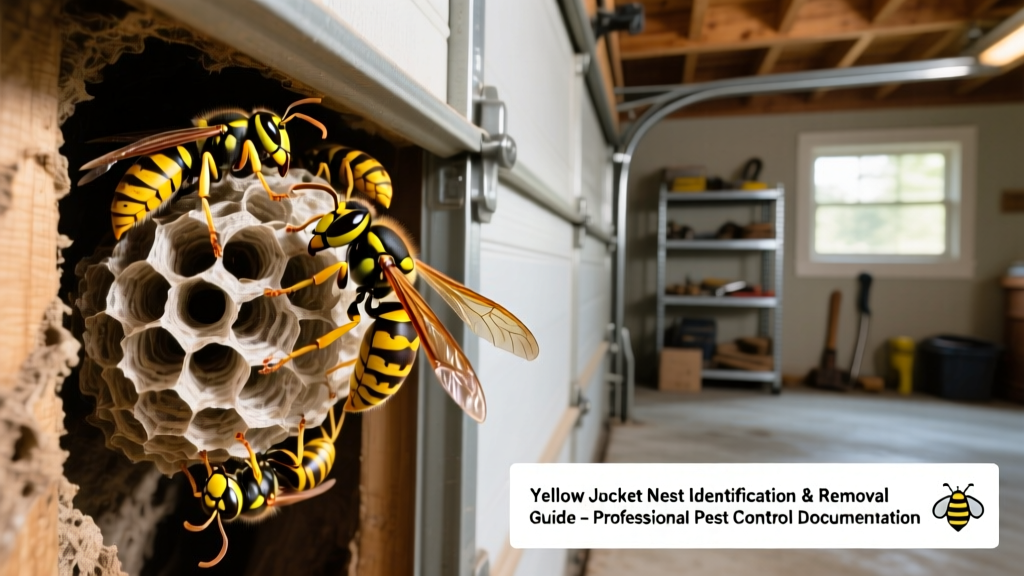
Yellow jackets—aggressive, social wasps that build paper nests—frequently invade garages because of sheltered entry points, warmth, and proximity to food sources. Unlike solitary wasps, they defend nests fiercely; stings can trigger severe allergic reactions in 3% of the U.S. population (American College of Allergy, Asthma & Immunology, 2022). A single nest in a garage wall void or overhead rafter can house 1,000–5,000 workers by late summer.
Identification
Spotting yellow jackets early prevents escalation. They’re ½–¾ inch long with alternating black-and-yellow bands, sleek bodies (no fuzzy hair), and rapid, side-to-side flight patterns near entry points. Unlike honeybees, they don’t carry pollen and rarely visit flowers—instead, they hover around trash cans, pet food bowls, or sugary spills.
| Feature | Yellow Jacket | Honeybee | European Hornet |
|---|---|---|---|
| Body texture | Smooth, shiny | Fuzzy, golden-brown | Thicker, reddish-brown head |
| Nest location | Wall voids, soffits, under garage doors | Rarely in garages—prefers hollow trees | Attics, tree cavities—not common in garages |
| Aggression level | High—stings repeatedly when disturbed | Low—only stings if crushed | Moderate—less defensive than yellow jackets |
Key signs in your garage:
- Constant buzzing from walls, ceiling joists, or behind insulation
- Dozens of wasps entering/exiting a small crack (often near door frames or utility conduits)
- Paper-mâché–like nest material peeking from gaps in drywall or baseboards
- Sudden increase in dead insects near light fixtures (they’re drawn to UV light at night)
What Attracts Them
Garages offer three critical resources: shelter, food, and water. Yellow jackets seek insulated, low-traffic spaces for nesting—especially where heat escapes through cracks near the foundation or attic access panels. They’re also drawn to protein (pet food left overnight) and sugar (soda spills, open juice boxes, fermenting fruit in storage bins).
According to the National Pest Management Association’s 2023 Field Survey, 68% of residential yellow jacket infestations begin within 10 feet of a garage door or side entrance—often exploiting gaps >⅛ inch wide.
- Unsealed gaps around garage door weatherstripping
- Open windows or vents without fine-mesh screening (minimum 16 mesh)
- Uncleaned grease traps in utility sinks or floor drains
- Cardboard boxes stored directly on concrete (moisture + cellulose = nesting lure)
Treatment Methods
Natural Removal Options
For small, accessible nests (<100 wasps) spotted early (late spring/early summer), try non-chemical methods first. Wear thick gloves, long sleeves, and a bee veil—even “gentle” approaches risk provocation.
- Soapy water spray: Mix 1 cup liquid dish soap + 1 gallon warm water in a pump sprayer. Spray directly into nest entrance at dusk, when most wasps are inside. The soap disrupts their exoskeletons; expect 90% mortality within 24 hours (University of Kentucky Entomology Extension, 2021).
- Vacuum extraction: Use a shop vac with a 20-foot hose extension and a fine-mesh filter bag. Seal the bag immediately after use and freeze for 48 hours before disposal.
- Peppermint oil deterrent: Apply 10 drops peppermint oil + 1 cup water around door tracks and baseboard cracks—yellow jackets avoid the scent, though it won’t eliminate established nests.
Chemical Treatments
For larger nests or those embedded in walls, targeted insecticides are necessary—but only as a last resort and never indoors without ventilation. Dust formulations (e.g., deltamethrin or cyfluthrin) work best for void nests because they adhere to wasps’ bodies and spread through grooming.
"Dust applications beat sprays for wall voids—wasps track the powder back to the queen. But always confirm nest location first with an infrared camera or listening device. Guessing wrong risks colony relocation into living spaces." — Dr. Lena Cho, Urban Entomologist, Purdue University Extension (2023)
Apply dust at night using a bulb duster inserted into the primary entrance. Wait 48–72 hours before checking for activity. Do not seal the hole until you’ve confirmed zero movement for 72 consecutive hours—premature sealing forces wasps to chew new exits, often into adjacent rooms.
Prevention
Long-term prevention hinges on exclusion and sanitation—not repellents. Yellow jackets rarely reuse old nests, but they’ll return to favorable conditions year after year.
- Install metal mesh over all garage vents, including gable and soffit openings (replace plastic screening—it degrades and tears)
- Seal gaps >1/16 inch with copper mesh + silicone caulk (copper resists chewing; silicone lasts 10+ years)
- Store pet food in sealed metal containers—not plastic bins—and wipe down garage floors weekly with vinegar solution
- Switch outdoor motion lights to yellow sodium vapor bulbs—they emit less UV and cut nocturnal insect attraction by 70% (U.S. Department of Energy Lighting Research, 2022)
When to Call an Exterminator
Call a licensed pest management professional if:
- The nest is inside a wall cavity, ceiling, or behind insulation—drilling and monitoring require specialized tools
- You’ve had two or more failed DIY attempts (increased aggression raises sting risk)
- Anyone in the household has a known hymenoptera allergy (carrying an EpiPen isn’t enough—professional removal avoids exposure)
- The nest entrance is near electrical wiring, gas lines, or HVAC ductwork
Most reputable providers offer same-day inspection and guarantee retreatment if activity resumes within 30 days. Compare quotes that include thermal imaging and post-treatment exclusion recommendations—not just spraying.
Can yellow jackets chew through drywall?
Yes—they don’t digest gypsum board, but they’ll exploit existing seams, nail holes, or poorly taped joints to reach insulation cavities. Once inside, they tunnel along stud bays, sometimes reaching adjacent rooms. If you hear scratching behind drywall, assume active nesting—not just seasonal activity.
Why do yellow jackets swarm my garage door at dusk?
They’re orienting themselves for nighttime navigation. Yellow jackets use visual landmarks and polarized light cues. Your garage door’s reflective surface, combined with porch lighting, creates a disorienting beacon. Reduce this by installing a matte-finish door wrap or switching to shielded LED fixtures.
Will freezing temperatures kill a yellow jacket nest in the garage?
Only if sustained below 20°F for 72+ hours—and most garages stay above freezing even in winter. Queens hibernate elsewhere; workers die off naturally by November, but the nest remains intact and may attract rodents or mold. Always remove and dispose of abandoned nests in sealed bags.
Are yellow jackets attracted to gasoline fumes?
Indirectly—yes. Hydrocarbon vapors mimic floral scents to some Hymenoptera. Mechanics report increased yellow jacket presence near fuel cans, lawnmower storage areas, and oil drip pans. Store gasoline in UL-listed metal containers with vapor-tight seals, and wipe spills immediately with baking soda paste.
How long does a yellow jacket nest last in a garage?
Typically 3–4 months—from founding (April–May) to decline (September–October). However, in mild climates or heated garages, colonies may persist into December. Nests rarely exceed 10,000 cells, but even a 500-wasp nest poses serious risk during peak activity.
Can I use a wasp trap inside the garage?
Not recommended. Traps lure foragers but don’t reduce colony size—workers simply replace lost members. Worse, traps placed indoors cause confused wasps to fly toward light sources (windows, skylights), increasing human contact. Use traps only outdoors, 20+ feet from entrances, baited with heptyl butyrate (a synthetic meat odor).
Garage yellow jacket problems resolve fastest when you combine precise identification, timed intervention, and structural exclusion. Don’t wait until you see dozens flying—address the first sign of buzzing near a crack or hole. For related issues, see our guides on paper wasps in attic spaces and carpenter ants in garage floor joists. Consistent sealing and seasonal inspections cut recurrence risk by over 80%, according to the Garage Pest Prevention Checklist.