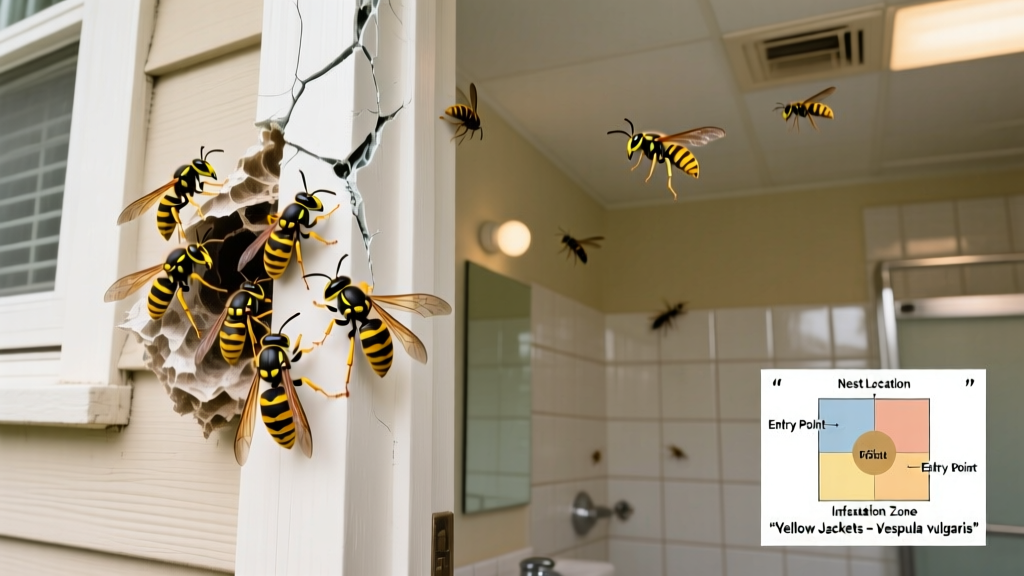
Yellow jackets—aggressive, social wasps with black-and-yellow banding—are increasingly found inside homes, especially bathrooms. Unlike solitary wasps, they build paper nests in wall voids, attic spaces, or behind shower surrounds—and a bathroom’s warm, humid, often poorly sealed environment makes it an ideal, dangerous harbor. A single nest can hold 1,000–5,000 workers (National Pest Management Association, 2022), and their stings can trigger severe allergic reactions in up to 3% of the population (AAAAI, 2021).
Identification
Spotting yellow jackets early prevents escalation. They’re ½–¾ inch long, slender, with distinct alternating black-and-yellow bands, smooth shiny bodies (unlike fuzzy bumblebees), and rapid, side-to-side flight patterns near entry points.
- Look for small holes (¼–⅜ inch) around baseboards, light fixtures, exhaust fan grilles, or caulk gaps near tub/shower enclosures
- Listen at dawn or dusk for a low, persistent buzzing from walls or ceilings
- Notice increased activity near drains, vents, or ceiling fans—especially during late summer
| Feature | Yellow Jacket | Honeybee | Drain Fly |
|---|---|---|---|
| Size | ½–¾ inch | ⅜–½ inch | ⅛ inch |
| Color/Pattern | Sharp black/yellow bands, glossy | Golden-brown, hairy, muted stripes | Grayish-black, moth-like, fuzzy wings |
| Flight Behavior | Aggressive, fast, directional | Hovering, slower, often near windows | Weak, fluttering, near drains or damp tiles |
| Nesting Site | Wall voids, soffits, behind mirrors | Rarely indoors; prefers hollow trees | Drain pipes, sewer traps, biofilm in overflow tubes |
What Attracts Them
Bathrooms offer three key draws: warmth, moisture, and sheltered access points. Yellow jackets scout for gaps near plumbing penetrations, HVAC ducts, or recessed lighting—then exploit them to reach insulated wall cavities where they build nests. Leaky faucets, steam from hot showers, and poor ventilation raise humidity, mimicking ideal outdoor nesting conditions.
- Cracks >1/8 inch around tub surrounds or vanity backsplashes
- Unsealed gaps behind exhaust fan housings (60% of indoor nests start there—NPMA Pest Control Insights, 2023)
- Old, deteriorated caulk around shower doors or tile grout lines
- Open attic access hatches connected to bathroom ceiling joists
Treatment Methods
Natural Methods
For small, newly discovered nests (under 24 hours old and fewer than 20 visible wasps), try non-chemical suppression first. Wear thick gloves, long sleeves, and a beekeeper-style veil—even minor agitation triggers defensive swarming.
- Apply dust-grade diatomaceous earth (food-grade) into entry points using a hand duster at night when wasps are less active
- Use a shop vacuum on low suction to collect foraging wasps near vents—immediately freeze the canister for 48 hours before disposal
- Hang pheromone traps like Scotch® Yellow Jacket Trap outside bathroom windows to intercept scouts before they enter
Chemical Methods
For established nests (3+ days old, >50 wasps), use targeted insecticides—but never spray blindly into walls. Dust formulations like DeltaDust® (deltamethrin) penetrate deeper than aerosols and remain effective for months inside voids.
- Apply dust only through confirmed entry points—not open walls—to avoid contaminating insulation or HVAC systems
- Avoid pyrethroid sprays near drains or tubs—residues can corrode PVC piping over time (EPA Pesticide Fact Sheet, 2022)
- Never use foggers (“bug bombs”) in bathrooms—they disperse chemicals unevenly and increase inhalation risk in confined spaces
Prevention
Sealing is 90% of long-term success. Focus on the ‘bathroom envelope’—the boundary between conditioned space and wall/attic voids. Most infestations begin at overlooked junctions where drywall meets plumbing or framing.
- Replace cracked or missing caulk around shower bases, sink drains, and toilet flanges with silicone-based sealant rated for wet areas
- Install fine-mesh vent covers (≤1/8-inch openings) over bathroom exhaust fans—check annually for tears or loosening
- Use expanding foam (e.g., Great Stuff Pestblock®) to fill gaps >¼ inch behind vanity cabinets and around pipe chases
- Run bathroom fans 20 minutes post-shower to reduce humidity below 50%—a level yellow jackets avoid (ASHRAE Standard 62.2, 2023)
When to Call an Exterminator
Call a licensed pest professional immediately if you hear consistent buzzing inside walls for more than two days, see >30 wasps entering/exiting daily, or suspect a nest behind tile, mirror, or drywall. Removing nests embedded in structural cavities requires infrared scanning, precision drilling, and post-treatment monitoring—skills beyond DIY scope.
"Over 70% of bathroom yellow jacket calls involve nests located behind tile or within shower valve assemblies—areas that require specialized access tools and containment protocols." — Dr. Lena Cho, Entomologist, National Pest Technicians Association (2023)
Can yellow jackets build nests inside shower drains?
No—they lack the physical ability to construct paper nests in narrow drain pipes. What you’re seeing is likely drain flies or wasps using the drain as a temporary entry route to a wall void above. Confirm by inspecting the overflow tube and behind the wall adjacent to the drain assembly.
Why do yellow jackets appear only in the morning?
They’re most active during peak foraging hours—roughly 7–11 a.m.—when temperatures rise and nectar sources (including household sugars) are accessible. If you see them exclusively then, it suggests a nearby nest with a short flight path to your bathroom.
Will sealing the bathroom door gap stop them?
Not reliably. Yellow jackets rarely fly under doors—they prefer vertical entry points like vents, light fixtures, or plumbing gaps. Focus instead on sealing the top and sides of the door frame where it meets the wall, plus any gaps around the threshold where flooring meets drywall.
Are yellow jackets attracted to bathroom cleaners?
Yes—some scented products (especially citrus- or floral-scented disinfectants) mimic floral nectar cues. Switch to unscented, vinegar-based cleaners like white vinegar solutions, which also help break down pheromone trails.
Can I remove a nest myself if it’s behind a bathroom mirror?
No. Removing a mirror risks exposing live nest material and triggering mass emergence. Even after treatment, residual venom sacs and decomposing wasps attract carpet beetles and mold. Hire a technician trained in non-invasive wall inspection and cleanout protocols.
Do yellow jackets return to the same bathroom next year?
Not typically—but if the original entry point remains unsealed, new queens may reuse it. Queens emerge in spring and seek pre-existing openings to start colonies. That’s why post-removal sealing is non-negotiable.
Yellow jackets in bathrooms aren’t just a nuisance—they’re a structural warning sign. Addressing them means treating both the insects and the building envelope. Fix the gap, not just the wasp. For related concerns, see our guides on drain flies in bathroom and carpenter ants in bathroom walls.