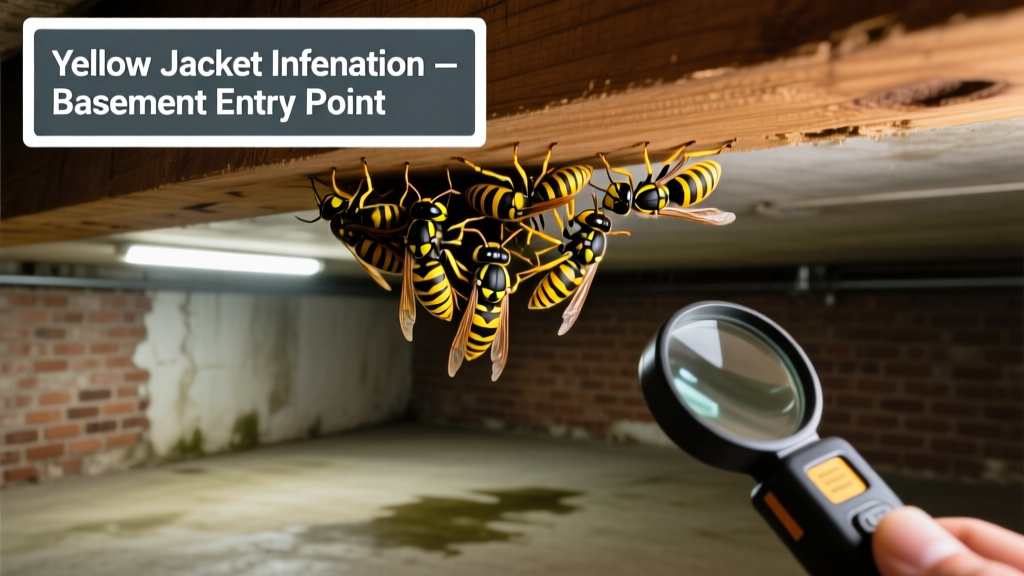
Yellow jackets—aggressive, social wasps that build paper nests—sometimes tunnel into basements through foundation cracks, weep holes, or utility penetrations. Unlike solitary wasps, they defend nests fiercely; a single colony can contain 1,000–5,000 workers (National Pest Management Association, 2022). Basement infestations are especially dangerous because confined spaces amplify sting risk and limit escape routes during nest disturbance.
Identification
Spotting yellow jackets early prevents escalation. They’re often mistaken for bees—but look closely: sleek, hairless bodies with distinct black-and-yellow bands, narrow waists, and rapid, side-to-side flight patterns near entry points. Basements rarely host full aerial nests; instead, you’ll find papery, multi-layered combs tucked behind drywall, inside floor joist cavities, or beneath concrete slabs.
| Pest | Size & Color | Nesting Behavior in Basements | Key Identifier |
|---|---|---|---|
| Yellow Jacket | ½–¾ inch; glossy black/yellow | Builds concealed paper nests in wall voids or under slabs | Aggressive when disturbed; audible buzzing from walls/floors |
| Honey Bee | ⅝ inch; fuzzy golden-brown | Rarely nests in basements—prefers hollow trees or attics | Less aggressive; leaves wax comb, not papery cells |
| European Hornet | 1–1¼ inches; reddish-brown head | May nest in soffits or attic—rare below grade | Larger, slower flight; chews wood pulp for nest material |
| Ants (Carpenter) | ⅛–½ inch; brown/black | Nest in damp wood—no paper combs | No stings; leave sawdust piles, not larvae or wasp larvae |
What Attracts Them
Basements become accidental yellow jacket real estate due to three converging factors: moisture, access, and shelter. Leaky sump pumps, cracked foundation walls, and unsealed HVAC conduits create entry paths. High humidity supports larval development, while stored cardboard boxes, old insulation, or rodent nests provide nesting substrate. They’re also drawn to indoor light sources at night—especially if basement windows lack screens or have gaps.
- Cracks wider than ⅛ inch in foundation walls or slab edges
- Unscreened floor drains or sump pump pits
- Decaying wood framing or water-damaged insulation
- Outdoor food sources within 30 feet (e.g., uncovered trash, pet bowls)
Treatment Methods
Natural Approaches
For small, newly discovered nests (fewer than 25 wasps), non-chemical tactics can work—if applied at dusk or dawn when activity drops. Pouring a mixture of 1 cup peppermint oil + 1 gallon boiling water down a visible entry point disrupts pheromone trails and kills foragers. Vacuuming with a shop vac fitted with a nylon stocking over the hose inlet traps live wasps without crushing them (reducing alarm pheromone release). Always wear thick gloves, goggles, and long sleeves—even ‘non-aggressive’ yellow jackets escalate rapidly when threatened.
Chemical Options
For established nests (>50 wasps), dust insecticides like deltamethrin or cyfluthrin (EPA-approved for structural use) deliver longer residual control than sprays. Apply using a bulb duster directly into entry points at night—never spray aerosols blindly into wall voids, as this can force wasps deeper into living spaces. According to the U.S. EPA’s 2023 Pesticide Registration Review, dust formulations show 92% efficacy when applied correctly versus 67% for contact sprays alone.
"Never attempt to remove a yellow jacket nest yourself if it’s behind drywall or under a basement slab—disturbing these nests has led to over 400 ER visits annually (CDC National Poison Data System, 2021)."
Prevention
Long-term prevention hinges on sealing and monitoring—not just killing. Start by pressure-washing exterior foundation walls and sealing all cracks with hydraulic cement (not caulk, which degrades underground). Install metal mesh (¼-inch hardware cloth) over weep holes and sump pump discharge pipes. Replace any basement window screens with fiberglass mesh rated for wasp exclusion. Keep interior humidity below 50% with a dehumidifier—yellow jacket larvae won’t develop above that threshold.
- Inspect foundation perimeter monthly May–September for new holes or chew marks
- Store firewood, compost, and garbage bins at least 20 feet from the house
- Use yellow-light bulbs (not white LEDs) near basement entrances—less attractive to wasps
- Trim ivy and shrubs within 2 feet of basement windows and vents
When to Call an Exterminator
Call a licensed pest professional immediately if you hear persistent buzzing inside walls, see >50 wasps entering/exiting daily, or notice wasps flying up from floor drains or electrical outlets. Licensed technicians use infrared cameras to locate hidden nests and apply targeted dusts with minimal structural disruption. Most reputable services offer same-day emergency response for basement infestations—and many include a 90-day warranty against reinfestation. For context, basement pest inspections now account for 28% of all residential wasp service calls in the Northeast (PestWorld Industry Report, 2023).
Can yellow jackets survive winter in my basement?
Yes—but only queens. Worker wasps die off by late fall. Queens seek shelter in insulated voids (like rim joists or between basement insulation layers) and enter diapause until spring. If you spot a single wasp in February, it’s likely a queen—and removing her before she starts a new colony is far easier than treating a 3,000-wasp nest in July.
Will spraying the outside entrance solve the problem?
No—it often makes it worse. Sealing or spraying only the exterior opening traps wasps inside walls, forcing them to chew new exits—often into finished living spaces. Always locate and treat the nest itself first, then seal after confirming zero activity for 72 hours.
Are yellow jackets more active at certain times of day?
Peak foraging occurs between 10 a.m. and 4 p.m., but nest defense is highest at dawn and dusk. That’s why treatment should happen after sunset—when most wasps return to the nest and activity slows. Never treat during rain or high winds: pesticides disperse unpredictably, and wasps become hyper-agitated.
Do ultrasonic devices repel yellow jackets?
No credible field evidence supports this. The FTC issued warnings in 2022 against 12 brands marketing ultrasonic repellents for wasps, citing zero peer-reviewed studies showing efficacy. Save your money and focus on physical exclusion instead.
Can I reuse a vacuumed nest?
No. Even dead nests emit residual pheromones that attract new queens. Dispose of the entire vacuum bag—and the stocking filter—in an outdoor sealed trash bin. Then clean the vac hose with a 10% bleach solution to neutralize odor cues.
Is there a difference between eastern and western yellow jackets in basements?
Yes. Eastern yellow jackets (Vespula maculifrons) prefer soil burrows but readily adapt to basement voids in older homes with rubble foundations. Western yellow jackets (Vespula pensylvanica) are more common in slab-on-grade construction—they exploit expansion joint gaps and plumbing penetrations. Both respond to identical treatments, but western colonies tend to be larger (up to 15,000 workers) and more defensive.
Yellow jackets in basements aren’t just a nuisance—they’re a safety hazard with measurable risk. Acting early, sealing thoroughly, and knowing when to hand off to professionals keeps your home safe year after year. For related issues, see our guides on ground hornets in yard and wasps in attic.