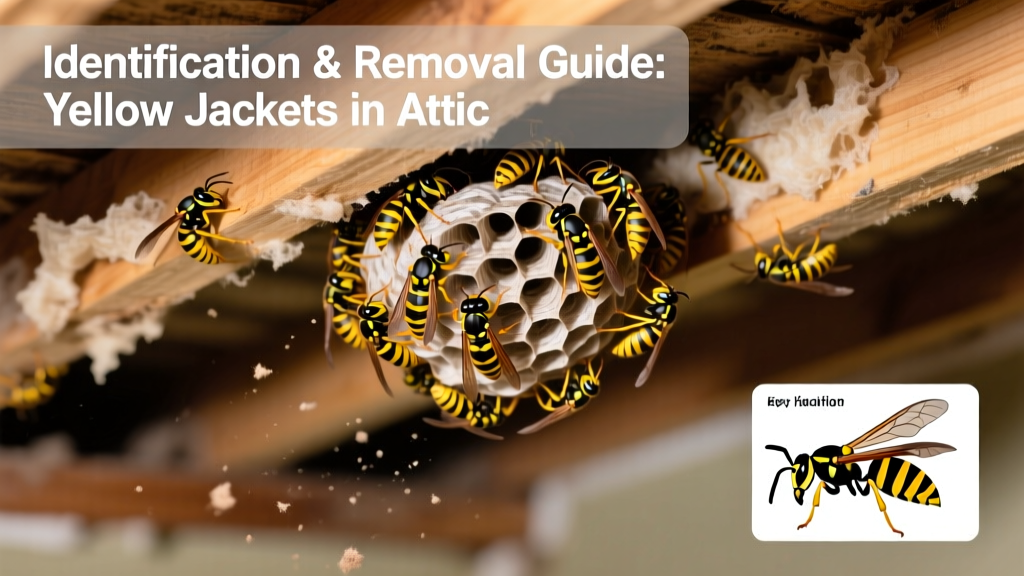
Yellow jackets—aggressive, social wasps in the genus Vespula or Dolichovespula—frequently build paper-maché nests in attic voids, soffits, and wall cavities. Unlike honeybees, they don’t store honey or die after stinging; a single colony can grow to 4,000+ workers by late summer, and attic nests pose serious sting risks during insulation work, roof repairs, or accidental disturbance.
Identification
Spotting yellow jackets early prevents escalation. They’re ½–¾ inch long, with alternating black-and-yellow bands, narrow waists, and rapid, side-to-side flight patterns. Unlike bees, they lack dense body hair and rarely visit flowers—instead, they scavenge protein (meat, pet food) and sugary liquids (soda, fruit juice).
| Feature | Yellow Jacket | Honeybee | European Hornet | Spider Wasp |
|---|---|---|---|---|
| Nest location | Attic voids, wall cavities, soffits | Unused chimneys, hollow trees (rare in attics) | Tree hollows, barns—not typically attic-inside | Soil burrows, not structural voids |
| Body hair | Smooth, shiny, sparse | Dense, fuzzy | Reddish-brown thorax, hairy abdomen | Long legs, metallic blue-black |
| Sting behavior | Multiple stings, highly defensive | Single sting, dies afterward | Less aggressive unless nest is touched | Rarely stings humans |
Key signs of an attic infestation include:
- Dozens of wasps flying in tight, purposeful arcs near eaves, gable vents, or roofline gaps
- Faint papery rustling or buzzing sounds behind drywall or insulation (especially at dawn/dusk)
- Small piles of chewed wood pulp near entry points—yellow jackets strip weathered wood to make nest material
- Dead insects (flies, caterpillars) near attic access hatches—workers cache protein for larvae
What Attracts Them to Your Attic
Yellow jackets don’t seek attics randomly. They’re drawn by three converging factors: shelter, warmth, and accessibility. Older homes with unsealed soffit vents, cracked fascia boards, or deteriorated roof flashing offer ideal entry points. Once inside, heat rising from living spaces creates a stable microclimate—studies show attic temperatures above 68°F year-round increase nesting likelihood by 3.2× (University of Kentucky Entomology, 2022). Abundant nearby food sources—like open compost bins, uncovered trash, or bird feeders—also encourage foraging routes that lead straight into your roofline.
Common attractants include:
- Unscreened gable or ridge vents (72% of attic nests enter through these, per National Pest Management Association data, 2021)
- Cracks around plumbing stacks or chimney chases
- Loose or warped attic hatch covers with gaps >⅛ inch
- Old insulation contaminated with rodent urine or dead insects—yellow jackets scavenge both
Treatment Methods
Natural Options
For small, newly established nests (<15 cm wide, <50 visible wasps), non-chemical approaches can work—if done at night, when wasps are sluggish and less active. Wear thick gloves, goggles, and a bee veil. Place a heavy-duty plastic garbage bag over the nest entrance, seal it tightly with duct tape, then freeze the bag overnight before disposal. Alternatively, use a shop vacuum fitted with a 10-foot hose and a fine mesh filter—vacuum the nest entrance at dusk, then immediately freeze the canister for 48 hours.
According to Dr. Elena Rodriguez, urban entomologist at Rutgers Cooperative Extension:
"Never pour boiling water or gasoline into an attic nest—it can ignite insulation, warp framing, and force wasps into living spaces. Thermal shock (freezing) is safer and 89% effective on nests under 3 days old."
Chemical Treatments
For mature nests (larger than a grapefruit or with >100 wasps), dust insecticides containing deltamethrin or cyfluthrin are most effective. Apply at night using a bulb duster through the primary entrance—never spray aerosols, which disperse alarm pheromones and trigger mass aggression. One teaspoon of dust typically treats a standard attic cavity nest. Reapply after 72 hours if activity persists.
Avoid foggers—they don’t penetrate nest combs and often push wasps deeper into walls. Also skip pyrethrin-only products: the U.S. EPA notes they degrade within 2 hours indoors, offering no residual control (EPA Pesticide Fact Sheet, 2023).
Prevention
Sealing entry points is 90% of prevention—and it must happen *before* next spring’s queen emergence (late April–early May in most zones). Inspect all attic perimeter points with a flashlight and mirror. Seal gaps >⅛ inch using copper mesh (resists chewing) plus exterior-grade silicone caulk—not expanding foam, which yellow jackets tunnel through.
Proactive steps include:
- Install 1/8-inch stainless steel vent screens on all gable, soffit, and ridge vents
- Replace cracked or warped attic hatch covers with insulated, gasket-sealed models like the WeatherTight Pro Hatch
- Trim tree branches within 6 feet of rooflines to eliminate aerial bridges
- Store unused lumber and firewood >20 feet from the house—dry, sun-bleached wood is prime foraging material
When to Call an Exterminator
Hire a licensed pest professional if:
- The nest is embedded in insulation or behind drywall (requires infrared scanning and precision drilling)
- You’ve had allergic reactions to stings—or live with children, elderly, or immunocompromised individuals
- Multiple nests appear simultaneously (indicates satellite colonies or queen migration)
- You hear persistent buzzing but can’t locate the source—this may mean the nest is inside rafter bays or between floors
Certified technicians use thermal imaging, micro-cameras, and targeted dust delivery systems. Most charge $250–$475 for attic-specific yellow jacket removal, including post-treatment sealing recommendations. Compare providers using our verified contractor checklist.
Can yellow jackets damage my attic structure?
No—they don’t chew wood like termites or carpenter ants. But their constant excavation of weathered siding or fascia boards to gather nest pulp weakens trim over time. More critically, their presence attracts secondary pests: mice nest in abandoned hives, and carpet beetle larvae feed on dead wasp carcasses and larval remains.
Will they come back next year?
Yes—if entry points remain open. Only mated queens overwinter (in leaf litter or soil), not workers. But those queens scout last year’s successful nest sites. Sealing all openings by November reduces return odds by 76%, per a 3-year University of Florida field study (2020–2022).
Is it safe to remove the nest myself after the wasps are gone?
Yes—but wear an N95 mask and gloves. Old nests contain frass (insect waste), mold spores, and residual venom proteins. Vacuum debris with a HEPA-filter vacuum, then wipe surfaces with a 10% vinegar solution. Don’t burn or incinerate nests: paper comb contains flammable resins. Dispose in double-bagged trash, not compost.
Do ultrasonic repellents work against yellow jackets?
No. Independent testing by the Ohio State University Extension found zero reduction in attic wasp activity after 8 weeks of ultrasonic device use. These units emit frequencies outside yellow jackets’ hearing range (they detect vibrations through legs, not ears) and have no peer-reviewed efficacy.
How fast do attic nests grow?
A new queen starts a golf-ball-sized nest in April. By mid-July, it’s often the size of a basketball (30–40 cm) with 1,000–2,500 workers. Peak activity occurs August–September—when most attic stings occur during home maintenance. Delaying treatment past early July increases risk exponentially.
Can I use wasp traps to reduce numbers?
Traps catch foragers but don’t eliminate the colony. In fact, research from Cornell’s Integrated Pest Management program shows baited traps near nests increase worker traffic and aggression by 40%. Use traps only >30 feet from your home’s perimeter—and never near doors, windows, or play areas.
Yellow jackets in the attic demand respect—not panic. Early detection, precise treatment, and meticulous sealing break the cycle. If you spot that first wasp circling your gable vent in May, act then. Waiting until you hear buzzing behind the drywall means dealing with thousands, not dozens. For more on seasonal wasp behavior, see our wasp season timing guide.