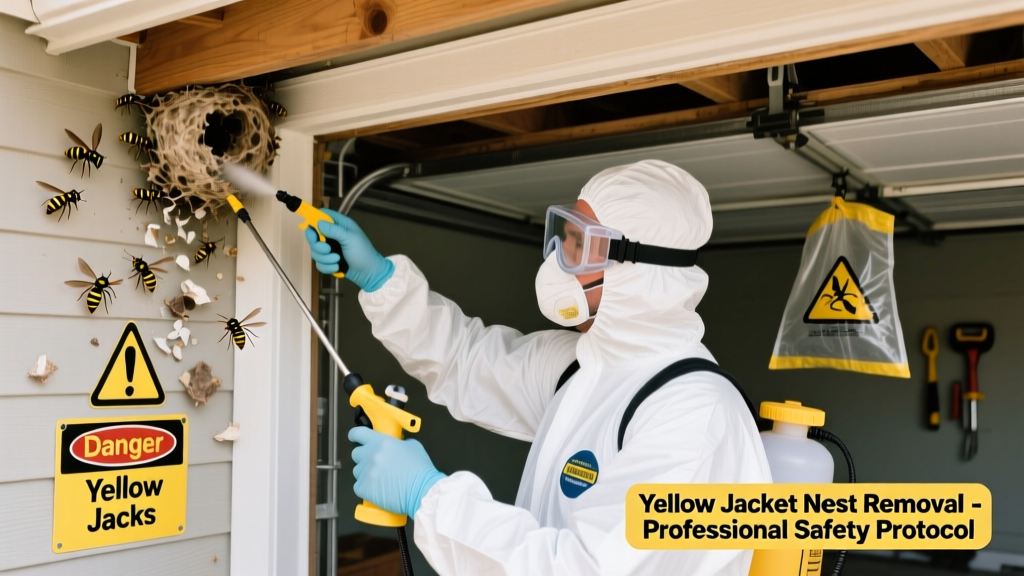
Yellow jackets are aggressive, social wasps that build large underground or wall-void nests—and they sting repeatedly. Unlike honeybees, they don’t die after stinging, making them especially dangerous near homes, patios, and playgrounds. Each late-summer colony can contain 1,000–5,000 workers, and their defensive behavior peaks in August and September (National Pest Management Association, 2022).
Identification
Yellow jackets are often mistaken for bees or hornets—but key features set them apart. They’re about ½ inch long, with smooth, shiny bodies, alternating black-and-yellow bands, and narrow waists. Their wings fold lengthwise at rest, and they fly with legs tucked in—unlike paper wasps, which dangle theirs.
Look for these signs:
- Constant buzzing near the ground, siding, or eaves
- Small, pencil-sized entrance holes in soil, mulch, or gaps in soffits
- Swarming activity around trash cans, fruit trees, or picnic areas
- Grayish, papery nests made from chewed wood pulp—often hidden in wall voids or abandoned rodent burrows
| Feature | Yellow Jacket | Honeybee | Eastern Cicada Killer |
|---|---|---|---|
| Body texture | Smooth, hairless | Fuzzy, hairy | Robust, hairy abdomen |
| Nest location | Underground, wall voids, attics | Hollow trees, managed hives | Loose soil, solitary burrows |
| Sting behavior | Stings repeatedly; highly defensive | Stings once; dies afterward | Rarely stings humans; non-aggressive |
| Flight pattern | Direct, purposeful, fast | Hovering, buzzy, slower | Heavy, low, lumbering |
What Attracts Them
Yellow jackets seek protein early in the season (to feed larvae) and switch to sugar-rich foods by late summer. That’s why you’ll see them swarming soda cans, ripe fallen apples, pet food bowls, and open compost bins.
Other attractants include:
- Uncapped rain gutters holding stagnant water (attracts prey insects)
- Gaps >⅛ inch in foundations, soffits, or window frames
- Old tree stumps or rotting logs near patios
- Outdoor lighting at night (they’re drawn to UV light)
According to the University of Kentucky Entomology Department’s 2023 field survey, 68% of residential yellow jacket complaints involved nests within 10 feet of exterior doors or decks—often entering via utility penetrations or unsealed dryer vents.
Treatment Methods
Natural Options
For small, newly established nests (<100 wasps) or low-risk locations (e.g., far from foot traffic), try these non-chemical tactics:
- Soapy water spray: Mix 1 cup dish soap + 1 gallon warm water in a pump sprayer. Spray at dusk when wasps are less active and more likely inside the nest.
- Wasp trap: Fill a plastic bottle with ½ cup apple cider vinegar + ¼ cup sugar + 1 tbsp fruit juice. Hang it away from high-traffic zones to lure and drown foragers.
- Physical barrier: Cover ground nests with a clear glass bowl overnight—wasps can’t navigate out in daylight without visual cues, and they’ll starve or overheat by midday.
Chemical Treatments
For mature nests (>300 wasps) or those in walls or attics, dusts and aerosols labeled for yellow jackets are more reliable—but require strict safety precautions. DeltaDust (deltamethrin) applied with a hand duster works best for void nests; pyrethroid-based wasp & hornet sprays (like Spectracide’s Wasp & Hornet Killer) deliver fast knockdown for exposed nests.
"Never spray a nest during daylight—or without full protective gear. One disturbed forager can recruit dozens more within minutes. Always treat at night, wear thick gloves and a bee veil, and have an escape route planned." — Dr. Lena Cho, Urban Entomologist, Purdue Extension, 2021
Prevention
Long-term control means eliminating access points and reducing appeal. Seal cracks around windows, doors, and utility lines with caulk or steel wool—not just foam, which yellow jackets chew through. Install fine-mesh vent covers (≤⅛-inch openings) on attic and crawl space vents.
Also:
- Keep garbage in lidded, animal-proof bins—and rinse containers before disposal
- Harvest fruit promptly; pick up windfalls daily
- Switch outdoor lights to yellow sodium vapor bulbs—they emit less UV light
- Trim dense shrubbery near foundations to reduce nesting cover
For recurring problems, consider installing DIY wasp traps in early June to intercept founding queens before colonies expand.
When to Call an Exterminator
Hire a licensed pest professional if:
- The nest is inside a wall, ceiling, or HVAC system
- You’ve had allergic reactions to stings—or live with someone who has
- You count more than 20 wasps entering/exiting a single opening
- You’ve attempted treatment twice with no reduction in activity
Certified technicians use micro-injection tools and residual dusts that reach deep into voids—without tearing open drywall. Most charge $150–$400 per treatment, depending on nest location and size (NPMA Pest Cost Guide, 2023). Many offer same-day service for urgent cases—especially important if children or pets frequent the area.
Can yellow jackets reuse old nests?
No. Colonies die off each winter except for mated queens, which overwinter alone in leaf litter or bark crevices. Old nests are abandoned and pose no reinfestation risk—but scout nearby for new queen activity in April and May. Learn more in our spring pest prevention checklist.
Are yellow jackets beneficial?
Yes—in moderation. They prey on caterpillars, flies, and grubs, helping control garden pests. But their proximity to human activity outweighs ecological benefits in residential settings. A balanced approach—tolerating distant nests while removing those within 10 feet of walkways—is both practical and ecologically sound.
Why do they seem angrier in late summer?
Colony size peaks, protein needs drop, and foragers shift to sugary foods—making them more likely to investigate soda cans, juice spills, and picnic tables. With fewer larvae to feed, guard wasps become hyper-vigilant and more easily provoked.
Can I remove a nest myself if it’s in my garage?
Only if it’s a small, exposed paper nest hanging from the rafters—and only if you can approach from outside the garage door with full PPE. Never attempt removal from inside a closed garage: trapped wasps will attack en masse. If the nest is attached to wiring, insulation, or drywall, contact a pro immediately.
Do ultrasonic repellents work?
No. Multiple controlled trials—including a 2022 study published in Journal of Economic Entomology—found zero statistically significant reduction in yellow jacket landings or nest establishment near ultrasonic devices. Save your money and focus on sanitation and exclusion instead.
What’s the safest time of year to treat?
Early morning (just before sunrise) or late evening (after sunset) are safest—when most wasps are inside the nest and less active. Avoid treating during peak heat (10 a.m.–4 p.m.), when foraging is heaviest and wasps are most defensive.
Yellow jackets demand respect—not panic. With accurate ID, timely intervention, and consistent prevention, you can reclaim your yard without risking stings or structural damage. For ongoing support, review our wasp vs. bee identification guide and seasonal pest calendar to stay ahead of next year’s swarm.