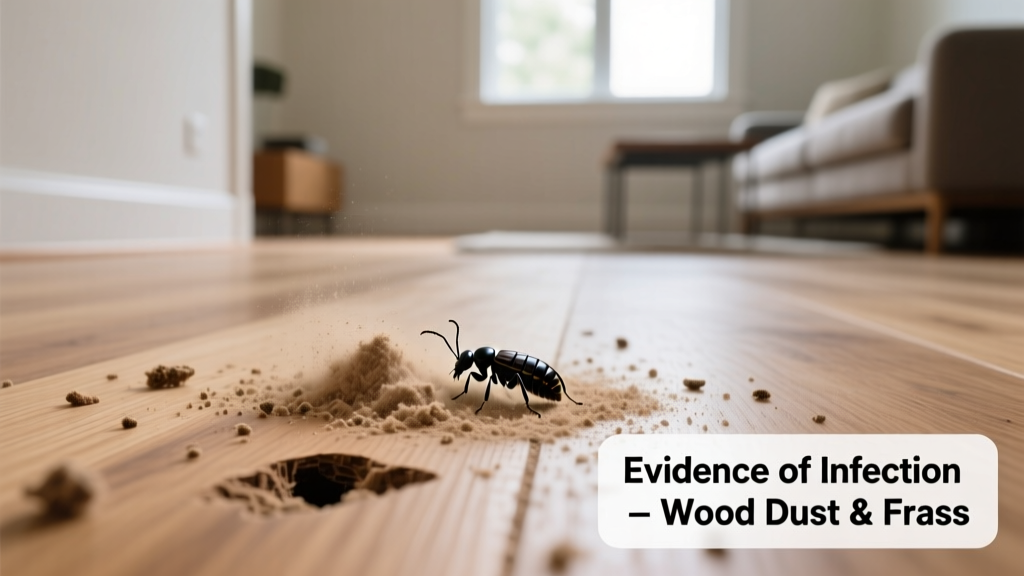
Wood dust on your floor isn’t just messy—it’s a red flag. Unlike sawdust from renovation, pest-generated frass (insect excrement and chewed wood) signals active infestation behind walls, under floors, or inside baseboards. Left unchecked, these pests can compromise load-bearing timbers in as little as 6–12 months.
Identification
Three primary pests produce wood dust indoors: powderpost beetles, carpenter ants, and drywood termites. Each leaves distinct clues—not just pile location, but grain, color, texture, and timing.
| Pest | Dust Appearance | Typical Location | Seasonal Activity |
|---|---|---|---|
| Powderpost beetles | Fine, flour-like, pale tan; feels silky when rubbed between fingers | Hardwood floors, trim, furniture, unstained oak/maple | Adults emerge spring–early summer; larvae feed year-round |
| Carpenter ants | Coarse, fibrous, often mixed with insect parts; may contain bits of insulation or soil | Moist areas—bathrooms, kitchens, around windowsills, roof leaks | Most visible March–October; foraging peaks at night |
| Drywood termites | Small, hard, six-sided pellets (frass); stacked like salt grains; uniform size (1 mm) | Attic beams, door frames, window sills, wall voids—no soil contact needed | Swarmers appear late summer/fall; frass accumulates year-round |
Also check for exit holes: powderpost beetles leave 1/32"–1/16" round holes; drywood termites make 1/8" oval openings; carpenter ants rarely bore clean holes—they excavate galleries, often leaving ragged edges.
What Attracts Them
These pests don’t invade randomly. They respond to specific environmental triggers that make your home irresistible.
- Moisture: Carpenter ants require >20% wood moisture content—leaky pipes, poor ventilation, and condensation create ideal nesting zones.
- Wood type: Powderpost beetles prefer hardwoods with high starch content (oak, ash, walnut); drywood termites favor seasoned, dry lumber over damp or pressure-treated wood.
- Entry points: Cracks >1/16" in foundation, gaps around utility lines, and untreated firewood stored indoors give all three pests access.
According to the National Pest Management Association’s 2022 Structural Pest Report, 68% of drywood termite infestations begin near attic vents or eaves—areas where heat buildup and minimal inspection create perfect stealth conditions.
Treatment Methods
Natural Methods
For light, localized activity—especially early-stage powderpost beetle emergence—non-chemical options can disrupt life cycles without fumigants.
- Freeze infested furniture or trim at 0°F for 72+ hours (kills eggs/larvae in hardwoods up to 1" thick).
- Apply food-grade diatomaceous earth (DE) into cracks and crevices—dehydrates adults and crawling larvae.
- Use borate-based sprays (e.g., Bora-Care) on exposed raw wood surfaces—penetrates sapwood and deters feeding for years.
Chemical Treatments
When frass appears in multiple rooms or exits holes multiply, targeted chemical intervention becomes necessary—and timing matters.
- For drywood termites: Termidor SC is not labeled for drywood use; instead, XT-200 aerosol delivers sodium borate directly into galleries via precision tip.
- For carpenter ants: Phantom Termiticide (chlorfenapyr) applied as a crack-and-crevice treatment disrupts mitochondrial function—workers carry it back to nests.
- For powderpost beetles: Tim-Bor Professional (disodium octaborate tetrahydrate) injected into exit holes stops larval development within 48 hours.
"If you see fresh frass in February or July, it’s almost certainly drywood termites—carpenter ants go dormant below 50°F, and powderpost beetles only emerge when indoor temps hit 68–72°F consistently." — Dr. Elena Ruiz, Entomologist, UC Riverside Urban Pest Management Program, 2023
Prevention
Stopping reinfestation means managing both wood condition and access points—not just treating symptoms.
- Keep indoor humidity below 50% using dehumidifiers in basements and crawlspaces—this slows larval development across all three pests.
- Seal exterior gaps with copper mesh + silicone caulk—termites and beetles won’t cross metal, and ants avoid tight, dry seals.
- Store firewood at least 20 feet from the house and elevate it 6" off the ground—firewood pests are a leading vector for powderpost beetles.
- Inspect hardwood flooring annually with a 10x magnifier—look for new holes or faint “blushing” (lighter wood discoloration) around old exit sites.
Replace water-damaged baseboards and subflooring promptly. The U.S. Forest Service notes that carpenter ants colonize wood with moisture content above 15%—and once established, they’ll tunnel into adjacent dry framing.
When to Call an Exterminator
Call a licensed professional if you observe any of the following:
- Frass appearing in more than two separate rooms on the same floor
- Exit holes clustered within 12 inches of each other on structural beams or joists
- Winged swarmers indoors between August–November (drywood termite season)
- Visible ant trails >3 feet long moving continuously between wall voids and food sources
Delaying service increases repair costs. A termite inspection starts at $75–$150, but untreated drywood termite damage averages $3,200 in repairs per affected room (NPMA, 2023).
Is wood dust always from pests?
No. Sawdust from recent renovations, sanding, or even pet chewing can mimic frass. Check for consistency: pest frass doesn’t contain splinters or glue residue—and it reappears within 3–5 days after vacuuming.
Can I vacuum up the dust safely?
Yes—but use a HEPA-filter vacuum. Standard vacuums blow fine frass particles back into the air, potentially spreading pheromone trails (for ants) or airborne fungal spores that feed beetle larvae. Empty the canister outdoors immediately.
Does bleach kill wood-boring insects?
No. Bleach evaporates too quickly to penetrate wood and has no residual effect on larvae hidden deeper than 1/8". It may discolor surfaces and corrode fasteners—making it counterproductive. Stick to borates or targeted insect growth regulators.
Why do I only see dust near baseboards?
Baseboards are prime real estate: they’re often made of susceptible hardwoods, sit against concrete foundations (cool/moist), and conceal expansion gaps where pests travel. Carpenter ants especially use baseboard voids as highways between satellite nests and kitchens.
Will painting over exit holes stop them?
No—paint seals the surface but not the gallery beneath. Larvae continue feeding and will eventually bore new exits. Always treat the wood first with borate or fumigant, then patch and paint.
Are pine floors immune?
Not entirely. While softwoods like pine are less attractive to powderpost beetles, drywood termites readily infest kiln-dried pine used in millwork. And carpenter ants will nest in any wood softened by moisture—even pressure-treated pine near leaky tub surrounds.
If you’ve ruled out recent construction and still find consistent, fresh wood dust, assume pest activity is present. Early detection prevents costly repairs—especially since hidden termite damage often goes unnoticed until joists sag or floors creak. Monitor weekly, document hole locations with painter’s tape and date labels, and act before spring emergence ramps up.