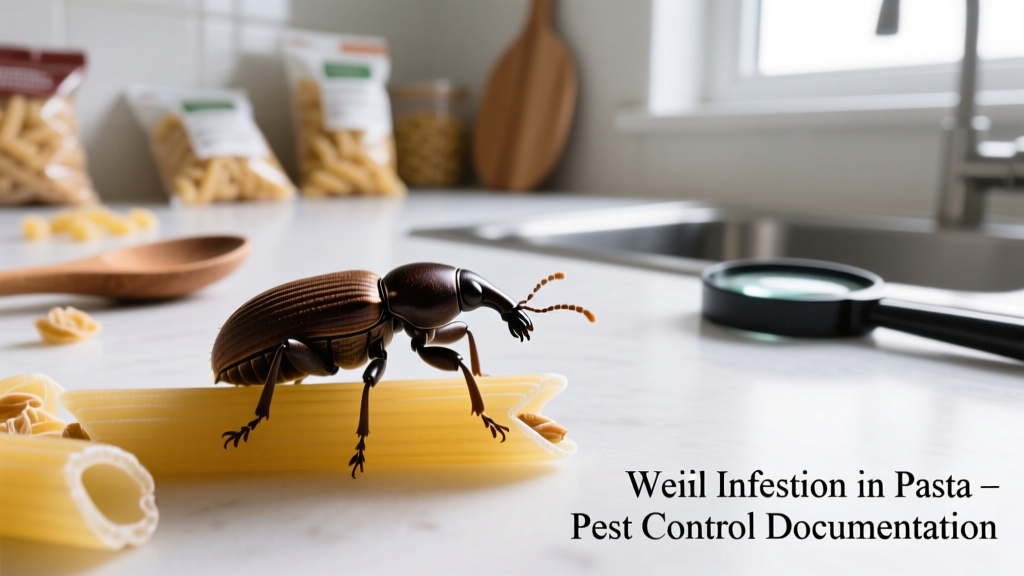
Weevils in your pasta aren’t random invaders—they’re likely granary or rice weevils (Sitophilus granarius or S. oryzae), tiny beetles that hatch, feed, and reproduce inside dry goods. Left unchecked, a single female can lay up to 400 eggs over four months—turning a box of spaghetti into a breeding ground within weeks.
Identification
Granary weevils are 2–3 mm long, reddish-brown, with a distinctive elongated snout and no wings. Rice weevils look nearly identical but have four faint reddish spots on their wing covers and *can* fly. Both larvae are legless, creamy-white grubs curled inside grains or pasta tubes.
Key signs include small holes in pasta shells (especially penne or rigatoni), fine dusty residue (frass), and live adults scurrying when you shake the box. You may also spot tiny, oval, pearly-white eggs glued to grain surfaces—but these are rarely visible without magnification.
| Feature | Granary Weevil | Rice Weevil |
|---|---|---|
| Wings | Present but nonfunctional; cannot fly | Functional; capable of flight |
| Spots on elytra | None | Four distinct reddish spots |
| Primary host preference | Wheat, corn, whole-grain pasta | Rice, oats, enriched pasta blends |
| Origin likelihood | Infested at processing or storage facility | Often enters home via open packaging or reused containers |
What Attracts Them
Weevils don’t seek out homes—they hitchhike in infested products from the store or warehouse. Once inside, they thrive in warm (70–85°F), low-humidity pantries with undisturbed dry goods. They avoid light and prefer dark, sealed containers where humidity stays stable—making vacuum-sealed or plastic-bagged pasta ideal incubators.
- Uninspected bulk-bin purchases (especially from co-ops or ethnic markets)
- Pasta stored in cardboard boxes past best-by dates
- Transferring dry goods into clear glass jars *without freezing first*
- Cracked cabinet seals or gaps near baseboards where adults crawl in
Treatment Methods
Natural Methods
Freezing is the most effective non-chemical step: place suspect pasta in a sealed freezer bag for 4 days at 0°F or colder. This kills all life stages—including eggs embedded deep in semolina. After freezing, sift pasta through a fine-mesh strainer (≤150 microns) to remove frass and dead adults.
Bay leaves and whole cloves placed in pantry shelves deter adult weevils—but they won’t kill larvae already inside food. Diatomaceous earth (food-grade) applied as a thin line along cabinet edges disrupts exoskeletons of crawling adults; reapply after cleaning.
Chemical Methods
Insecticidal dusts like pyrethrin-based pyrethrin aerosols offer quick knockdown for active adult infestations. Apply only in empty cabinets, never directly onto food or containers. The U.S. EPA notes that repeated pyrethrin exposure carries low mammalian toxicity but may irritate respiratory tracts in sensitive individuals (EPA Pesticide Fact Sheet, 2022).
"If you find weevils in *one* package, assume every unopened dry good purchased within the last 90 days is compromised—even if it looks clean." — Dr. Lena Cho, Entomologist, Purdue University Extension (2023)
Prevention
Start with source control: buy pasta in nitrogen-flushed, foil-lined bags—not plain cardboard. Inspect packaging for pinprick holes or bulging seams before checkout. Once home, freeze *all* new dry goods for 4 days before storing—even if labeled 'pest-free.'
- Transfer pasta to rigid, opaque, locking-lid containers (e.g., OXO Pop Containers)
- Label containers with purchase date and use oldest stock first (FIFO system)
- Wipe down pantry shelves weekly with vinegar-water (1:1) to dissolve pheromone trails
- Install door sweeps and caulk gaps >1/16″ around pantry entry points
For long-term storage, consider oxygen absorbers in Mylar bags—studies show this reduces weevil survival by 98% over six months (Journal of Stored Products Research, 2021).
When to Call an Exterminator
Call a licensed pest professional if you find live weevils in *three or more unrelated food categories* (e.g., pasta, flour, cereal, birdseed) across two separate cabinets—or if you spot them outside the pantry (on walls, countertops, or in bedrooms). These indicate possible structural harborages like wall voids or behind baseboards.
Most exterminators use targeted crack-and-crevice treatments with residual insect growth regulators (IGRs) like methoprene. Avoid whole-cabinet fumigation—it’s unnecessary and risks contaminating food prep surfaces.
Can weevils make me sick?
No. Granary and rice weevils are not disease vectors and don’t produce toxins. Eating one accidentally poses no health risk—though the psychological effect is real. The FDA permits up to 75 insect fragments per 50g of pasta (FDA Defect Levels Handbook, 2023), so trace presence is legally allowed.
Do weevils come from outside my home?
Rarely. Unlike ants or flies, adult weevils lack strong dispersal behavior. Over 92% of pantry infestations originate from pre-infested products—not outdoor entry (National Pest Management Association, 2022). Their short lifespan (3–6 months) and inability to breed without suitable grain means they won’t establish outdoors.
Why did my sealed pasta get infested?
Sealing stops *new* adults from entering—but does nothing for eggs or larvae already inside. Weevil eggs are laid *before* packaging, often during milling or silo storage. A sealed bag protects against contamination, not internal development.
Is throwing everything away necessary?
No—but be surgical. Discard only items purchased within the last 90 days *and* stored near confirmed infestations. Freeze older items first; if no adults emerge after 4 days at 0°F, they’re safe to keep. Check our pantry pest ID chart to rule out confused flour beetles or Indian meal moths.
Will cleaning alone fix it?
Cleaning removes adults and frass—but not eggs embedded in pasta ridges or larval tunnels inside grains. Vacuum cracks with a crevice tool, then dispose of the bag *outside*. Follow with freezing and container replacement. Skipping freezing is the #1 reason infestations recur.
Can I reuse infested pasta containers?
Yes—if thoroughly cleaned. Wash with hot soapy water, rinse, then soak 10 minutes in 70% isopropyl alcohol. Air-dry completely before refilling. Avoid reusing cracked or warped plastic bins—they harbor hidden eggs in micro-scratches.
Weevils in pasta are less about poor hygiene and more about supply-chain gaps—and that means the fix is precise, not punitive. Focus on freezing, smart storage, and early detection. Most households resolve this in under 10 days with no chemical sprays. For ongoing pantry protection, see our guide on reusable pheromone traps for grain pests.