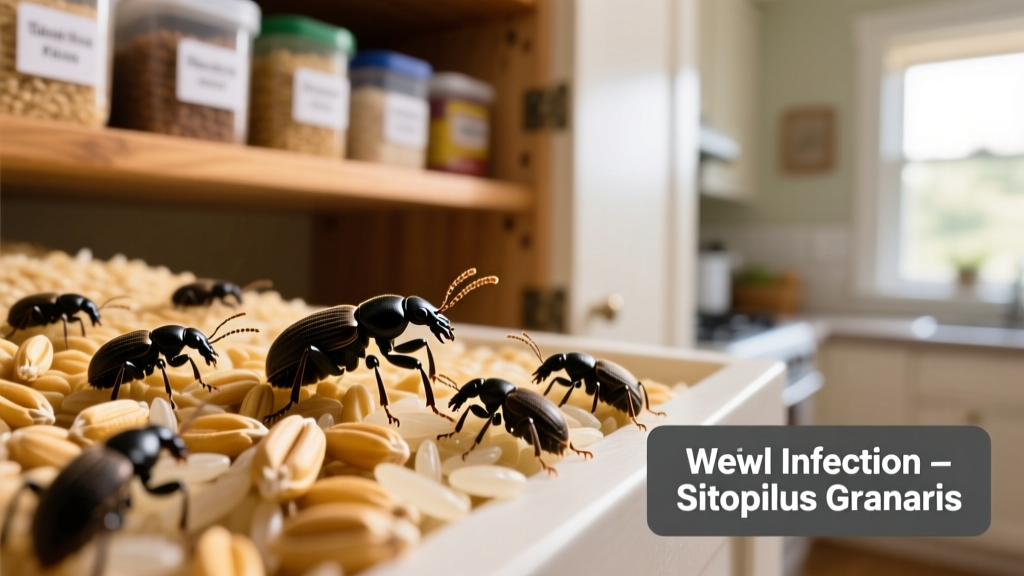
Granary weevils (Sitophilus granarius) and rice weevils (Sitophilus oryzae) are tiny, snout-nosed beetles that infest stored grains, flour, cereal, and pet food—often going unnoticed until you see them crawling or find hollowed-out kernels. They don’t bite or spread disease, but they contaminate food with feces, cast skins, and frass—and a single female can lay up to 400 eggs over her 8-month lifespan (U.S. Department of Agriculture, Agricultural Handbook No. 651, 2022).
Identification
Weevils in grain are often mistaken for flour mites or Indian meal moths—but their physical traits and damage patterns are distinct. Adult granary weevils are 2–3 mm long, reddish-brown to black, with a pronounced curved snout and elbowed antennae. They cannot fly. Rice weevils are similar but have four light-colored spots on their wing covers and *can* fly.
| Pest | Size & Color | Flying Ability | Primary Signs |
|---|---|---|---|
| Granary weevil | 2–3 mm, dark brown/black | No | Hollowed whole grains; no webbing |
| Rice weevil | 2–3 mm, reddish-brown with 4 pale spots | Yes | Small holes in kernels; live adults visible in bins |
| Indian meal moth | Larvae: ½ inch, pinkish-white; adults: ⅝ inch, copper-and-gray wings | Yes | Silky webbing, clumped grains, cocoons in corners |
| Flour beetle | 3–4 mm, reddish-brown, oval, no snout | No | Infests already-ground products; no holes in whole grains |
Look closely inside open bags of rice, oats, or birdseed—you’ll often spot adults scurrying when disturbed, or tiny exit holes in intact kernels. A flashlight and magnifying glass help confirm snouts and leg structure.
What Attracts Them
Weevils don’t invade from outdoors. They enter homes hidden inside infested products purchased from stores or mills—especially bulk grains, cracked corn, or imported rice with poor post-harvest controls. Once inside, they thrive where humidity stays above 60% and temperatures hover between 70–85°F.
- Unsealed cardboard boxes or thin plastic bags (they chew through both)
- Warm pantries near stoves or dishwashers
- Old stock—grains stored longer than 3 months increase risk
- Crumbs or spilled grain behind shelves or in cabinet crevices
According to Purdue University’s Stored Product Pest Management Guide (2023), 68% of residential weevil infestations originate from newly purchased dry goods—not structural entry.
Treatment Methods
Natural Methods
Start non-toxic: discard all infested items in sealed outdoor trash (not your kitchen bin). Then deep-clean cabinets with hot soapy water and vinegar—pay special attention to seams, drawer tracks, and shelf brackets where eggs hide.
- Freeze unopened grain packages at 0°F for 4 days to kill all life stages
- Heat-treat small batches in oven at 130°F for 30 minutes (monitor closely—don’t scorch)
- Store future grains in rigid, airtight containers: glass jars with rubber gaskets or #5 HDPE buckets with gamma seals
Chemical Options
Residual insecticides are rarely needed indoors—and never applied directly to food. If heavy infestation persists in wall voids or behind appliances, use only EPA-registered aerosol insect growth regulators (IGRs) like methoprene (e.g., Gentrol IGR), which disrupt larval development without neurotoxicity.
"Never spray pesticides inside food storage areas. Even low-toxicity IGRs must be applied to non-food surfaces only—and always follow label directions for ventilation and re-entry time." — Dr. Linda Mason, Entomologist, Purdue Extension, 2022
Prevention
Prevent recurrence with strict rotation and barrier control. Label every grain container with purchase date and use a "first-in, first-out" system. Buy smaller quantities of whole grains—especially wheat berries, millet, and popcorn—since they’re most vulnerable.
- Inspect new grain packages for pinprick holes or dustiness before bringing them home
- Transfer bulk purchases immediately into clean, disinfected airtight containers
- Vacuum pantry shelves monthly with a HEPA-filter vacuum—then wipe with 70% isopropyl alcohol
- Keep humidity below 55% using a dehumidifier or exhaust fan in humid climates
For long-term storage, add 1–2 bay leaves per gallon container—they deter adult weevils but won’t kill eggs or larvae. Pair with pantry pest prevention strategies for layered defense.
When to Call an Exterminator
Call a licensed pest management professional if you find weevils in *three or more separate food categories* (e.g., flour, birdseed, and dried beans) *after* thorough cleaning and disposal—or if you spot adults emerging from wall outlets, baseboards, or ceiling fixtures. That suggests breeding in inaccessible voids, not just contaminated groceries.
Most reputable firms use targeted heat treatments or controlled nitrogen atmospheres for grain storage facilities—but for homes, they’ll focus on source elimination and sealing entry points near plumbing or electrical conduits. Ask about their experience with stored product pests, not just general “kitchen bugs.”
Can weevils get into sealed plastic bags?
Yes—granary and rice weevils chew through polyethylene bags under 4 mil thickness. That’s why store-brand rice in thin plastic often arrives pre-infested. Always transfer to rigid containers upon purchase.
Are weevils harmful if eaten?
No known pathogens are carried by grain weevils, and accidental ingestion poses no health risk—though it’s understandably unsettling. The FDA allows up to 75 insect fragments per 50g of wheat flour (FDA Defect Levels Handbook, 2021), but visible adults mean contamination has progressed beyond acceptable thresholds.
Do weevils multiply in sugar or salt?
No. They require starchy, protein-rich substrates like whole grains, legumes, nuts, and cereals. Sugar, salt, baking soda, and dried herbs are safe—unless mixed with flour or grain dust.
How fast do weevils spread between cabinets?
Adults walk slowly—about 1 foot per minute—but can travel up to 10 feet overnight seeking new food sources. Most movement happens at night or in darkness. Infestations typically expand within 2–3 weeks if unchecked.
Can cold weather kill weevils in my garage storage?
Only sustained sub-zero temps for 5+ days reliably kill all life stages. Garage temperatures fluctuate—so even if it hits 20°F for a few hours, eggs may survive in insulated packaging. Freezing in a chest freezer is far more reliable.
Why do I keep finding them after cleaning?
You’re likely missing pupal cases glued to cabinet hinges or larvae inside unopened boxes of pasta or cereal. Check *every* dry good—even spice blends with rice flour fillers—and inspect pet food, birdseed, and craft supplies like dried beans used in sensory bins.
Weevils aren’t a sign of poor hygiene—they’re a supply-chain issue that lands in your pantry. With consistent inspection, proper storage, and prompt action at first sighting, you can break the cycle in under two weeks. For ongoing protection, pair physical barriers with regular audits—and consider adding pantry pest monitoring traps near high-risk zones like the cereal cabinet or pet food station.