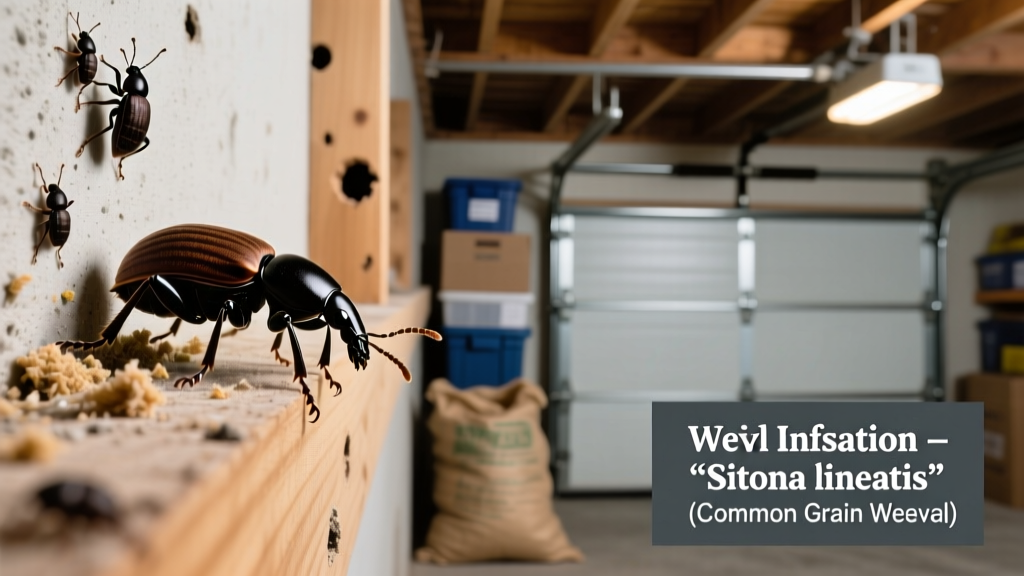
Weevils are small, beetle-like insects—most under 1/4 inch—with distinctive snouts and bent antennae. In garages, they’re rarely biting or harmful to humans, but they signal serious food or plant material infestations—and can chew through cardboard, paper, and thin plastic packaging. Left unchecked, a few weevils can become hundreds within weeks, especially near stored grains, birdseed, pet food, or dried herbs.
Identification
Weevils in garages are usually granary, rice, or drugstore beetles—but all share key traits: dark brown to black coloration, oval bodies, and that unmistakable curved snout. You’ll spot them crawling slowly along concrete floors, inside open bags, or clustered near baseboards at dusk. Unlike pantry moths, they don’t fly; unlike ants, they don’t trail. Their presence almost always means an infested food source is nearby—even if it’s sealed in a container with microscopic gaps.
| Species | Size | Key Features | Typical Source |
|---|---|---|---|
| Granary Weevil (Sitophilus granarius) | 2–3 mm | No wings; deep reddish-brown; elongated snout | Whole grains (wheat, corn, oats) |
| Rice Weevil (Sitophilus oryzae) | 2–3.5 mm | Faint reddish spots on wing covers; weak flier | Rice, pasta, cereal, birdseed |
| Drugstore Beetle (Stegobium paniceum) | 2–3 mm | Uniform brown; grooved wing covers; strong flier | Dried herbs, spices, supplements, potpourri |
What Attracts Them
Weevils don’t wander in from outdoors for no reason—they follow scent trails of starches and oils. Your garage becomes a magnet when it stores unsealed or expired dry goods, especially in warm, humid conditions (above 70°F and 60% RH). Cardboard boxes, canvas totes, and reused plastic bins are prime hiding spots: they offer shelter, moisture retention, and easy access to food residues.
- Birdseed spilled near feeders or storage bins
- Pet food left in non-airtight containers
- Old holiday decorations packed with dried fruit or nuts
- Unused craft supplies like flour-based glue or homemade playdough
Treatment Methods
Natural Methods
Start with sanitation and physical removal. Vacuum every crack and crevice using a shop vac with a HEPA filter—dispose of the bag outside immediately. Freeze suspect items at 0°F for 4 days to kill eggs and adults (per University of Kentucky Entomology’s 2022 pest protocol). Diatomaceous earth (food-grade) applied as a 1/8-inch band along baseboards disrupts their waxy cuticle—reapply after sweeping or damp mopping.
Chemical Options
If natural methods stall after 10–14 days, consider targeted treatments. Pyrethrin-based aerosols (like CB-80) work well for spot-killing adults on surfaces—but avoid spraying near food prep zones or HVAC intakes. For long-term residual control, use boric acid dust (0.5% concentration) only in inaccessible voids behind shelves or under cabinets—not where children or pets can contact it. The U.S. EPA notes that improper application of boric acid increases inhalation risk by 300% in enclosed spaces like garages (EPA Pesticide Fact Sheet, 2021).
"Weevils reproduce fastest in temperatures between 75–85°F—so turning down your garage heater by 5°F during winter storage months cuts development time in half." — Dr. Lena Cho, Urban Entomologist, Purdue Extension (2023)
Prevention
Prevention hinges on breaking the breeding cycle before it starts. Replace cardboard boxes with hard-sided, latching plastic totes labeled with purchase dates. Store birdseed and pet food in metal or thick polyethylene containers with gasketed lids—test seals by submerging them briefly in water; bubbles mean air leaks. Keep garage humidity below 55% using a dehumidifier (especially in coastal or basement-adjacent garages), and inspect all new dry goods for pinprick holes before bringing them in.
- Wipe down shelves monthly with vinegar-water (1:1) to remove pheromone residue
- Rotate stored goods using “first-in, first-out” labeling
- Install door sweeps to block entry under garage doors
- Check insulation gaps near water heaters or HVAC units—these harbor warmth and dust
When to Call an Exterminator
Call a licensed pest professional if you find live weevils in >3 separate locations after 2 weeks of treatment—or if you discover larvae (tiny, C-shaped, cream-colored grubs) inside sealed packages. These indicate deep infestation requiring thermal or CO₂ fumigation, which isn’t DIY-safe. Also call if you spot evidence in attached living spaces (e.g., kitchen pantry or laundry room), suggesting migration beyond the garage.
Can weevils damage garage structures?
No—they don’t chew wood, drywall, or wiring. Their mouthparts are designed for soft plant tissue and grain kernels. Any structural concern is likely misidentification: carpenter ants or powderpost beetles cause actual damage.
Do weevils lay eggs in concrete cracks?
Rarely. They prefer organic substrates—egg-laying occurs almost exclusively inside food sources. However, adult weevils will hide in hairline cracks to avoid light, so sealing those gaps helps reduce daytime visibility.
Will cold weather kill weevils in my garage?
Only if sustained below 20°F for 7+ days. Most garages hover above freezing even in winter—especially if attached to homes. Don’t rely on seasonal cold; active management is required.
Are weevils attracted to LED lights?
No. Unlike moths or flies, weevils aren’t phototactic. If you see them near fixtures, they’re likely following heat gradients or crawling along walls toward warmer zones.
Can I reuse infested containers after cleaning?
Yes—if thoroughly washed with hot soapy water, scrubbed with a stiff brush, then soaked in boiling water for 5 minutes. Discard any container with visible pitting, warping, or lingering odor.
Do weevils carry diseases?
No known human pathogens. The CDC has no recorded cases of disease transmission from weevils (CDC Arthropod-Borne Disease Surveillance Report, 2020). Their main risk is contamination and spoilage of consumables.
Garages are often overlooked as pest incubators—but they’re ground zero for many pantry invaders. Fixing a weevil problem here doesn’t just clear bugs; it protects your entire home’s food supply chain. Start with inspection and sealing, not sprays. For more on related pests, see our guides on pantry moths in garage and carpet beetles in garage.