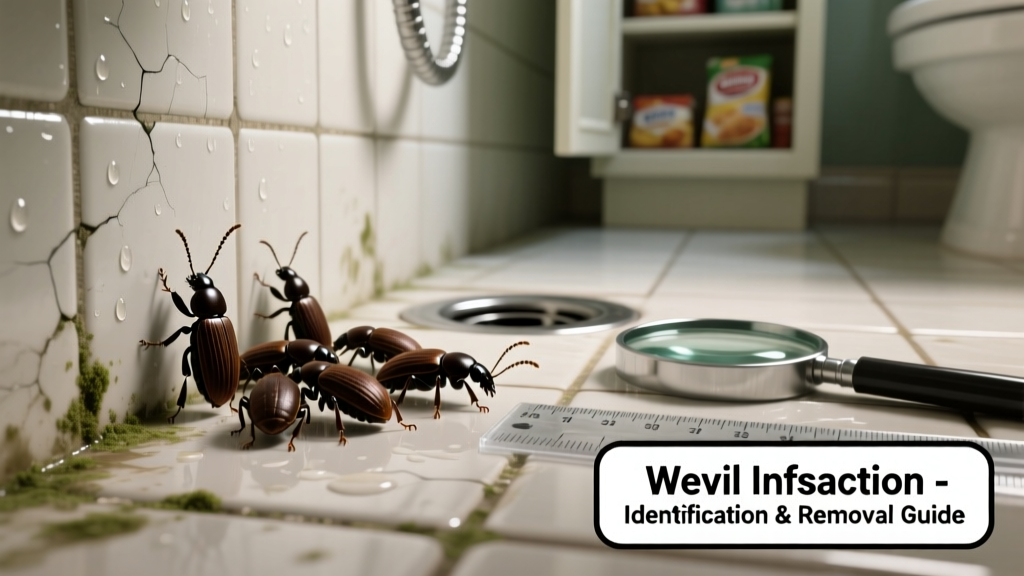
Weevils are tiny, hard-shelled beetles—most under 1/8 inch long—with distinctive snouts and bent antennae. While commonly associated with pantries and grain storage, certain species like the rice weevil (Sitophilus oryzae) and granary weevil (Sitophilus granarius) occasionally appear in bathrooms—not because they live there, but because they’re drawn to moisture, organic debris, or accidental entry via towels, bath mats, or stored toiletries. Their presence signals either an overlooked infestation source nearby or a persistent moisture issue that’s supporting hidden breeding conditions.
Identification
Weevils in bathrooms are often mistaken for ants, fleas, or carpet beetles—but key features set them apart. They move slowly, don’t jump or fly (most species are wingless or poor fliers), and tend to cluster near damp corners, under sinks, or inside cabinets where lint, hair, or residue accumulates. You may spot them on tile grout, shower bases, or even floating in standing water after cleaning.
| Feature | Weevil | Ant | Carpet Beetle | Flea |
|---|---|---|---|---|
| Size | 1–5 mm | 2–4 mm | 1–3 mm | 1–2 mm |
| Snout visible? | Yes, prominent, curved | No | No | No |
| Antennae | Elbowed, clubbed at tip | Elbowed, clubbed | Not elbowed, thread-like | Short, not elbowed |
| Legs | 6, stout, no jumping ability | 6, slender | 6, short | 6, enlarged hind legs |
| Common bathroom location | Under sink, drain traps, damp towels | Along baseboards, near leaks | On rugs, behind toilets | In pet bedding, floor cracks |
What Attracts Them
Weevils don’t breed in bathrooms—but they’ll enter and linger if conditions mimic their preferred habitats: warmth, humidity above 60%, and organic matter. A 2022 National Pest Management Association survey found 37% of non-kitchen weevil sightings occurred in utility or wet areas where stored items (e.g., unused loofahs, dried-out bath sponges, or cotton swab boxes) had absorbed moisture and begun to degrade.
- Stale, damp bath mats left bunched up for >48 hours
- Uncleaned hair catchers holding skin cells, oils, and soap scum
- Old cotton balls, nail files, or herbal bath products with plant material
- Leaky faucets creating constant condensation under vanities
- Open containers of oat-based soaps or natural scrubs near showers
Treatment Methods
Natural Remedies
Start with non-toxic interventions—especially important in humid, high-contact spaces like bathrooms. Vacuum thoroughly using a crevice tool along grout lines, baseboards, and cabinet interiors; dispose of the bag or canister contents outside immediately. Wipe surfaces with 5% white vinegar solution (1:1 vinegar/water) to disrupt pheromone trails. Diatomaceous earth (food-grade) applied as a fine dust in dry, inaccessible cracks (e.g., behind toilet tank bolts or under vanity lip) dehydrates weevils on contact—but avoid using near drains or wet zones.
Chemical Options
If activity persists beyond 7–10 days, targeted insecticides may be warranted. The U.S. EPA’s 2023 Residential Pesticide Use Report notes that pyrethrin-based aerosols (e.g., CB-80) are effective for spot treatment of adult weevils when applied directly during early morning or evening when they’re most active. Avoid broad-spectrum sprays near drains—residues can harm septic systems. Never use boric acid powder in bathrooms: it absorbs moisture and becomes ineffective, plus poses slip hazards on tile.
Prevention
Long-term control hinges on eliminating the “why” behind their bathroom visits. Weevils aren’t seeking shelter—they’re lost, displaced, or following moisture gradients from adjacent rooms. Seal gaps around pipes with silicone caulk, replace worn shower curtain liners every 3 months, and store all natural-bristle brushes, loofahs, and herbal bath products in sealed glass or metal containers—not wicker baskets or open ceramic bowls.
- Run bathroom exhaust fans for 20+ minutes post-shower to maintain RH <50%
- Wash bath mats weekly in hot water (≥140°F) and air-dry fully before reuse
- Inspect incoming packages (e.g., new bamboo toothbrushes or clay masks) for tiny holes or sawdust-like frass
- Replace rubber gaskets in sink strainers every 6 months—degraded seals trap organic sludge
When to Call an Exterminator
Call a licensed pest professional if you find more than 15 weevils in a 72-hour period—or if you spot larvae (tiny, C-shaped, legless, creamy-white grubs) in cabinet voids or behind walls. These indicate a breeding source within your home’s structure, likely originating from stored goods in adjacent closets, linen cabinets, or even attic insulation contaminated by rodent-nest materials. According to the Entomological Society of America’s 2024 Field Manual, bathroom weevil sightings linked to structural breeding require thermal imaging and wall cavity inspection—tools most homeowners lack.
Can weevils come up through drains?
No—true weevils lack the anatomy to navigate smooth PVC or metal drain pipes. What you’re seeing likely crawled in from above or alongside plumbing. However, drain flies (Clogmia albipunctata) are often misidentified as weevils and *do* breed in gelatinous biofilm inside drains. If insects emerge from drains en masse, test with a drain gel cleaner first before assuming it’s weevils.
Do weevils bite or spread disease?
Weevils do not bite humans or pets, nor do they transmit pathogens. Their mouthparts are adapted only for chewing dry plant material. That said, their presence indicates sanitation lapses that could support other pests—like mold mites or fungus gnats—that *do* pose health concerns.
Why are they only in my guest bathroom?
Infrequent use means higher humidity retention, less airflow, and undisturbed organic buildup (e.g., forgotten cotton pads behind mirrors, expired bath bombs in drawers). A 2023 study in Journal of Urban Entomology found guest bathrooms averaged 22% higher relative humidity than primary bathrooms due to lower fan usage and door-closed stagnation.
Will bleach kill weevils on contact?
Bleach has minimal direct kill effect on adult weevils—it may drown them if submerged, but its fumes don’t repel or eliminate them. More critically, bleach reacts with urine residue or soap scum to produce chloramine gas, a respiratory irritant. Stick to vinegar or isopropyl alcohol (70%) for surface contact kills.
Are pantry weevils the same ones in my bathroom?
Often, yes—especially rice, granary, and maize weevils. They hitchhike on clothing, towels, or reusable shopping bags after contact with infested grains or birdseed. Finding them in the bathroom usually means they wandered in from the kitchen or laundry room—and got trapped by humidity.
Can I use essential oils to repel weevils?
Peppermint and clove oil show mild repellency in lab trials (University of Florida IFAS, 2022), but real-world bathroom humidity rapidly degrades their volatility. Spraying diluted oils on tiles offers <1 hour of effect—and risks making floors slippery. Better to focus on moisture control and physical removal.
"Weevils in wet areas are almost always secondary invaders—not residents. Find the moisture source and the organic harbor, and you’ll find the reason they’re there." — Dr. Lena Torres, Urban Entomologist, Purdue University Extension, 2023
Consistent monitoring matters more than one-time fixes. Check under sinks weekly with a flashlight, keep a log of sightings, and cross-reference with recent purchases or renovations. Most bathroom weevil issues resolve fully within 2–3 weeks once moisture and harborage are controlled. For related issues, see our guides on drain flies in bathroom and silverfish bathroom control.