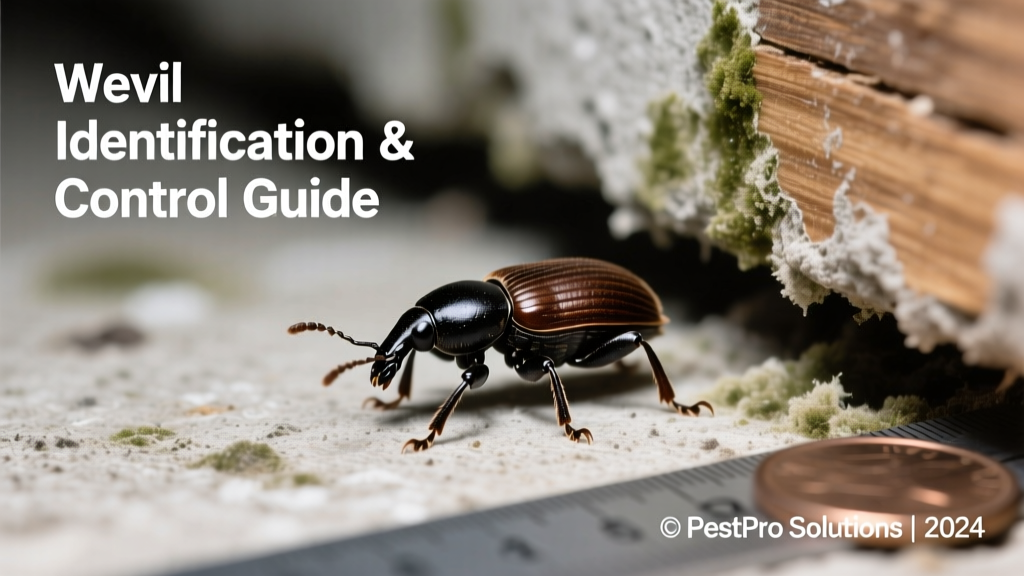
Weevils in your basement aren’t just a nuisance—they’re a red flag for moisture issues and overlooked food storage problems. These small, snout-nosed beetles (Curculionidae family) rarely bite or damage structures, but they infest stored grains, flour, cereal, and pet food—and thrive where humidity lingers and organic debris collects.
Identification
Weevils are typically 1/16" to 1/8" long, dark brown to black, with a distinctive curved snout and elbowed antennae. You’ll spot them crawling—not flying—on basement floors, near sump pumps, or inside open pantry boxes stored on shelves or cardboard bins.
| Pest | Size & Color | Key Feature | Typical Location |
|---|---|---|---|
| Granary Weevil | ~1/8", reddish-brown | No wings; cannot fly; smooth, oval body | Inside grain bags, flour canisters |
| Rice Weevil | ~1/8", reddish with four light spots | Faint wing covers; weak flier | Loose cereal, birdseed, pasta boxes |
| Drugstore Beetle | ~1/8", reddish-brown | Striped wing covers; strong flier | Old spices, dried herbs, supplements |
| Carpet Beetle Larva | ~1/8"–1/4", hairy, rusty-brown | Woolly, segmented body; no snout | Under baseboards, behind furniture |
Signs of infestation include tiny holes in packaging, fine dust (frass) near food containers, and live adults scurrying when lights flip on at night.
What Attracts Them
Weevils don’t wander in from outside for fun—they follow food and moisture. Basements attract them because:
- Relative humidity often exceeds 60%, especially near foundation walls or sump pits;
- Stored dry goods (flour, oats, cornmeal, pet food) sit unsealed on concrete floors or in cardboard boxes;
- Old, forgotten items—like holiday baking supplies or camping rations—provide multi-month breeding grounds;
- Cracks in foundation walls or gaps around utility lines let in occasional adults from nearby soil or adjacent crawl spaces.
According to Purdue University’s Extension Entomology report (2022), over 73% of residential weevil infestations originate from pre-infested pantry items purchased months earlier—then activated by basement warmth and humidity.
Treatment Methods
Natural Methods
Start here—especially if you store food in bulk or have children or pets. Freeze infested items at 0°F for 4 days to kill eggs and larvae. Discard anything with visible webbing, holes, or live adults. Clean shelves with vinegar-water (1:1) to remove pheromone trails.
- Place bay leaves or whole cloves in grain containers (repels adults but doesn’t kill eggs);
- Vacuum cracks along baseboards and under shelves using a crevice tool—immediately seal and discard the bag;
- Use diatomaceous earth (food-grade) in wall voids or behind shelving—only where kids/pets won’t contact it.
Chemical Options
Reserve these for persistent hotspots—never apply directly to food areas. The U.S. EPA permits pyrethrin-based aerosols (e.g., CB-80) for crack-and-crevice treatment in unfinished basements. Always ventilate during and after use.
- DeltaDust (deltamethrin) applied in wall voids via bulb duster—lasts up to 8 months indoors;
- Phantom Termiticide (chlorfenapyr) for non-food-zone perimeter treatment—low odor, delayed action disrupts egg development;
- Avoid foggers: they scatter weevils deeper into wall cavities and rarely reach larval nests in food debris.
Prevention
Basement prevention is about controlling two variables: moisture and access. Install a dehumidifier set to 50% RH—studies show weevil development slows sharply below that threshold (University of Florida IFAS, 2021). Store all dry goods in rigid, clear plastic containers with gasket seals—not glass jars (they lack air-tight lids) or re-used coffee cans (threads trap eggs).
"Weevils rarely breed in basements unless food is present—but once established, they’ll cycle through 3–4 generations per year in warm, humid corners. Seal first, then store, then monitor." — Dr. Elena Ruiz, Stored Product Entomologist, Kansas State University Grain Science Department, 2023
Inspect new groceries before bringing them downstairs. Rotate stock using “first-in, first-out,” and wipe down container exteriors monthly with isopropyl alcohol to disrupt pheromone trails.
When to Call an Exterminator
Call a licensed pest professional if:
- You find live weevils in >3 separate locations across two consecutive weeks;
- Infestation persists after discarding all suspect food and deep-cleaning for 10 days;
- You spot larvae inside wall voids or behind built-in shelving—indicating hidden breeding;
- Your basement has chronic moisture intrusion (efflorescence, mold on joists) alongside the weevils.
Reputable providers will inspect for entry points, perform targeted dusting in inaccessible voids, and provide a moisture assessment—not just a spray-and-go service. Check credentials with your state’s Structural Pest Control Board.
Can weevils damage my home’s structure?
No. Weevils feed exclusively on plant-based materials—grains, seeds, nuts, and dried legumes. They do not chew wood, insulation, drywall, or wiring. If you see damage to structural elements, you’re likely dealing with carpenter ants, termites, or powderpost beetles instead. Learn more about carpenter ants in basement or termites in basement.
Do weevils come from the soil outside?
Sometimes—but rarely as a primary source. Most granary and rice weevils develop inside grain before it reaches your home. Outdoor species like the black vine weevil may enter through foundation cracks, but they target ornamental plants, not pantry goods. Focus first on stored products, not exterior barriers.
Why do I only see them at night?
Weevils are photophobic. They avoid light and become most active in darkness—especially between 10 p.m. and 3 a.m. Use this behavior to your advantage: turn on lights suddenly in suspected areas and watch for movement near floor-level cracks or food storage zones.
Can I salvage infested flour or cereal?
No—do not attempt to sift or heat-treat. Eggs and larvae embed deep in granular material, and some species produce toxins that persist after cooking. Discard everything in sealed plastic bags, then clean the container with boiling water and 70% isopropyl alcohol before reuse.
Will sealing basement windows stop weevils?
Not significantly. Weevils don’t fly well and rarely enter through upper openings. They crawl in through gaps around pipes, sump pump discharge lines, floor drains, or expansion joints in concrete slabs. Prioritize sealing those low-entry points first.
Are pantry moths and weevils related?
No—they’re biologically distinct. Moths (Plodia interpunctella) are Lepidoptera with wings and larvae that spin silk webbing. Weevils are beetles (Coleoptera) with hard shells and chewing mouthparts. Their control overlaps in sanitation, but treatments differ: pheromone traps work for moths, not weevils. See our guide on pantry moths in basement for comparison.
Controlling weevils in the basement isn’t about eradicating every last insect—it’s about disrupting their lifecycle where it begins: in overlooked food and unchecked humidity. Consistent monitoring, smart storage, and targeted moisture control yield better long-term results than reactive sprays. Keep a log of where you spot them weekly, and revisit your dehumidifier’s drainage line—it’s often the quietest source of sustained dampness feeding the problem.