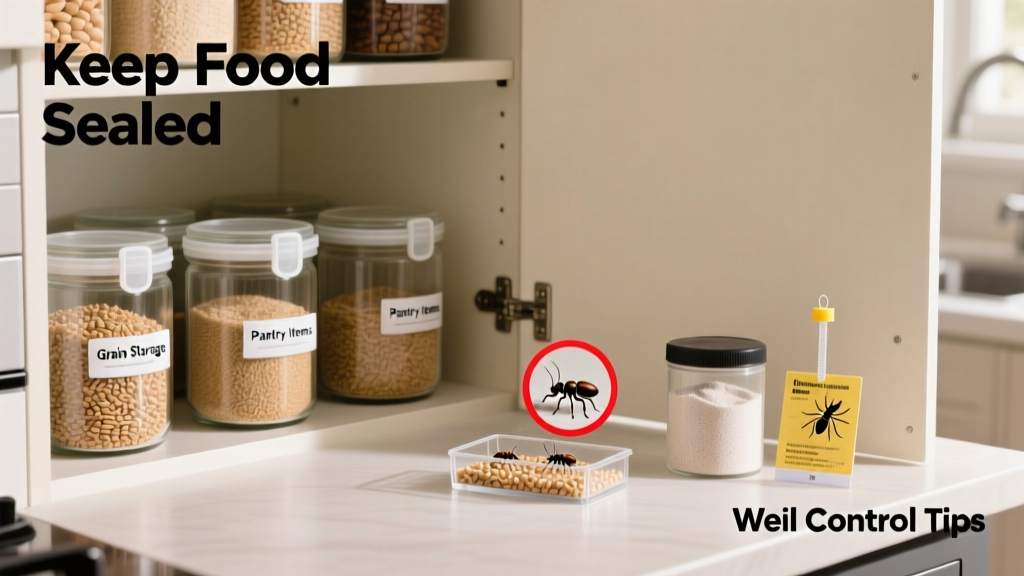
Weevils are tiny, beetle-like pantry pests—most commonly the granary weevil (Sitophilus granarius) and rice weevil (Sitophilus oryzae)—that infest whole grains, flour, pasta, nuts, and dried beans. They don’t bite or spread disease, but their presence ruins food, introduces contaminants, and signals deeper storage failures. Left unchecked, a single female can lay up to 400 eggs inside kernels over her 5–8 month lifespan (University of Florida IFAS Extension, 2022).
Identification
Weevils are 1/8-inch long, reddish-brown to black beetles with distinctive downward-curved snouts. Larvae are legless, creamy-white grubs that live entirely inside grain kernels—so you often won’t see them until adults emerge. Look for tiny holes in rice, wheat berries, or oat groats; flour that feels gritty or smells musty; or small beetles crawling on shelves at dawn.
| Pest | Size & Color | Key Features | Typical Food Sources |
|---|---|---|---|
| Weevils | 1/8"; brown/black | Hard shell, prominent snout, flightless (granary) or weak fliers (rice) | Whole grains, beans, seeds, nuts |
| Moths (Indian meal moth) | 3/8"; copper/tan wings | Flying adults, silky webbing in food | Flour, cereal, chocolate, dried fruit |
| Drugstore beetles | 1/8"; reddish-brown | Smooth, oval body; no snout; strong fliers | Potato chips, spices, pet food, supplements |
| Spider beetles | 1/16–1/8"; shiny red/brown | Arched back, long legs, resemble tiny spiders | Dry pet food, old paper, birdseed, rodent droppings |
What Attracts Them
Weevils don’t wander in from outside—they hitchhike into homes inside infested grocery items. Once indoors, they thrive in warm (70–85°F), low-humidity environments with undisturbed dry goods. Bulk bins at co-ops or discount stores pose higher risk: a 2021 FDA retail inspection found weevil contamination in 12% of unpackaged grain samples tested across 8 states.
- Unsealed or cardboard-packaged grains (especially imported rice, wheat berries, or lentils)
- Storage areas above 70°F and below 60% RH—ideal for egg development
- Cabinets near heat sources (ovens, dishwashers, HVAC vents)
- Old stock: products stored >6 months increase infestation likelihood by 3x (Pest Control Technology Magazine, 2023)
Treatment Methods
Natural Methods
Start here—especially if you have children, pets, or prefer non-toxic solutions. Discard all infested items in sealed outdoor trash (never compost). Then deep-clean: vacuum shelf cracks with a crevice tool, wipe surfaces with vinegar-water (1:1), and freeze suspect unopened packages for 4 days at 0°F to kill eggs and larvae.
- Bay leaves: Place 2–3 dried leaves per container—eugenol deters adult weevils (but doesn’t kill eggs)
- Food-grade diatomaceous earth (DE): Dust lightly on shelf corners and behind appliances; dehydrates adults on contact
- Freeze new bulk purchases for 96 hours before transferring to containers
Chemical Options
Reserve these for persistent cases where sanitation fails. Never apply pesticides directly to food or food prep surfaces. The U.S. EPA allows pyrethrins (derived from chrysanthemums) and synergized pyrethroids like deltamethrin for crack-and-crevice treatment only.
Always follow label instructions precisely—and never use foggers in pantries. According to the National Pesticide Information Center (2023), improper use of residual sprays caused 62% of reported pantry pesticide incidents last year.
"If you’re seeing more than 5–6 adult weevils in one week, assume every grain product in your kitchen is compromised—even sealed bags. Replace everything, then clean and monitor for 10 days." — Dr. Lena Cho, Entomologist, UC Riverside Stored Product Pest Lab, 2022
Prevention
Prevention hinges on three rules: inspect, isolate, rotate. Buy smaller quantities of whole grains, especially during summer months. Transfer all dry goods into rigid, smooth-sided containers with airtight gaskets—not screw-top jars with rubber seals, which weevils can squeeze through.
- Label containers with purchase date; use FIFO (first-in, first-out) rotation
- Store grains below 60°F when possible—pantry refrigeration works for oats, barley, and rye
- Wipe down container exteriors before returning to shelves to remove stray eggs
- Inspect new purchases under bright light: look for pinprick holes or faint dusting (frass) around seams
When to Call an Exterminator
Most weevil issues are self-contained—but call a licensed pest management professional if you find adults in wall voids, ceiling tiles, or behind baseboards. That indicates breeding colonies beyond pantry items. Also consult one if traps catch >20 weevils/day for 3 consecutive days, or if you’ve repeated full sanitation twice with no reduction.
Look for firms certified in stored product pest control, not general home pest services. Their technicians use pheromone traps, thermal imaging for hidden hotspots, and targeted aerosol treatments approved for food-handling facilities.
Can weevils get into sealed plastic bags?
Yes—especially thin polyethylene bags. Granary weevils chew through packaging; rice weevils may exploit micro-tears or imperfect seals. Always transfer bulk items to hard-sided containers within 24 hours of purchase.
Are weevils harmful if eaten?
No known human illness results from accidental ingestion. The FDA permits up to 75 insect fragments per 50g of wheat flour (2023 Defect Action Levels). Still, discard visibly infested food—it’s degraded nutritionally and may harbor mold spores from larval activity.
Do weevils fly?
Rice and maize weevils can fly short distances, especially toward light or warmth. Granary weevils are wingless and cannot fly—so finding flying beetles narrows it to S. oryzae or S. zeamais. Check window sills and lampshades at dusk.
Why do I keep finding them after cleaning?
Larvae develop inside intact kernels for 3–5 weeks before emerging as adults. If you cleaned but didn’t discard all suspect food, new adults will continue hatching. Monitor with sticky traps for 21 days post-cleanup—the full lifecycle duration.
Can cold weather kill weevils?
Freezing at 0°F for ≥4 days kills all life stages. Refrigeration (32–40°F) only slows development—it does not stop eggs or pupae. For long-term storage, consider vacuum-sealed freezing of heirloom seeds or bulk grains.
Do ultrasonic devices work against weevils?
No peer-reviewed study supports efficacy. The FTC issued warnings in 2022 to three manufacturers for unsubstantiated claims. Save your money—focus instead on physical exclusion and temperature control.
Weevils test your attention to detail—not your home’s cleanliness. A single overlooked bag of cracked wheat can seed a months-long cycle. Stay vigilant at the grocery aisle, ruthless with expiration dates, and consistent with your container system. For more on protecting stored foods, see our guide on common pantry pests and how to tell weevils from flour mites.