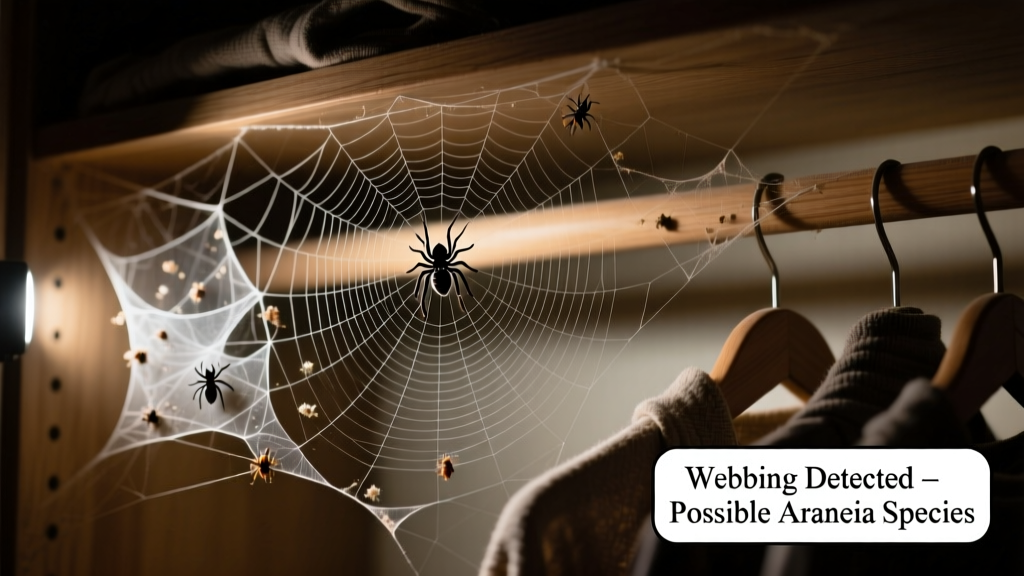
Webbing in your closet isn’t just unsightly—it’s a red flag that something is feeding on natural fibers, spinning silk, or nesting where your wool sweaters and cashmere scarves live. Left unchecked, these pests can destroy hundreds of dollars in clothing, upholstery, and stored textiles in weeks.
Identification
Closet webbing most commonly comes from one of three culprits: webbing clothes moth larvae, carpet beetle larvae (which don’t spin webs but leave silken trails), or harmless spiders seeking shelter. Visual clues matter—size, location, texture, and associated damage tell the real story.
| Pest | Web Appearance | Associated Damage | Size & Color |
|---|---|---|---|
| Webbing clothes moth (Tineola bisselliella) | Thin, irregular silk tubes or mats; often mixed with frass and shed skins | Holes in wool, fur, feathers, or silk—especially along seams or folds | Larvae: ¼" long, creamy white with brown head; adults: pale beige, ⅜" wingspan, avoid light |
| Carpet beetle larvae (Anthrenus spp.) | No true web—but leave sticky, silken drag-lines and molted skins near damage | Irregular notches or bare patches on wool rugs, taxidermy, or stored furs | Larvae: ¼–⅜" long, oval, bristly, brown-to-black with alternating light/dark bands |
| Common house spider (Parasteatoda tepidariorum) | Loose, tangled, 3D cobwebs in corners or behind shelves—not on clothing | No fabric damage; may see live spiders or egg sacs (tan, papery, ~¼") | Adults: ¼–⅜" body, brownish with leg banding; non-aggressive |
Pro tip: Shine a flashlight at a low angle across hanging garments—if you spot tiny moving specks inside silk tunnels or hear faint scratching when pressing fabric, it’s almost certainly clothes moth larvae.
What Attracts Them
Closets offer ideal conditions for textile pests: darkness, low airflow, stable temperatures (65–80°F), and abundant food sources. Moths and beetles don’t target clean clothes—they’re drawn to organic residues like human sweat, skin cells, food stains, or pet dander embedded in fibers.
- Wool, cashmere, alpaca, feathers, fur, and silk are prime targets—synthetics alone won’t support infestation
- Cluttered closets with cardboard boxes, old luggage, or unused seasonal clothing create undisturbed breeding zones
- High humidity (>60% RH) encourages larval survival; basements and ground-floor closets are higher risk
Treatment Methods
Natural Methods
Start here if infestation is light (≤3 damaged items, no visible larvae on hangers). Vacuum thoroughly—including shelf cracks, baseboards, and behind rods—then freeze suspect items at 0°F for 72 hours. Wash washables in hot water (120°F+) for 30 minutes. Cedar blocks and lavender sachets repel adult moths but do not kill eggs or larvae—they’re deterrents only.
Chemical Methods
For confirmed moth larvae, use targeted insect growth regulators (IGRs) like nylon or pyriproxyfen applied as aerosol sprays to closet interiors (not clothing). According to the National Pesticide Information Center’s 2022 review, IGRs disrupt larval development without harming humans or pets when used as directed. Avoid broad-spectrum pyrethrins unless combined with an IGR—adult moths will return within days otherwise.
Prevention
Prevention hinges on breaking the life cycle: deny access, remove food, and monitor. Store off-season woolens in airtight plastic bins—not dry-clean bags or cedar chests (moths chew through both). Clean all items before storage—even "just worn once" pieces carry skin oils.
- Inspect new secondhand clothing, rugs, or taxidermy under bright light before bringing indoors
- Rotate closet contents every 4–6 weeks to disrupt hidden development
- Install pheromone traps like Trapper Monitor Clothes Moth Traps year-round—replace every 3 months
- Use a hygrometer to keep closet humidity below 50%; consider a small desiccant pack in enclosed bins
When to Call an Exterminator
Call a licensed pest professional if you find webbing on ≥5 garments, live larvae in multiple locations, or recurring infestations despite 8+ weeks of consistent treatment. The Entomological Society of America notes that 68% of persistent clothes moth cases involve overlooked sources—like attic insulation contaminated with bird nests or wall voids harboring rodent carcasses.
"Closet webbing is rarely just a closet problem. We’ve traced infestations to HVAC ducts, behind baseboards, and even inside light fixtures—always inspect beyond the obvious." — Dr. Lena Cho, Urban Entomology Extension, UC Riverside, 2023
Can vacuuming alone eliminate clothes moths?
No. Vacuuming removes surface larvae and frass but misses eggs glued deep in fabric weaves and hidden crevices. Combine it with heat treatment or freezing—and always dispose of the vacuum bag immediately outdoors.
Do spiders in my closet mean I have a bigger pest problem?
Not necessarily. House spiders follow prey—so their presence may indicate flies, silverfish, or springtails in walls or drains. Check for moisture leaks and install door sweeps to reduce entry points. See our guide on silverfish in bathroom for related moisture control tips.
Why did my dry-cleaned sweater still get damaged?
Dry cleaning kills adults and larvae but doesn’t remove eggs, which hatch 4–10 days later. Always store cleaned items in sealed containers—not garment bags—and re-inspect after 2 weeks.
Are pantry moths causing closet webbing?
No. Indian meal moths (Plodia interpunctella) infest dried foods—not fabrics. Their webbing appears in cereal boxes or pet food, never on sweaters. Confusion arises because both are small, tan moths—but their biology and habitats don’t overlap.
Can I use mothballs safely in my closet?
Only if labeled for fabric protection and used in sealed containers. The U.S. EPA warns that naphthalene-based mothballs release toxic vapors that accumulate in poorly ventilated spaces—and pose risks to children and pets. Safer alternatives include diatomaceous earth in perimeter cracks or cold storage.
Will washing everything solve it?
Only if every infested item is washed at >120°F for ≥30 minutes—or dry-cleaned and immediately sealed. But laundering won’t touch eggs in baseboards, vents, or ceiling corners. Treat the environment, not just the clothes.
Webbing in your closet is rarely random—it’s a symptom of conditions that favor specific pests. Accurate ID saves time, money, and heirloom sweaters. If you’ve ruled out spiders and confirmed textile damage, start with freezing and pheromone monitoring—then scale up only if needed. For more on fabric-safe solutions, see our wool moth damage repair guide.