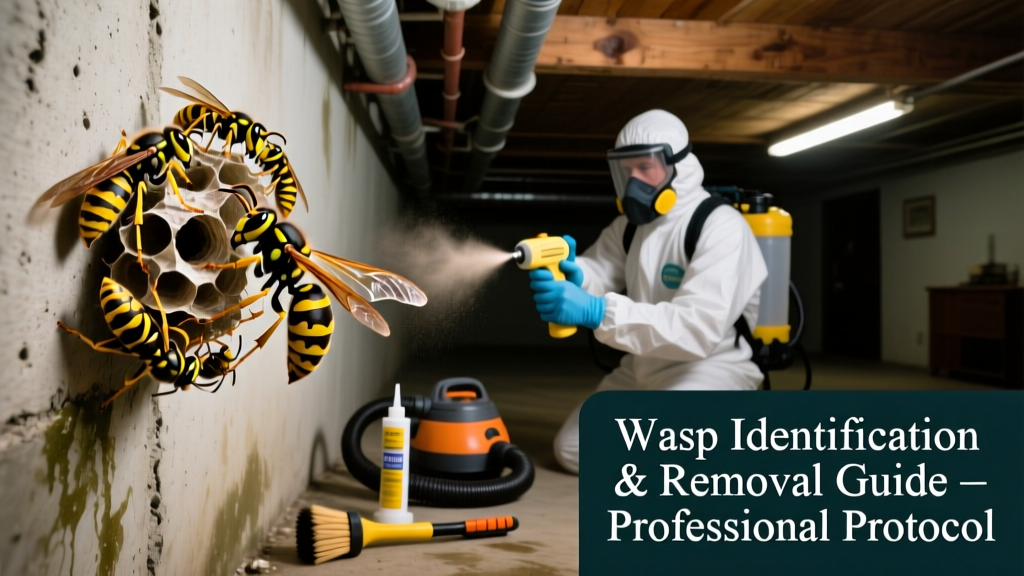
Wasps in the basement aren’t just a seasonal nuisance—they’re a sign of unchecked entry points, moisture issues, or undetected nests behind walls or under floor joists. Unlike bees, most wasps (especially paper wasps and yellow jackets) build nests from chewed wood pulp and can sting repeatedly. A single nest may house 100–5,000 individuals, and basements offer ideal shelter: stable temperatures, low light, and minimal disturbance.
Identification
Basement wasps are typically European paper wasps (Polistes dominula), eastern yellow jackets (Vespula maculifrons), or occasionally bald-faced hornets (Dolichovespula maculata). All share narrow waists, black-and-yellow (or black-and-white) banding, and smooth, non-hairy bodies—unlike fuzzy bumblebees.
Look for these signs:
- Steady, low-flying insects entering near cracks in foundation walls or around sump pump pits
- Papery, umbrella-shaped or football-shaped nests tucked into ceiling joists, behind drywall, or inside wall cavities
- Small piles of chewed wood fiber near baseboards or window wells
- Sudden increase in wasp activity near basement windows—even on cool days
| Species | Nest Location | Size & Shape | Aggression Level |
|---|---|---|---|
| European Paper Wasp | Exposed rafters, shelf brackets, furnace ducts | Open, single-comb, umbrella-like; 3–4 inches wide | Moderate—stings only if nest is touched |
| Eastern Yellow Jacket | Wall voids, floor joist cavities, under concrete slabs | Enclosed, multi-layered, football-shaped; up to 12 inches tall | High—defends nest aggressively within 10 feet |
| Bald-Faced Hornet | Corner of unfinished ceilings, soffits above basement stairs | Gray, football-shaped, papery envelope; 14–24 inches tall | Very high—swarms at first sign of threat |
What Attracts Them
Wasps don’t randomly choose basements. They follow cues: warmth, shelter, food, and nesting material. Basements often provide all three—especially if they’re damp, cluttered, or poorly sealed.
- Moisture: Leaky sump pumps, cracked foundation walls, and condensation create humid microclimates ideal for nest-building (wasps need water to make pulp)
- Entry points: Gaps >1/8” around pipes, vents, windows, or where foundation meets framing let them crawl in unnoticed
- Food sources: Pet food left overnight, uncovered trash, or even spider webs (wasps prey on spiders and other insects)
- Wood debris: Old cardboard boxes, scrap lumber, or untreated framing give them raw material to chew for nest construction
Treatment Methods
Natural Methods
For small, accessible nests (under 6 inches, not behind walls), try non-chemical approaches first—ideally at dusk or dawn when wasps are least active.
- Soapy water spray (1 tbsp dish soap + 1 cup water): Clogs spiracles and immobilizes wasps on contact. Spray directly into nest openings for 2–3 nights running.
- Vacuum removal: Use a shop vac with a 10-foot hose and a fine-mesh filter bag. Seal bag immediately and freeze for 48 hours before disposal.
- Citronella or peppermint oil sprays (10 drops oil + 1 cup water): Deterrent—not lethal—but effective near entry points when reapplied weekly.
Chemical Methods
Only use EPA-registered insecticides labeled for wasps *and* indoor use—never generic pyrethrins in enclosed spaces without ventilation. According to the U.S. EPA’s 2022 Pesticide Product Label System, aerosol wasp sprays containing cypermethrin or deltamethrin are safest for targeted nest treatment when applied from 15+ feet away.
Important: Never spray a live nest during daylight. Wait until full darkness, wear protective clothing (gloves, veil, long sleeves), and retreat immediately after application. Do not seal nest entrances until 48 hours post-treatment—wasps may chew new exits into living spaces.
"Yellow jacket nests in basements often go unnoticed for months because foragers enter and exit through tiny gaps. By the time you see 10+ wasps, the colony likely has 300+ workers." — Dr. Laurel T. Johnson, Entomologist, Penn State Extension (2023)
Prevention
Preventing reinfestation means sealing, drying, and monitoring—not just spraying. Focus on conditions wasps exploit.
- Seal all cracks >1/8” with silicone caulk or steel wool (wasps avoid steel wool due to texture and rust)
- Install tight-fitting, screened covers over sump pump pits and foundation vents
- Run a dehumidifier to keep basement humidity below 50%—wasps avoid dry air for nest-building
- Store firewood, cardboard, and lumber at least 20 feet from the foundation
- Inspect exterior foundation walls twice yearly using a flashlight—look for pencil-sized holes near grade level
When to Call an Exterminator
Hire a licensed pest management professional if:
- The nest is inside a wall void or under concrete (requires infrared inspection and drill-and-treat methods)
- You’ve had allergic reactions to stings—or anyone in the household has known Hymenoptera allergy
- You count more than 25 wasps entering/exiting daily (indicates mature colony >1,000 individuals)
- Previous DIY attempts failed or caused increased activity indoors
Reputable companies will inspect for secondary nests, treat with dust formulations (like deltamethrin dust) that travel through wall voids, and provide a 30-day warranty. Check credentials via pest control license verification.
Why do wasps nest in basements but not garages?
Basements maintain more stable temperatures year-round (typically 55–65°F), while garages fluctuate wildly. Wasps seek thermal consistency for brood development—especially yellow jackets, whose larvae won’t survive temps below 50°F for more than 48 hours. Also, basements often have hidden moisture sources garages lack.
Can wasps damage basement structure?
Not directly—but their nesting behavior can worsen existing problems. Wasps chew wood framing, insulation backing, and drywall paper to make pulp. Over time, repeated nesting in the same joist cavity weakens substrate integrity. More critically, moisture trapped behind nests accelerates mold growth and rot—see our guide on basement mold removal for related mitigation.
Are wasps in the basement active in winter?
In northern climates, most worker wasps die by late October. Queens hibernate in protected spots—including basement corners, behind baseboards, or in attic insulation. You might spot 1–2 sluggish wasps on warm winter days, but true colony activity resumes only in April–May. That’s why early-spring inspections are critical.
How long does it take to eliminate a basement wasp nest?
Small exposed nests respond to soapy water in 2–3 days. Enclosed yellow jacket nests require 5–7 days for full mortality—even with professional dust treatment—because workers must carry the insecticide back to larvae. Always monitor for activity for 10 days post-treatment before sealing entry points.
Do ultrasonic repellents work on basement wasps?
No. The Federal Trade Commission issued warnings in 2021 against ultrasonic devices claiming to repel wasps, citing “no credible scientific evidence” (FTC Consumer Alert, March 2021). These units emit frequencies outside wasps’ hearing range (they detect vibration, not sound) and have zero impact on nest behavior or foraging.
Can I reuse a vacated wasp nest?
No—and don’t try. Even empty nests retain pheromone residue that attracts new queens in spring. Plus, abandoned nests often harbor mites, mold spores, and frass (insect waste) that trigger allergies. Remove carefully with gloves and a mask, place in double-bagged trash, and disinfect the area with 10% bleach solution.
Basement wasps thrive where humans overlook detail: a hairline crack, a forgotten box of old lumber, a slow drip near the sump pump. Fix those, and you break the cycle—not just for this season, but for years. For persistent issues, pair your efforts with a basement inspection checklist to catch vulnerabilities before wasps do.