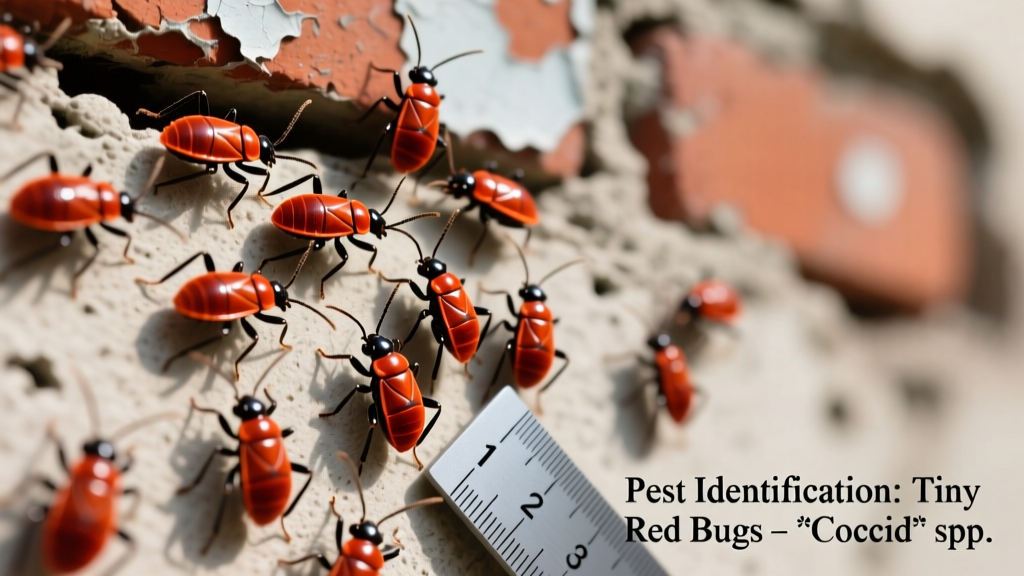
Tiny red bugs crawling up interior walls—especially near windows, baseboards, or sunlit corners—are rarely dangerous but almost always alarming. Most are not biting pests, yet their sudden appearance triggers panic. The real issue isn’t health risk—it’s misidentification leading to ineffective treatments (like spraying for bed bugs when it’s actually clover mites).
Identification
Three pests commonly mistaken for one another appear as tiny red specks on walls: clover mites, chiggers, and spider mites. Clover mites are the most frequent indoor intruder in spring and fall; chiggers rarely enter homes; spider mites stay on plants—but can hitchhike indoors on infested foliage.
| Pest | Size & Color | Legs | Common Location | Bites? |
|---|---|---|---|---|
| Clover mite | 0.75 mm, brick-red, oval, 8 legs (2 front legs longer, look like antennae) | 8 | South-facing walls, window sills, light-colored paint | No |
| Chigger | 0.2–0.4 mm, red-orange, round, 6 legs as larva (8 as adult) | 6 (larval stage only) | Grass, brush—rarely indoors unless on clothing or pets | Yes (itchy, delayed reaction) |
| Spider mite | 0.4 mm, red or green, oval, 8 legs | 8 | Houseplant leaves, undersides of foliage—not walls unless dislodged | No |
Confirm clover mites by pressing one with a white paper towel: they leave a red smear (hemolymph), not blood. Chiggers won’t survive >48 hours indoors. Spider mites leave fine webbing and stippled leaf damage.
What Attracts Them
Clover mites thrive where grass meets foundation—especially lawns over-fertilized with nitrogen. They’re phototactic (drawn to light) and heat-seeking, so south- and west-facing walls act as magnets in early spring and autumn. Cracks >0.1 mm wide let them inside; they don’t need food indoors—they’re just lost.
- Overgrown ivy or shrubs touching exterior walls
- Cracks in stucco, brick mortar, or vinyl siding seams
- Exterior lighting left on overnight near entry points
- Recent heavy rainfall followed by warm, dry days
According to the University of Nebraska-Lincoln Extension’s 2022 pest bulletin, 73% of clover mite complaints occur within 10 feet of foundation plantings or mulch beds.
Treatment Methods
Natural Control
Vacuuming with a crevice tool removes live mites instantly—discard the bag or empty the canister outdoors immediately. Diatomaceous earth (food-grade) applied in a 1/8-inch band along baseboards and window tracks dehydrates them in 24–48 hours. Wipe walls with damp microfiber cloth first to remove residue before applying.
- Trim grass and groundcover to 18 inches from foundation
- Seal gaps with silicone caulk (not acrylic—mites chew through)
- Use double-sided tape traps near window frames (replace daily)
Chemical Options
Pyrethroid sprays (e.g., bifenthrin or deltamethrin) applied as a perimeter barrier 2–3 feet up and 2 feet out from foundation reduce entry by 68%, per the Clover Mite Control Guide (Pest Management Professional, 2021). Indoor use is unnecessary—and discouraged. Never spray insecticides on windowsills where children or pets touch surfaces.
"Clover mites don’t reproduce indoors. If you see more than 20 in an hour, your barrier treatment has failed—or new cracks opened." — Dr. Elena Ruiz, Urban Entomologist, Rutgers NJAES, 2023
Prevention
Long-term prevention hinges on habitat modification—not just killing bugs. Replace turfgrass next to foundations with gravel, stone, or drought-tolerant perennials like lavender or yarrow. Install zinc strips under window sills—mites avoid zinc oxide contact. Re-caulk every 2 years; check during March and September inspections.
- Install fine-mesh screening (<100 micron) over attic vents
- Switch exterior lights to yellow sodium vapor bulbs (less attractive to mites)
- Keep humidity below 50% indoors—mites desiccate faster in dry air
For ongoing monitoring, place sticky cards (yellow or blue) near problem windows. Count mites weekly—if counts rise >15% week-over-week, re-evaluate your perimeter seal.
When to Call an Exterminator
Call a licensed pest management professional if mites appear daily for more than three weeks despite sealing and vacuuming—or if you find them inside wall voids (heard rustling behind drywall, or seen emerging from electrical outlets). These indicate structural gaps larger than typical hairline cracks, requiring infrared inspection and foam-injection repair.
Also consult a pro if you’ve ruled out clover mites and suspect chiggers (due to bites) or spider mites (on houseplants)—both require different protocols. A misdiagnosis wastes time and money.
Are clover mites dangerous to pets or kids?
No. They don’t bite, feed, or transmit disease. Their only hazard is staining when crushed. Pets may lick walls out of curiosity, but ingestion poses no toxicity risk (University of Florida IFAS, 2020).
Why do they only show up in spring and fall?
Clover mites seek thermal refuge. In spring, warming soil drives them upward; in fall, cooling soil pushes them toward sun-warmed structures. Peak activity aligns with 55–70°F ambient temps and low humidity—conditions common in April and October across most U.S. zones.
Can they live in carpet or furniture?
No. They lack mouthparts to feed on fabric or dust. Finding them deep in carpet means they wandered in and died—no infestation exists. Vacuum thoroughly, then inspect baseboard gaps.
Do bug bombs work on tiny red wall bugs?
No. Foggers disperse insecticide too broadly and fail to reach mite entry points. Worse, they scatter live mites deeper into wall voids. The National Pest Management Association explicitly advises against foggers for clover mites (NPMA Guidelines, 2023).
Is there a seasonal pattern I should track?
Yes. Log sightings monthly using a simple spreadsheet. Clover mites peak March–May and September–October. A July sighting suggests either misidentification—or a moisture issue attracting mold mites (which are tan, not red). Track alongside outdoor temps and lawn maintenance dates.
Will painting over them kill them?
No. Paint seals surface pores but doesn’t penetrate cracks where mites hide. However, oil-based primer + latex topcoat *does* reduce visibility of stains and makes surfaces less attractive for resting. Don’t rely on paint alone—it’s cosmetic, not curative.
Small red bugs on walls are usually harmless—but confusing them with biting pests causes unnecessary stress. Accurate ID saves time, money, and peace of mind. Start with the smear test, inspect your foundation edge, and act before numbers climb. For persistent cases, find a certified exterminator who uses thermal imaging—not guesswork.