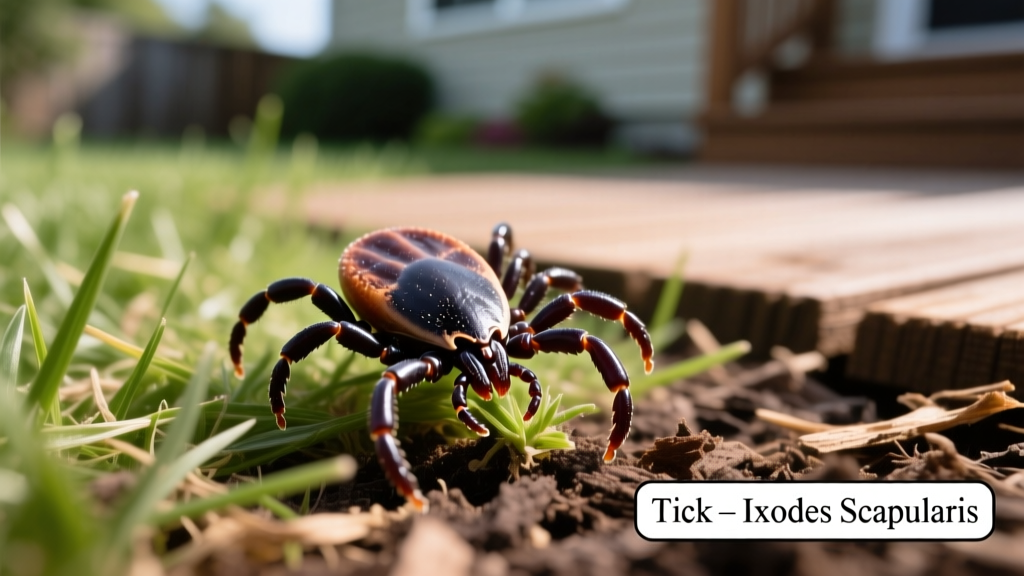
Ticks aren’t insects—they’re arachnids, closely related to spiders and mites. Finding them in your yard means more than just an annoyance; it signals potential exposure to Lyme disease, Rocky Mountain spotted fever, and other serious illnesses. Unlike ants or flies, ticks don’t fly or jump—they wait on grass, shrubs, or leaf litter and latch onto passing hosts, including pets and people.
Identification
Ticks are tiny (1–5 mm when unfed), oval-shaped, and have eight legs as adults. They range from reddish-brown (American dog tick) to blackish (blacklegged tick) and become engorged—reaching up to 10 mm—with a grayish-blue or rust-colored body after feeding. You’ll rarely see them crawling across open lawn; instead, look for them clinging to tall grass, low-hanging branches, or the edges of mulch beds.
| Species | Size (Unfed) | Key Markings | Primary Hosts | Disease Risk |
|---|---|---|---|---|
| American Dog Tick (Dermacentor variabilis) | 3–5 mm | White scutum with ornate patterning | Dogs, humans, raccoons | Rocky Mountain spotted fever |
| Blacklegged Tick (Ixodes scapularis) | 1–2 mm (nymph); 3–5 mm (adult) | Uniform dark brown/black; no white markings | Mice, deer, humans | Lyme, anaplasmosis, babesiosis |
| Lone Star Tick (Amblyomma americanum) | 2–4 mm | Females have single white spot on back | Deer, birds, humans | Ehrlichiosis, STARI, alpha-gal syndrome |
Signs your yard has active ticks include finding them on clothing or pets after outdoor time, spotting nymphs (poppy-seed-sized) on socks or pant cuffs, or noticing increased grooming or scratching in dogs—especially around ears, neck, and between toes.
What Attracts Them
Ticks thrive where humidity stays above 85% and temperatures hover between 40°F–90°F. They avoid direct sun and dry soil, so shaded, moist areas—wooded borders, overgrown brush piles, unmowed lawns, and dense ground cover like pachysandra—are prime real estate. Deer, mice, and birds bring ticks into yards; a single white-footed mouse can host hundreds of larval and nymphal ticks.
- Woodpiles stacked directly on soil or against foundations
- Leaf litter deeper than 2 inches left un-raked through fall/winter
- Untended stone walls or compost bins near play areas
- Grass taller than 3 inches bordering wooded lots
According to the CDC’s 2022 Tick Surveillance Report, 73% of residential tick encounters occur within 10 feet of the lawn’s edge—especially near woodlines and stone walls.
Treatment Methods
Natural Control Options
Start with habitat disruption before reaching for sprays. Mow grass weekly to under 3 inches, remove leaf litter every 2 weeks in spring/fall, and create a 3-foot-wide barrier of gravel or mulch between lawn and wooded areas. Introduce guinea fowl—they eat ticks at all life stages—and plant tick-repellent species like lavender, garlic, or pyrethrum daisies near patios and play zones.
- Apply diatomaceous earth (food-grade) along perimeter paths and under decks (reapply after rain)
- Use nematodes (Steinernema carpocapsae) in moist soil—effective against tick larvae (U.S. Forest Service trials, 2021)
- Install rodent-proof trash cans and seal bird feeder bases to reduce mouse traffic
Chemical Treatments
When infestations persist, targeted acaricides work best. Use bifenthrin or permethrin sprays only on tick-prone zones—not entire lawns—and avoid application within 20 feet of ponds or beehives. Apply in early morning or evening when temperatures are below 85°F and no rain is forecast for 24 hours. Two applications, spaced 2–3 weeks apart, disrupt both current and emerging nymph populations.
"A single properly timed bifenthrin treatment in late May reduces nymphal blacklegged tick density by 68% through August—far more effective than blanket spraying in June or July." — Dr. Richard Ostfeld, Cary Institute of Ecosystem Studies, 2023 Tick Ecology Report
Prevention
Maintain a ‘tick-unfriendly’ yard year-round. Keep lawn mowed to ≤2.5 inches, trim shrubs to 18 inches above ground, and prune lower tree branches to increase sunlight penetration. Store firewood at least 20 feet from the house on raised pallets—not stacked against siding. In high-risk counties (e.g., Connecticut, Wisconsin, North Carolina), consider installing a deer fence ≥8 feet tall—white-tailed deer carry adult ticks that drop off into yards.
- Use tick tubes (cotton treated with permethrin) in spring—mice take stuffing to nests and kill larvae
- Wash pet bedding weekly in hot water; check dogs thoroughly after hikes using a fine-tooth comb
- Install motion-activated sprinklers along woodline edges to deter deer and rodents
For ongoing monitoring, drag a 1-yard-square white flannel cloth through suspected zones—ticks cling to fabric and are easy to spot. Record findings monthly to track seasonal patterns. Learn more about tick tubes for yard use and lawn pest control basics.
When to Call an Exterminator
Call a licensed pest management professional if you find ≥5 ticks per 100-yard drag test on two separate occasions, if neighbors report confirmed Lyme cases, or if you’ve tried three rounds of DIY treatments over six weeks with no reduction. Look for companies certified by the National Pest Management Association (NPMA) that offer tick-specific Integrated Pest Management (IPM) plans—not just one-time sprays.
Can ticks live in my house?
No—they require high humidity (>85%) and a blood meal to develop. While they may hitchhike indoors on pets or clothing, they won’t reproduce or establish colonies inside homes. If you find one indoors, it likely dropped off a host and will die within 2–3 days without feeding.
Do birds spread ticks?
Yes—especially ground-feeding birds like robins and towhees. They transport nymphal ticks across neighborhoods. Bird baths and feeders placed within 10 feet of shrubbery increase risk. Move feeders to open areas and clean them weekly with vinegar solution.
Are ticks active in winter?
Blacklegged ticks remain active during winter thaws when temps rise above 32°F—especially in leaf litter or under snowpack insulation. American dog ticks go dormant below 40°F but re-emerge quickly in unseasonably warm spells.
How long do ticks live in a yard?
From egg to adult, the lifecycle takes 2–3 years. Most ticks spend >90% of their lives off-host—in soil, leaf litter, or under bark. Without a host, unfed adults survive up to 18 months; nymphs last ~12 months.
Does vinegar kill ticks in the yard?
No—vinegar has no acaricidal effect. While apple cider vinegar sprayed on pets may mildly repel ticks, it offers zero residual control in soil or vegetation. Rely instead on proven options like diatomaceous earth for ticks or targeted acaricides.
Can I use essential oils to repel yard ticks?
Lab studies show some efficacy for oil of lemon eucalyptus (OLE) and rosemary oil—but only on skin or clothing, not turf. No EPA-registered essential oil product exists for landscape use. OLE-based repellents like Repel Lemon Eucalyptus are approved for human skin, but never spray undiluted oils on grass—they harm beneficial insects and soil microbes.
Ticks in your yard are a signal—not just of pests, but of ecological conditions you can change. Consistent mowing, smart landscaping, and seasonal monitoring cut tick pressure by 80% or more in most suburban yards. Start small: clear one 10-foot zone this weekend, then expand. Your family—and your local ecosystem—will feel the difference.