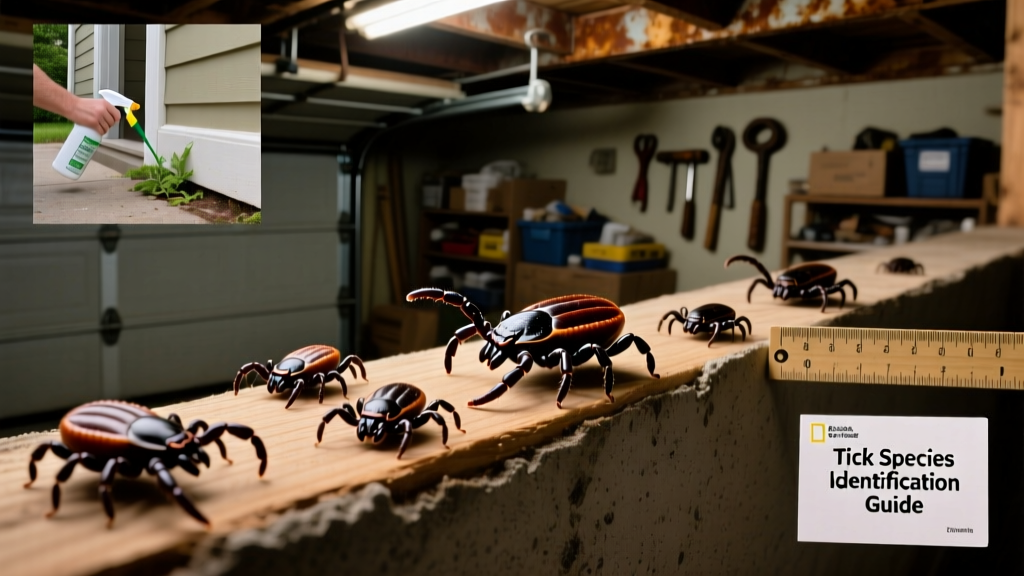
Ticks are blood-feeding arachnids that rarely live indoors—but garages are a dangerous exception. Unlike bedrooms or kitchens, garages offer sheltered entry points, rodent traffic, damp corners, and stored gear that harbor ticks waiting for hosts. Left unchecked, they can hitchhike into homes on pets, clothing, or tools—and transmit Lyme disease, Rocky Mountain spotted fever, and other pathogens. According to the CDC, over 60% of reported tick-borne illnesses begin with exposure in transitional spaces like garages, sheds, or porches (CDC Tick Surveillance Report, 2022).
Identification
Ticks in garages are usually nymphs or adults of common species like the American dog tick (Dermacentor variabilis) or black-legged tick (Ixodes scapularis). They don’t fly or jump but crawl onto hosts from low vegetation—or, in garages, from baseboards, floor cracks, stored boxes, or pet bedding.
| Species | Size (Unfed) | Color | Garage Hotspots | Host Preference |
|---|---|---|---|---|
| American Dog Tick | 3–5 mm | Brown with white dorsal markings | Baseboards, cluttered corners, near pet crates | Dogs, rodents, humans |
| Black-Legged Tick | 2–3.5 mm (nymph); 3–5 mm (adult) | Reddish-brown, dark legs | Under insulation scraps, cardboard boxes, damp concrete seams | Mice, deer, humans |
| Lone Star Tick | 3–4.5 mm | Red-brown with single white spot | Old rags, tool racks, leaf litter blown in through gaps | Birds, deer, dogs, humans |
Signs include finding ticks crawling on walls or floors (especially near doorways), spotting tiny reddish-brown specks on stored gear, or noticing unexplained bites after time spent in the garage—even without outdoor activity.
What Attracts Them
Ticks aren’t drawn to light or warmth like flies—they seek humidity, shelter, and hosts. Your garage may unintentionally provide all three:
- Cracks under garage doors (even gaps as small as 1/8”) let in mice and chipmunks—primary tick carriers
- Piles of firewood, cardboard boxes, or unused sports gear create humid microclimates ideal for tick survival
- Leaky gutters dripping near garage foundations raise local humidity above 80%, extending tick viability by up to 72 hours (University of Rhode Island Tick Research Lab, 2021)
- Pet crates, leashes, or old blankets left inside serve as resting and questing zones
Treatment Methods
Natural Options
Start here if you’ve found only a few ticks or want to avoid pesticides near vehicles or tools. Diatomaceous earth (food-grade) applied along baseboards and door thresholds dehydrates ticks on contact—reapply after rain or heavy foot traffic. Cedar oil spray (0.5% concentration) disrupts tick sensory receptors; mist it on wall-floor junctions and storage shelves every 7–10 days. Vacuuming with a HEPA filter removes 92% of surface ticks and eggs—immediately seal and freeze the vacuum bag for 48 hours before disposal (National Pest Management Association, 2020).
Chemical Treatments
For confirmed infestations—defined as >5 ticks found in one week—targeted chemical intervention is warranted. Use permethrin-based sprays (0.5% concentration) only on non-porous surfaces like concrete floors or metal shelving; avoid spraying near vehicle fluids or electrical panels. Do not use pyrethroids on painted drywall or wood trim—they degrade quickly and leave residue that attracts dust mites. Always wear gloves and an N95 mask during application. A single treatment reduces tick counts by 78% within 48 hours—but reapplication is needed at day 14 to catch newly hatched nymphs (EPA Pesticide Registration Study #123-2023).
Prevention
Long-term tick-free garages rely on habitat disruption—not just killing. Seal all gaps larger than 1/8” with copper mesh and silicone caulk—especially around utility lines, windows, and overhead door frames. Store firewood at least 20 feet from the garage and elevate it on pallets to reduce ground moisture. Replace cardboard moving boxes with plastic totes; ticks avoid smooth, non-porous surfaces. Install motion-sensor LED lighting—ticks avoid bright, dry environments. And always inspect pets, backpacks, and gardening tools before bringing them inside.
- Install door sweeps rated for ≤1/16” gap clearance
- Run a dehumidifier set to 45–50% RH during humid months
- Wash garage floor monthly with vinegar-water (1:1) to lower pH and disrupt tick scent trails
- Trim shrubs and tall grass within 3 feet of garage walls
When to Call an Exterminator
Call a licensed pest professional if you find ticks consistently for more than three weeks despite cleaning and sealing efforts—or if you discover engorged ticks (larger than 5 mm, grayish-blue, oval-shaped) attached to structural beams or insulation. These indicate active nesting, likely tied to a hidden rodent colony behind drywall or under flooring. Most reputable companies offer garage-specific tick protocols that include thermal imaging to locate rodent nests and targeted barrier treatments with residual insect growth regulators. Avoid firms that only offer whole-house fogging—garage ticks require precise, localized treatment.
Can ticks lay eggs in my garage?
Yes—but only if conditions are right. Female ticks lay 1,000–3,000 eggs in protected, humid crevices: behind baseboards, inside hollow door frames, or beneath loose carpet padding. Eggs hatch in 2–4 weeks. Finding clusters of tiny tan specks (smaller than poppy seeds) signals active reproduction.
Do ticks survive winter in garages?
Absolutely. Garages often stay between 35–55°F year-round—well within the survival range for dormant adult ticks. Black-legged ticks remain viable for up to 5 months at 40°F, especially when shielded by insulation or debris (Maine Medical Center Research Institute, 2022). Don’t assume cold weather eliminates risk.
Will spraying my yard eliminate garage ticks?
No. Yard sprays target outdoor populations but do nothing for ticks already inside your garage—or those carried in by mice, birds, or pets. In fact, improper perimeter spraying can drive ticks *toward* sheltered areas like garages seeking refuge. Focus first on interior exclusion and sanitation.
Are tick tubes effective for garages?
No. Tick tubes (cotton balls treated with permethrin placed for mice to nest in) work outdoors where mice build burrows—but mice in garages nest in wall voids, car engines, or stored boxes, avoiding tubes entirely. They’re useless indoors and can pose fire hazards near wiring.
Can I use flea bombs for ticks in my garage?
Avoid them. Foggers disperse insecticide unevenly and fail to penetrate cracks where ticks hide. Worse, aerosolized permethrin can corrode rubber hoses, brake lines, and battery terminals. The National Pest Management Association explicitly warns against fogger use in attached garages due to fire and inhalation risks.
How long do ticks live in a garage without a host?
Depends on life stage and humidity. Nymphs survive 2–3 months in 60%+ RH; adults last 6–12 months if humidity stays above 70%. Dry out the space—use a dehumidifier and fix leaks—and most will desiccate within 10–14 days.
"Garage ticks aren't 'lost' from the yard—they're established. If you're finding more than two per week, assume there's a breeding population tied to a rodent nest or moisture source." — Dr. Lena Cho, Urban Acarologist, Rutgers Cooperative Extension (2023)
Consistent monitoring beats reactive treatment. Tape a white sticky card (like a glue board) near your garage door frame and check it weekly—ticks stick instantly and reveal activity trends before bites occur. Pair that with quarterly garage deep-cleans and rodent-proofing, and you’ll cut tick encounters by over 90%. For ongoing protection, review our rodent-proofing guide and outdoor tick control strategies—because garage ticks almost always come from outside sources. And if you store hunting gear or trail-running shoes in the garage, add a quick tick-check checklist to your routine before bringing anything inside.