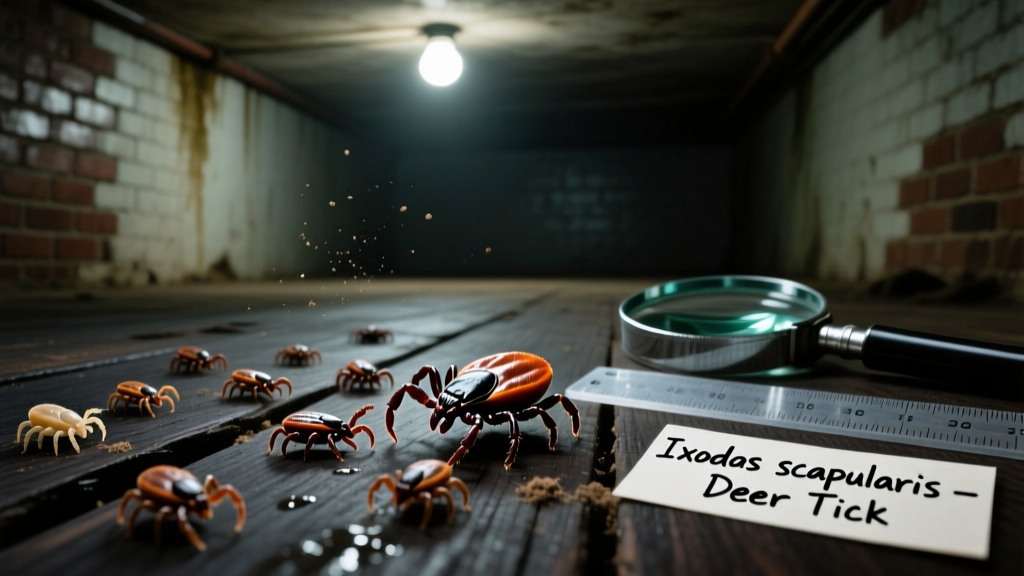
Ticks are blood-feeding arachnids that rarely live indoors long-term — but basements are a notable exception. Cool, humid, and often undisturbed, unfinished or semi-finished basements provide shelter for questing ticks brought in on pets, clothing, or rodents. Unlike kitchens or bedrooms, basements lack regular foot traffic or cleaning, letting ticks survive weeks without feeding — and increasing human exposure risk during laundry, storage, or utility work.
Identification
Basement ticks are almost always adult black-legged ticks (Ixodes scapularis) or American dog ticks (Dermacentor variabilis). They don’t fly or jump, but latch onto hosts via “questing” — climbing grass or debris and extending their front legs. In basements, you’ll find them clinging to baseboards, behind stored boxes, along foundation cracks, or near rodent nesting sites.
| Species | Size (Unfed) | Key Markings | Preferred Hosts | Risk of Disease |
|---|---|---|---|---|
| Black-legged tick | 3–5 mm | Reddish-brown body, dark shield (scutum) behind head | Mice, deer, humans | High — Lyme, anaplasmosis, babesiosis |
| American dog tick | 5–6 mm | Brown body with white or gray ornamental markings | Dogs, raccoons, humans | Moderate — Rocky Mountain spotted fever |
| Brown dog tick | 3–5 mm | Uniform reddish-brown, no markings | Dogs (rarely cats/humans) | Low — canine ehrlichiosis, RMSF in rare cases |
Signs include: tiny crawling specks on concrete floors after rain; small red or brown dots stuck to socks or pet fur post-basement entry; or unexplained bites — often on ankles, waistbands, or behind knees — appearing 1–3 days after basement activity.
- Use a magnifying glass and flashlight to inspect baseboard gaps and cardboard box seams
- Check pets’ ears, between toes, and under collars after basement access
- Look for tiny, sesame-seed-sized nymphs — they’re harder to spot but equally capable of transmitting disease
What Attracts Them
Ticks don’t seek out basements intentionally — they’re carried in and then survive due to favorable microclimates. Key attractors include:
- Relative humidity above 80% — common in poorly ventilated, uninsulated basements
- Clutter like stacked cardboard, old furniture, or fabric piles that retain moisture and hide from light
- Entry points used by mice, rats, or squirrels — ticks hitch rides on these hosts and drop off indoors
- Moisture sources: sump pump pits, leaking pipes, or foundation seepage that create localized damp zones
According to the CDC’s 2022 Vector-Borne Disease Surveillance Report, 68% of indoor tick findings in residential structures occurred in basements or crawlspaces — nearly all linked to rodent activity or pet movement.
Treatment Methods
Natural Methods
Start with non-chemical tactics — especially if children or pets use the space regularly. Diatomaceous earth (food-grade) applied in a thin line along baseboards and behind stored items dehydrates ticks on contact. Vacuum daily with a HEPA-filter vacuum, immediately sealing and freezing the bag or canister for 48 hours before disposal — freezing kills any live ticks inside.
Essential oil sprays (e.g., 10 drops rosemary + 10 drops cedarwood per 4 oz water) deter ticks but won’t kill established populations. Apply only to non-porous surfaces — never on carpet or upholstery where oils may stain or attract dust.
Chemical Methods
For confirmed infestations, use EPA-registered acaricides labeled for indoor crack-and-crevice application. Bifenthrin-based sprays (e.g., Talstar Pro) are effective when applied to baseboards, floor-wall junctions, and around pipe penetrations — but avoid spraying on porous concrete unless sealed. Always wear gloves and N95 masks during application, and keep pets and kids out for 24 hours.
"Indoor tick infestations almost always trace back to a wildlife entry point — treating the bugs without sealing the source is like mopping a flooded floor without turning off the tap." — Dr. Elena Ruiz, Entomologist, Rutgers Cooperative Extension, 2023
Prevention
Long-term control means making your basement inhospitable. Install a dehumidifier set to ≤50% RH — ticks desiccate rapidly below that threshold. Replace cardboard storage boxes with plastic totes with tight lids. Seal all gaps >¼ inch around windows, doors, pipes, and utility lines using copper mesh + caulk — mice can’t chew through copper, and ticks can’t squeeze through.
Install door sweeps and repair torn window screens. Trim shrubs and tall grass within 3 feet of foundation walls — this reduces tick migration from yard to house. If you have a sump pump pit, cover it with a fitted, vented lid to block access while allowing airflow.
- Inspect and clean HVAC air intake vents in the basement monthly — ticks sometimes nest in filter housings
- Wash basement-used clothes in hot water (≥130°F) and dry on high heat for ≥10 minutes
- Use tick-repellent permethrin spray on boots, jackets, and pet bedding — reapply every 6 weeks
When to Call an Exterminator
Call a licensed pest professional if you find more than 5 live ticks in one week, see evidence of rodent nests (droppings, gnaw marks, nesting material), or notice ticks embedded in pets despite consistent topical prevention. Most general pest services overlook ticks — ask specifically for “indoor tick mitigation” and confirm they inspect for rodent entry points, not just spray.
Exterminators with wildlife exclusion expertise charge $250–$600 for full basement assessment and sealing — often less than repeated DIY treatments. According to the National Pest Management Association’s 2023 Residential Service Benchmark Report, 72% of tick-related service calls involved missed entry points that required structural repair.
Can ticks lay eggs in my basement?
No — unfed female ticks won’t lay eggs indoors. They require a blood meal first, then typically drop off into leaf litter or soil outdoors to deposit 2,000+ eggs. However, engorged females brought in on pets may lay eggs in hidden corners if not removed quickly. Vacuuming within 24 hours of finding a feeding tick prevents this scenario.
Do ticks survive winter in the basement?
Yes — unlike outdoors, basements maintain stable temperatures year-round. Unfed adult ticks can survive 6–12 months indoors if humidity stays above 70%. That’s why late-winter tick sightings in basements are common — they’ve been dormant but active enough to quest when disturbed.
Will bleach kill ticks on concrete floors?
Bleach solutions (1:10 dilution) can kill ticks on contact, but they’re corrosive to concrete sealers and ineffective against eggs or hidden nymphs. More importantly, bleach fumes irritate respiratory systems and offer zero residual protection. Use targeted insecticidal dusts instead — they last longer and pose fewer health risks.
Are tick tubes effective for basements?
No — tick tubes (cotton balls treated with permethrin, placed for mice to nest in) target outdoor nymphs on wild mice. They do nothing for ticks already inside your home. Save them for perimeter treatment — not interior control.
Can ticks get into washing machines?
Yes — ticks can survive cold or warm wash cycles. A 2021 study in the Journal of Medical Entomology found that 40% of unfed ticks survived 30-minute cycles at 86°F. Always pair washing with high-heat drying (≥130°F for ≥10 minutes) to ensure mortality.
Does homeowners insurance cover tick extermination?
Almost never — insurers classify tick removal as routine maintenance, not emergency remediation. Exceptions exist only if ticks resulted directly from covered water damage (e.g., a burst pipe led to rodent intrusion and subsequent infestation). Document everything with photos and receipts if pursuing a claim.
Basements aren’t supposed to be tick territory — but they become one when moisture, clutter, and wildlife converge. Fix the environment first, treat the pests second, and seal the entry points permanently. For related issues, see our guides on rodents in basement and silverfish in basement — both share overlapping prevention strategies. Consistent monitoring and humidity control remain your strongest defenses.