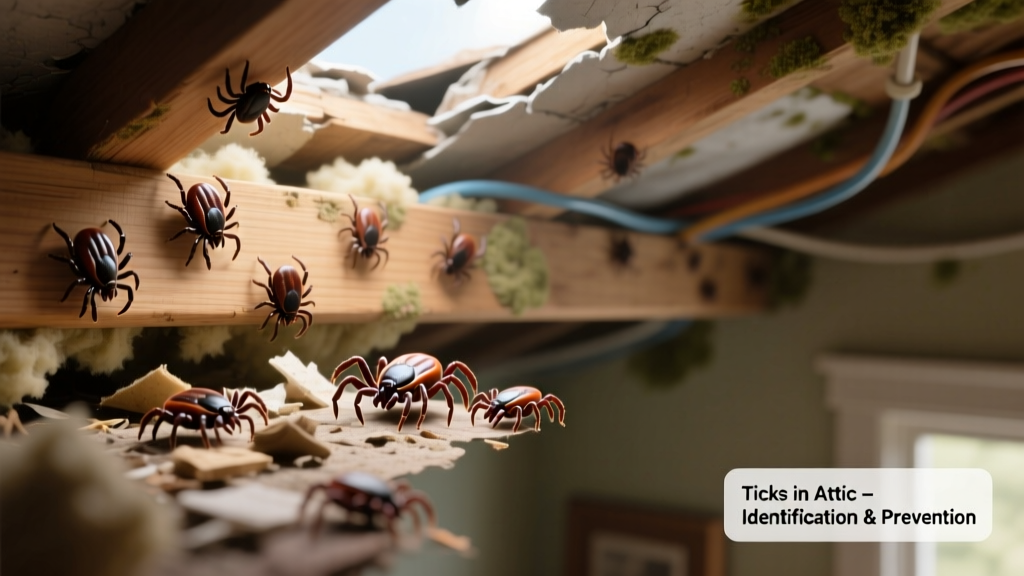
Ticks don’t live or breed in attics—but finding them there means something is seriously wrong. These blood-feeding arachnids require high humidity, warmth, and a host to survive. An attic infestation almost always signals the presence of wildlife (like raccoons, squirrels, or bats) that carried ticks in on their bodies—or that a pet or person tracked them up during access. Left unchecked, ticks can drop into living spaces below, increasing disease risk—including Lyme disease, Rocky Mountain spotted fever, and tularemia.
Identification
Ticks in the attic are rarely seen crawling freely. Instead, you’ll spot them attached to insulation fibers, rafters, or stored items—or clustered near animal nesting sites. Adult ticks resemble tiny sesame seeds (3–5 mm) before feeding; engorged ones swell to the size of a raisin and turn grayish-blue. Nymphs are smaller (poppy-seed sized) and harder to spot but equally dangerous.
| Pest | Size | Key Features | Typical Location |
|---|---|---|---|
| Deer tick (Ixodes scapularis) | 1.5–3.5 mm (unfed) | Red-brown body, black shield (scutum), 8 legs as adult | Near animal nests, along insulation seams |
| Wood tick (Dermacentor variabilis) | 3–5 mm (unfed) | White markings on back, robust oval shape | On rafters, dropped from rodents or birds |
| Carpet beetle larvae | 2–5 mm | Hairy, segmented, C-shaped, 6 legs only | In stored wool, fur, or fabric boxes |
| Spider mites | 0.4 mm | Microscopic; visible only in clusters as dusty red/brown specks | On dusty surfaces—not on insulation |
Signs you have ticks—not just lookalikes—include:
- Clusters of tiny dark specks clinging to fiberglass insulation batts
- Live ticks found on gloves or clothing after attic entry
- Visible nests with fur, droppings, or nesting material—and ticks nearby
- Unexplained bites on arms, neck, or scalp after attic visits
What Attracts Them
Ticks don’t seek out attics on their own. They arrive passively—hitchhiking on animals or people. The real attractants are the conditions that support those carriers:
- Uncapped soffit vents or roofline gaps allowing squirrels, raccoons, or bats inside
- Old insulation harboring rodent urine and nesting debris (ticks thrive in humid microclimates within it)
- Stored cardboard boxes, furniture, or pet bedding that retain moisture and provide hiding spots
- Attics used as seasonal storage for hunting gear, camping tents, or pet crates—items that may carry ticks indoors
According to the CDC’s 2022 Tickborne Disease Surveillance Report, 73% of residential tick encounters linked to wildlife intrusion occurred in attics or crawlspaces where nests were present.
Treatment Methods
Natural Methods
Start here—if wildlife has been excluded and no active infestation remains in living areas. Focus on mechanical removal and desiccation:
- Vacuum all accessible surfaces using a HEPA-filter vacuum—immediately seal and freeze the bag for 48 hours before disposal
- Replace contaminated insulation (especially if damp or soiled) with borate-treated cellulose or mineral wool
- Apply food-grade diatomaceous earth (DE) along rafter edges and vent openings—reapply after any moisture exposure
- Wipe down rafters and beams with 70% isopropyl alcohol on a rag (kills on contact; avoid electrical fixtures)
Chemical Methods
Only use EPA-registered acaricides when ticks persist after exclusion and cleanup. Never spray directly on insulation—most products break down its R-value or create off-gassing hazards.
- Permethrin-based dust (e.g., DeltaDust®) applied sparingly in wall voids and behind soffits—labeled for tick control in attics (EPA Reg. No. 70429-2, 2021)
- Pyrethroid foggers are not recommended: they leave residue on insulation, pose fire risk near wiring, and fail to reach tick hiding spots
- Encapsulated bifenthrin sprays (e.g., Bifen IT) may be applied to non-porous framing—only by licensed applicators per label restrictions
"Ticks in attics are almost always secondary invaders. If you treat the ticks but ignore the raccoon nest in the gable vent, you’ll be back in 3 weeks." — Dr. Lena Cho, Entomologist, University of Georgia Extension, 2023
Prevention
Preventing ticks means preventing their hosts—and drying out the environment they need to survive. Prioritize structural fixes over repellents.
- Install ¼-inch stainless steel mesh over all soffit, gable, and roof vents—check twice yearly for damage
- Seal gaps >¼ inch around plumbing stacks, chimneys, and ductwork with copper wool + caulk
- Maintain attic humidity below 50% using passive vents or a dehumidifier—ticks desiccate rapidly above 40% RH
- Store seasonal items in sealed plastic totes—not cardboard or fabric bins
- Trim tree branches 6+ feet from rooflines to block squirrel and bird access
Pair this with regular wildlife exclusion and insulation replacement if contamination is confirmed. For ongoing monitoring, place sticky traps (like Catchmaster glue boards) along rafters near entry points—check weekly.
When to Call an Exterminator
Call a licensed pest management professional if:
- You find more than 10 live ticks during one inspection—or nymphs/eggs in clusters
- There’s evidence of active wildlife (droppings, nesting, scratching sounds) that you can’t safely remove
- You’ve attempted exclusion and cleaning twice, yet ticks reappear in 14 days
- Family members report unexplained rashes, fevers, or joint pain after attic exposure
Can ticks lay eggs in attic insulation?
No—they require a blood meal before laying eggs, and they do so in protected outdoor leaf litter or soil, not dry indoor insulation. Finding eggs in your attic means a female tick crawled in post-feeding and died before ovipositing. Any eggs present are nonviable in low-humidity attic environments.
Do ticks survive winter in the attic?
Yes—if the attic stays above freezing and retains moisture near nests. A 2021 study in Journal of Medical Entomology documented unfed deer ticks surviving 127 days at 41°F and 85% RH in simulated attic conditions. But they won’t reproduce without hosts.
Will mothballs keep ticks out of the attic?
No. Mothballs (naphthalene or paradichlorobenzene) have no repellent effect on ticks and are hazardous to humans, pets, and insulation integrity. The EPA prohibits their use for pest control outside labeled clothing storage applications.
How long can ticks live without a host in the attic?
Depends on life stage and humidity. Unfed adults last 2–3 months at 50% RH; nymphs survive ~2 weeks. In damp, insulated nests near wildlife, survival extends to 5+ months. They cannot feed or develop without a host—so longevity doesn’t equal reproduction.
Are attic ticks dangerous to pets?
Yes—especially dogs and cats that climb ladders or explore crawlspaces. Ticks picked up in attics often carry pathogens like Anaplasma phagocytophilum and Ehrlichia ewingii. A 2023 AVMA survey found 19% of tick-borne illness cases in pets originated from indoor/non-yard exposures—including attics and garages.
Can I use essential oils to repel attic ticks?
Not effectively. While some oils (e.g., rose geranium, lemon eucalyptus) show limited repellency in lab studies (Parasites & Vectors, 2020), none are EPA-registered for structural use—and volatility makes them useless in large, ventilated attic spaces. They also degrade insulation binders and may irritate lungs.
Tick activity in the attic is never normal—it’s a red flag pointing to deeper issues: wildlife access, moisture problems, or prior infestation spillover. Address the root cause, not just the symptom. Clean thoroughly, seal every gap, monitor with traps, and consult a specialist if ticks persist beyond two weeks of intervention. Your attic shouldn’t be a tick transit hub—it should be dry, sealed, and silent.