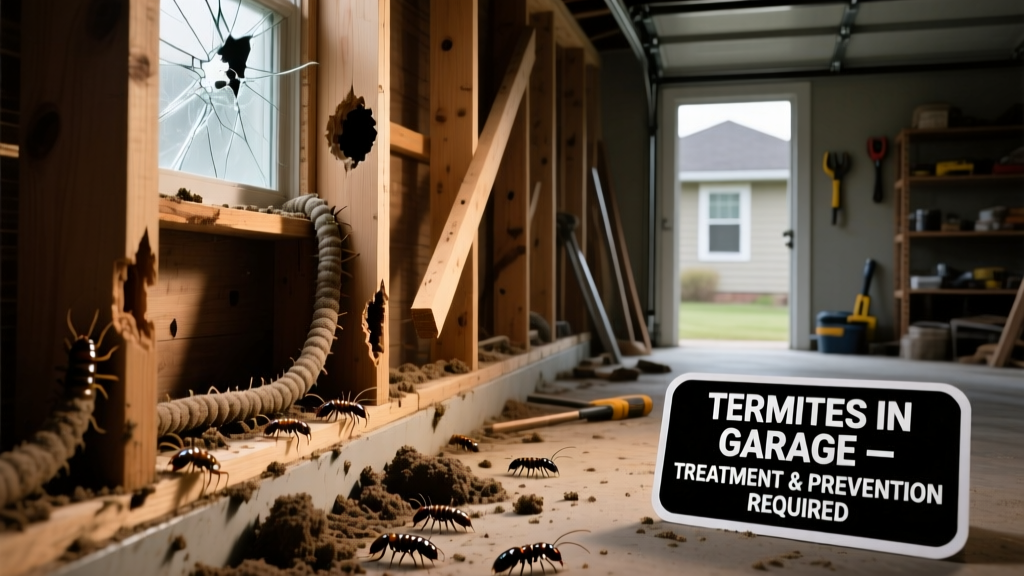
Termites in the garage are more common—and more dangerous—than most homeowners realize. Unlike kitchens or bedrooms, garages often have untreated wood framing, concrete cracks, stacked firewood, and poor ventilation—ideal conditions for subterranean and drywood termites to establish colonies unnoticed. Left unchecked, they can compromise structural supports, door frames, and even migrate into the main house within months.
Identification
Garage termites are usually either subterranean (most common) or drywood species. Subterranean termites build mud tubes along foundation walls or floor joists; drywood termites leave behind tiny, hexagonal fecal pellets (frass) near rafters or trim. Swarming alates—winged reproductives—often appear in spring near garage windows or overhead lights.
| Feature | Termites | Ants |
|---|---|---|
| Waist | Thick, uniform width | Narrow, pinched waist |
| Antennae | Straight, bead-like | Elbowed |
| Wings (swarmers) | Equal length, veined, easily shed | Front wings longer than rear |
| Damage pattern | Hollowed wood with layered galleries | Clean, smooth tunnels (carpenter ants) |
Look closely at garage door jambs, sill plates, and plywood storage shelves—these are hotspots. Tap suspect wood with a screwdriver handle: if it sounds hollow or crumbles, it’s likely infested.
What Attracts Them
Garages attract termites because they combine moisture, cellulose, and access points. Leaky gutters dripping near the garage wall, cracked concrete floors allowing soil contact, and firewood stacked directly against siding all create bridges for subterranean termites. Drywood termites hitchhike in used furniture, pallets, or lumber brought in from outside.
- Wood-to-soil contact (e.g., untreated 2×4 supports resting on bare concrete)
- Standing water from AC drip lines or poor grading
- Cardboard boxes stored on concrete floors (cellulose + humidity)
- Old insulation containing paper backing or wood fiber
According to the National Pest Management Association’s 2022 Termite Risk Report, garages account for 37% of first-identified termite activity in single-family homes—more than basements or crawl spaces.
Treatment Methods
Natural Options
For light, localized drywood activity—say, one infested shelf or tool chest—start with non-chemical tactics. Freeze small items using dry ice in sealed plastic bags for 72 hours (kills eggs and nymphs). Borate sprays like Tim-bor can be applied to exposed garage framing before painting or sealing; they penetrate wood and disrupt termite digestion.
- Orange oil injections into active galleries (effective for drywood only)
- Cardboard traps: damp corrugated cardboard placed near suspected areas—termites gather, then you burn or discard
- Beneficial nematodes (Steinernema feltiae) applied to soil around garage perimeter (targets subterranean larvae)
Chemical Treatments
For confirmed subterranean colonies or widespread damage, liquid termiticides remain the most reliable option. Termidor SC (fipronil) and Dominion 2L (imidacloprid) are non-repellent and transfer through trophallaxis—meaning worker termites unknowingly spread poison back to the colony. Soil drenches require trenching 6 inches deep and 6 inches wide around the garage’s exterior foundation.
"In garages with slab-on-grade construction, we see up to 40% higher treatment failure rates when applicators skip the interior perimeter trench—termites travel under the slab and re-enter through expansion joints." — Dr. Lena Cho, Entomologist, University of Florida IFAS Extension, 2023
Prevention
Preventing garage termite reinfestation means breaking the three-legged stool: food (wood), water, and shelter. Replace any rotted garage door bottom seal with vinyl or metal. Install dehumidifiers if relative humidity exceeds 60%—especially in attached garages with uninsulated walls.
- Keep firewood elevated on racks and at least 20 feet from the garage
- Seal cracks in concrete floors and walls with hydraulic cement—not caulk
- Install stainless steel mesh (Termimesh) behind new drywall or stucco repairs
- Use pressure-treated lumber for any garage shelving or framing touching concrete
Also consider professional termite inspection cost as part of your annual home maintenance—many companies include garage-specific scanning with moisture meters and borescopes.
When to Call an Exterminator
Call a licensed pest management professional immediately if you find mud tubes over ¼ inch wide, hear faint clicking inside walls (soldier termites), or notice sagging garage ceiling drywall. These indicate mature, entrenched colonies. Also call if you’ve attempted two rounds of DIY treatment with no reduction in frass or swarming.
Most reputable firms offer free garage-only inspections—and many include a 1-year warranty on treatments targeting slab-entry points. Ask about their use of termite monitoring stations, especially useful for detached garages where soil treatments aren’t feasible.
Can termites eat garage door tracks?
No—they don’t consume metal—but they’ll tunnel through wooden jambs or composite trim surrounding the track. If your garage door sticks or rattles unexpectedly, check the header and side jambs for soft spots.
Do garage heaters attract termites?
Not directly—but unvented propane heaters raise humidity and condensation on cold concrete floors, creating micro-environments where fungi grow and soften wood. That makes it easier for termites to chew.
Will sealing garage windows stop termites?
Sealing helps block swarmers, but it won’t stop subterranean workers moving underground. Focus instead on eliminating soil contact and fixing leaks that feed moisture-dependent colonies.
Are bait stations effective for garage infestations?
Yes—if installed correctly. Place them every 8–10 feet along the garage’s exterior foundation and inspect monthly. Bait stations work slower than liquid barriers but are ideal for homes near wells or gardens. See our full comparison of termite bait vs liquid treatment.
How fast do termites spread from garage to house?
In warm climates (USDA Zones 7+), subterranean colonies can bridge the gap in as little as 3–5 months via expansion joints, utility conduits, or shared framing. Drywood colonies move slower—typically 1–2 years—but are harder to detect early.
Can I treat garage termites myself and still get a warranty?
Rarely. Most structural warranties (including those from builders or insurers) require documentation of licensed treatment. DIY efforts may void coverage—or worse, mask symptoms while damage progresses.
Termites don’t announce themselves with noise or odor—just slow, silent erosion of what holds your home up. In the garage, that means compromised headers, weakened floor joists, and doors that no longer seal properly. Catching them early isn’t about convenience—it’s about preserving structural integrity and avoiding $8,000+ in repair bills down the line. Start with a flashlight, a screwdriver, and this checklist—and act before the next rainstorm gives them another foothold.