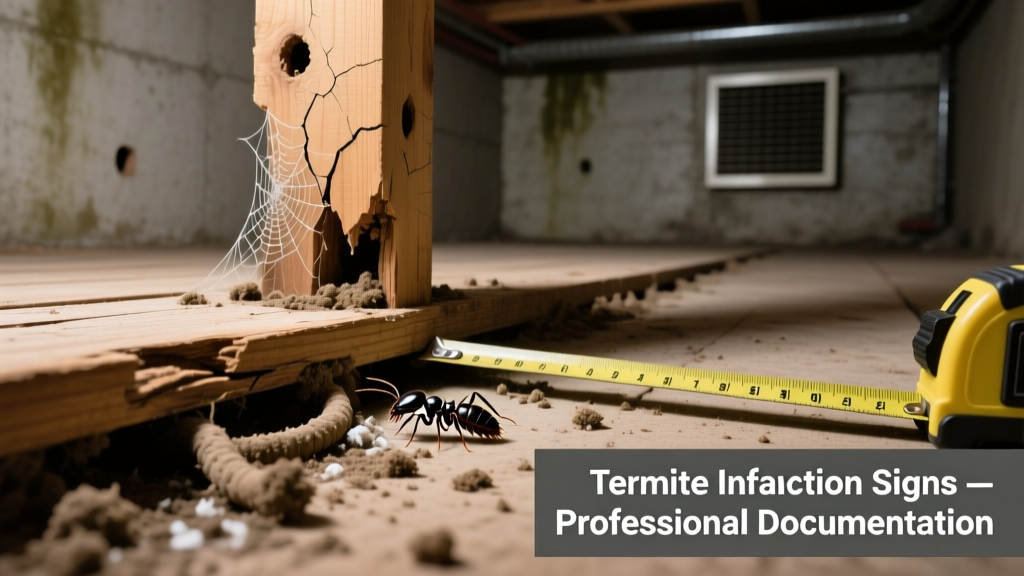
Subterranean termites are the most common cause of hidden, progressive damage in basements — often going unnoticed until floor joists soften or drywall buckles. Unlike ants or cockroaches, they don’t wander into living areas; they stay underground or inside wood, feeding silently from the inside out. By the time you see mud tubes or swarming alates, colonies may have been active for 2–5 years.
Identification
Basement termites are almost always subterranean (Reticulitermes spp.), not drywood or dampwood species. They’re creamy-white, ant-sized (1/8 inch), with straight antennae and no waist constriction. Soldiers have enlarged, darkened heads and pincer-like mandibles. Workers are blind and rarely seen unless disturbed.
Key signs differ from other pests:
| Feature | Subterranean Termites | Carpenter Ants | Moisture-Damaged Wood |
|---|---|---|---|
| Mud tubes | Yes — pencil-thin, soil-lined, on foundation walls or sill plates | No | No |
| Frass (droppings) | No | Yes — coarse, sawdust-like piles near entry points | No |
| Wood texture | Hollow-sounding, layered damage along grain; intact outer surface | Smooth, clean galleries; often with exit holes | Soft, spongy, discolored; crumbles easily |
| Swarmers | Wingless workers dominate; swarmers appear spring/early summer, black or brown, uniform wings | Reddish-black, front wings longer than hind wings | None |
- Tap exposed wood beams with a screwdriver — hollow spots indicate internal tunneling
- Check where concrete meets wood framing — look for mud tubes bridging gaps
- Inspect pressure-treated sill plates for blistering paint or fine dust (frass is absent, but termite-damaged wood may shed fine particles)
What Attracts Them
Termites don’t seek basements — they follow moisture, cellulose, and shelter. Your basement provides all three when conditions align:
- Relative humidity above 60% — especially near sump pumps, leaky pipes, or uninsulated cold walls
- Wood-to-soil contact: support posts, sill plates, or stored firewood touching concrete or dirt floors
- Cracks in foundation walls or floor slabs wider than 1/16 inch — enough for workers to enter
- Undetected leaks behind finished walls or under carpet padding (a major hidden attractor)
According to the National Pest Management Association’s 2022 Termite Damage Report, 73% of inspected basements with active infestations had at least one unaddressed moisture source within 3 feet of the foundation wall.
Treatment Methods
Natural Options
These work only for very early-stage, localized activity — think one isolated beam or a single mud tube near a window well. They won’t eliminate established colonies.
- Orange oil injections (d-limonene) into infested wood — kills termites on contact but offers zero residual protection
- Cardboard traps: damp corrugated cardboard placed near mud tubes attracts workers; replace weekly and burn off-site
- Nematodes (Steinernema feltiae): apply to soil adjacent to foundation — effective only in consistently moist, cool soil (below 85°F)
Chemical Treatments
For confirmed colony presence, professional-grade termiticides remain the standard. DIY liquid barriers (e.g., Termidor SC, Bora-Care) require precise dilution, calibrated sprayers, and trenching — misapplication creates gaps termites exploit.
The U.S. EPA notes that non-repellent termiticides like fipronil and imidacloprid account for over 89% of successful residential barrier treatments when applied correctly (EPA Pesticide Registration Review, 2023).
"A single untreated 6-inch gap in a chemical barrier can allow 30,000+ termites per day to bypass treatment — that’s why DIY perimeter applications fail more often than they succeed." — Dr. Lena Cho, Entomologist, University of Florida IFAS Extension (2021)
Prevention
Prevention focuses on breaking the termite triad: moisture, food, and access.
- Install dehumidifiers set to 45–55% RH — basement air should feel dry, not clammy
- Keep soil graded away from foundation — minimum 6 inches of clearance between soil and wood framing
- Replace damaged or rotting sill plates with ACQ-treated lumber — never reuse old, compromised wood
- Seal cracks in concrete floors/walls with hydraulic cement (not caulk), then coat with termite-resistant sealant like Xypex
Also consider basement moisture control as your first line of defense — many termite problems vanish after fixing leaks and improving drainage.
When to Call an Exterminator
Call immediately if you observe any of these:
- Mud tubes extending more than 12 inches up a foundation wall
- Multiple swarmer wings on basement windowsills or floor (especially March–June)
- More than two hollow-sounding structural members in one area
- Visible soil inside wall cavities or under flooring
Most reputable firms offer free inspections — but verify they’re licensed by your state’s Department of Agriculture and carry structural pest control certification. Avoid companies pushing “same-day tenting”; subterranean termites aren’t treated with fumigation.
Can termites come up through floor drains?
No. Subterranean termites avoid open water and won’t traverse PVC or cast-iron drain lines. However, they will use utility conduits, expansion joints, or gaps around pipe penetrations — so seal those, not the drain itself.
Do I need to remove basement carpet if termites are present?
Only if the subfloor beneath is damaged or if mud tubes run under the padding. In most cases, lifting carpet reveals the real issue — and lets you inspect and treat without full removal. Save the tear-out unless joists show >25% depth loss.
Will a dehumidifier alone kill termites?
No — termites survive at 40% RH. But lowering humidity to ≤50% slows their metabolism and makes the environment less hospitable for colony expansion. It’s a critical companion to other methods, not a standalone fix.
Are bait stations effective in basements?
Yes — but only when installed in soil *outside* the foundation, not indoors. In-basement bait monitors (like Advance® TRF) detect activity and trigger slow-kill bait deployment, but they don’t replace exterior perimeter control. For best results, pair them with a liquid barrier.
How long does it take for termites to damage a basement wall?
It depends on colony size and wood type. A mature colony (50,000+ workers) can consume 1 foot of 2×4 pine in ~5–6 months. Pressure-treated lumber delays feeding but doesn’t stop it entirely — especially if cut ends aren’t sealed. That’s why proper pressure-treated wood installation matters just as much as inspection.
Can I treat termites in my basement myself and still get a warranty?
No. Most structural warranties (including those from manufacturers like Koppers or Wolman) require treatment by a licensed applicator using registered products. DIY efforts void coverage — and often delay detection until repair costs double.
Termites in basements thrive where we overlook them: behind walls, under slabs, inside insulation. Catching them early isn’t about luck — it’s about routine checks, moisture discipline, and knowing when a problem has outgrown home remedies. Start with a flashlight and a screwdriver during your next basement walk-through. What you hear — or don’t hear — could save thousands in repairs. For deeper guidance, see our wood rot in basement troubleshooting guide — since decay and termites often arrive together.