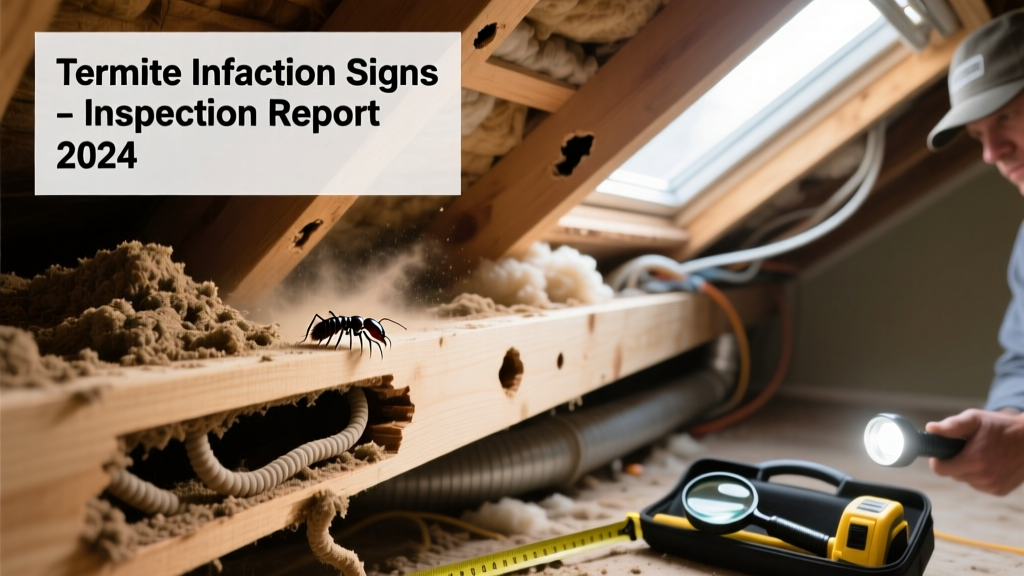
Termites in the attic are uncommon but dangerous — they bypass typical ground-level defenses and feed on roof framing, sheathing, and insulation without immediate detection. Unlike subterranean colonies that enter through foundations, attic-dwelling termites (often drywood or occasionally aerial-forming Formosan colonies) establish nests directly in wood above grade, making them stealthier and harder to intercept.
Identification
Drywood termites are the primary culprits in attic infestations. They’re 3/8 inch long, pale brown to reddish-brown, with straight antennae and equal-length wings. Unlike subterranean termites, they don’t need soil contact and produce distinctive fecal pellets — small, hard, six-sided “frass” that accumulates near entry points or on insulation below rafters.
Look for these signs:
- Fine, sand-like frass piled on attic floor joists or atop stored boxes
- Small, round kick-out holes (1–2 mm) in wood surfaces, especially along seams or end grain
- Hollow-sounding rafters when tapped with a screwdriver handle
- Wings shed near vents, soffits, or light fixtures — often mistaken for flying ants
| Feature | Drywood Termites | Subterranean Termites | Formosan Termites (aerial nests) |
|---|---|---|---|
| Entry point | Direct wood access (vents, gaps, soffits) | Soil-to-wood bridges or foundation cracks | Aerial nests in walls or attics; no soil contact needed |
| Frass | Visible, compact pellets | None (mud tubes instead) | Rare; may produce mud-lined galleries inside wood |
| Colony size | 500–1,000 individuals | 100,000+ | Up to 3 million; highly destructive |
| Inspection clue | Frass + surface holes | Mud tubes + sagging drywall | Swarmers at night; honeycombed wood with clay lining |
What Attracts Them
Attics become termite targets when three conditions align: accessible wood, moisture, and warmth. Leaky roofs, poor ventilation, and condensation from unvented bathroom fans create micro-habitats where drywood termites thrive — even without standing water. Insulation traps heat and humidity, softening wood fibers over time. Older homes with cedar shingles, untreated pine sheathing, or reused lumber are especially vulnerable.
Key attractants include:
- Roof leaks near chimneys or valleys that saturate roof decking
- Blocked soffit vents or missing ridge vents causing stagnant, humid air
- Wood-to-wood contact between framing and fascia boards or HVAC duct boots
- Stored cardboard boxes, furniture, or firewood stacked against rafters
Treatment Methods
Natural & Non-Chemical Options
For isolated, early-stage drywood infestations (under 3 linear feet of affected framing), localized heat treatment works well: raising attic wood temperatures to 120°F for 35+ minutes kills all life stages. Borate sprays (e.g., Bora-Care) penetrate dry wood up to 1 inch deep and disrupt termite digestion — but only on exposed, unpainted surfaces. Freeze treatments using liquid nitrogen are effective for spot-killing in accessible areas like rafter ends.
According to the University of Florida’s Entomology Department (2022), borate-treated wood resists re-infestation for 10+ years if kept dry — but offers zero protection if moisture exceeds 20% wood moisture content.
Chemical Treatments
Fumigation with sulfuryl fluoride remains the gold standard for whole-attic drywood infestations. It requires sealing the home under a tent for 2–3 days and evacuating pets, plants, and food. Success rates exceed 99% when applied correctly, per the California Structural Pest Control Board’s 2023 efficacy report. For smaller zones, injected insecticides like Termidor SC (fipronil) or Altriset (chlorfenapyr) can be drilled-and-filled into infested members — though this demands precise placement and licensed application.
Prevention
Preventing attic termites means disrupting their access and habitat. Start by sealing every gap larger than 1/8 inch around roof vents, plumbing stacks, and electrical conduits using copper mesh and silicone caulk — termites won’t cross metal. Install continuous soffit and ridge venting to maintain attic humidity below 55% year-round. Replace any rotted or previously infested wood with pressure-treated or naturally resistant species like heartwood redwood or ipe.
Additional steps:
- Clean gutters twice yearly to prevent overflow onto roof edges
- Keep attic storage off rafters — use plastic bins on metal shelving
- Inspect roof decking annually during routine HVAC maintenance
- Apply borate preservative to exposed framing during roof replacements
When to Call an Exterminator
Call a licensed pest control professional immediately if you find frass in multiple locations, hear faint clicking sounds (soldiers banging heads) inside walls, or see swarming alates indoors between April and July. Also act if more than two adjacent rafters sound hollow or show surface damage — DIY methods rarely eliminate established colonies beyond 10 linear feet. Delaying treatment risks hidden damage spreading to load-bearing collar ties or ridge beams.
Can termites live in attic insulation?
No — termites don’t eat fiberglass, cellulose, or foam insulation. But they tunnel *through* loose-fill cellulose to reach wood framing, leaving behind frass mixed in the material. If you find pellets in insulation, inspect nearby rafters and top plates immediately.
Do attic termites mean my foundation is infested too?
Not necessarily. Drywood termites operate independently of soil. However, finding them in the attic warrants a full-property inspection — subterranean termites could be active elsewhere. A 2021 National Pest Management Association survey found 27% of homes with drywood infestations also had concurrent subterranean activity, usually in basements or crawl spaces.
How long does it take attic termites to cause serious damage?
Drywood colonies grow slowly — a single pair may take 3–5 years to compromise a 2×6 rafter. But Formosan colonies can hollow out a 4×6 beam in under 18 months. The U.S. Forest Service estimates undetected attic drywood infestations reduce structural capacity by up to 30% after 7 years.
Will attic ventilation alone stop termites?
Ventilation helps — but isn’t a standalone solution. While low humidity deters egg development, termites adapt by nesting deeper in wood where moisture is retained. Ventilation must be paired with physical barriers and regular inspections to be effective.
Are termite swarmers in the attic always a sign of active infestation?
Yes — swarming indicates mature, reproducing colonies. Finding even one dead alate near a window or light fixture warrants investigation. Discard old swarmer wings you find in cobweb corners; they’re evidence of recent emergence.
Does homeowner’s insurance cover attic termite damage?
Almost never. Termite damage is universally excluded as “gradual deterioration” — not sudden or accidental. Some insurers offer optional riders, but premiums average $300–$600/year and require annual inspections. Consider it part of your termite inspection cost planning.
Attic termites don’t announce themselves with mud tubes or sagging floors — they work silently overhead. Catching them early hinges on knowing what to look for and acting fast. Pair routine visual checks with proactive sealing and ventilation upgrades, and don’t wait for visible damage. For confirmed infestations, consult a specialist trained in drywood termite treatment — because once they’re in the rafters, they’re already halfway to the roof deck. And for long-term resilience, integrate termite-resistant materials during any roof replacement project.