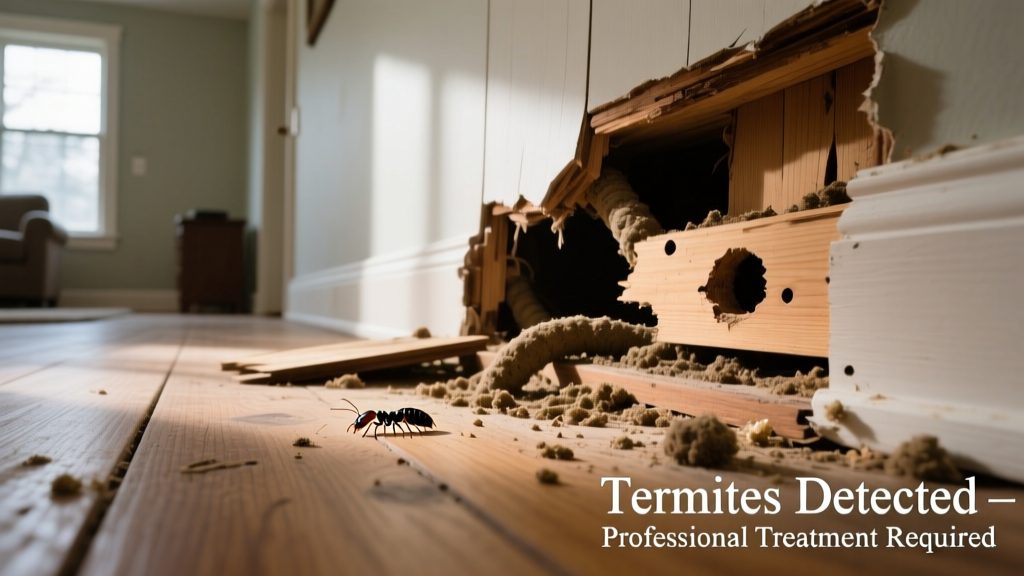
Termites are silent destroyers—small, pale insects that chew through wood, drywall, and even insulation, often undetected for months or years. A mature subterranean colony can consume up to 1 pound of wood per day, and the National Pest Management Association estimates that termites cause over $5 billion in property damage annually in the U.S. alone.
Identification
Spotting termites early is critical—but they’re rarely seen outside swarming season or deep inside structural wood. Look instead for their signs: mud tubes on foundation walls, hollow-sounding floor joists when tapped, discarded wings near windowsills, and frass (tiny, pellet-like droppings) beneath baseboards or in crawlspaces.
| Feature | Termites | Ants |
|---|---|---|
| Waist | Thick, uniform width | Narrow, pinched waist |
| Antennae | Straight, bead-like | Bent (elbowed) |
| Wings | Equal length, translucent, veined | Front wings longer than hind wings, often tinted |
| Color | Light brown to creamy white (workers); dark brown/black (swarmers) | Black, reddish, or golden brown |
What Attracts Them
Termites don’t seek out homes—they’re drawn to conditions that mimic their natural habitat: moisture, cellulose, and shelter. Leaky gutters, poor grading that pools water against foundations, untreated wood mulch within 6 inches of siding, and firewood stacked directly on soil all create ideal entry points.
- Crawlspaces with standing water or >70% relative humidity
- Wood-to-soil contact (e.g., deck posts, porch steps)
- Cracks in concrete slabs wider than 1/16 inch
- Cardboard boxes stored in damp basements (cellulose + moisture = buffet)
Treatment Methods
Natural Options
For light, localized activity—like a single infested fence post or garden shed—natural methods can slow spread while you assess severity. Orange oil (d-limonene) injected into galleries disrupts termite nervous systems; it’s EPA-registered and non-persistent. Borate sprays (e.g., Bora-Care) penetrate wood and remain toxic to termites for decades—but only protect treated surfaces, not adjacent lumber.
- Apply orange oil using a syringe injector into visible exit holes
- Use borate solutions on raw, unpainted wood before installation
- Install nematodes (Steinernema feltiae) in moist soil around foundations—effective only below 85°F and with consistent irrigation
Chemical Treatments
Professional-grade liquid termiticides like fipronil (Termidor) or imidacloprid (Premise) create non-repellent barriers in soil that termites unknowingly track back to the colony—killing workers, soldiers, and eventually the queen. According to the U.S. EPA’s 2022 Pesticide Registration Review, these products show >95% efficacy in field trials when applied at label rates with proper trench-and-treat coverage.
"Non-repellent termiticides work because termites don’t avoid them—and that’s what makes them so lethal. One forager contacting the barrier can poison dozens more within 48 hours." — Dr. Karen M. Vail, Entomologist, University of Tennessee Extension (2023)
Prevention
Prevention isn’t optional—it’s your first and most cost-effective line of defense. Start by eliminating moisture sources: clean gutters twice yearly, extend downspouts 5 feet from the foundation, and install French drains if your yard slopes toward the house. Replace damaged or rotted wood trim immediately, and use pressure-treated or naturally resistant lumber (e.g., cedar, redwood, or Accoya) for exterior projects.
- Maintain at least 18 inches of clearance between soil and wood siding or framing
- Store firewood on elevated racks at least 20 feet from the house
- Inspect basements and crawlspaces every spring and fall for mud tubes or blistered paint
- Install physical termite barriers (e.g., stainless steel mesh or crushed rock) during new construction or major renovations
When to Call an Exterminator
Call a licensed pest management professional immediately if you find mud tubes larger than pencil-width on interior walls, hear faint clicking sounds inside walls (soldier termites drumming), or see swarmers indoors—even one winged termite inside means a mature colony is likely nearby. The termite inspection process includes moisture meters, borescopes, and sometimes acoustic detection tools to map hidden damage.
Can termites eat concrete?
No—they can’t digest concrete, but they exploit hairline cracks, expansion joints, and gaps around plumbing penetrations to move through slabs. They’ll also build mud tubes over smooth concrete surfaces to reach wood above.
Do termites go away on their own?
Almost never. Colonies grow exponentially—starting with a single pair, a subterranean colony can reach 60,000+ individuals in 3–5 years (University of Florida IFAS Extension, 2021). Without intervention, structural compromise accelerates.
How long does termite treatment last?
Liquid soil barriers typically last 5–10 years depending on soil type and rainfall. Bait stations require quarterly monitoring and may take 3–6 months to eliminate colonies. Always request a written warranty—and verify the company is licensed by your state’s Department of Agriculture.
Are DIY termite kits worth it?
Rarely. Most retail bait systems lack the active ingredients or deployment precision needed for reliable control. A 2020 study published in Journal of Economic Entomology found that homeowner-applied baits failed to eliminate colonies in 78% of monitored cases—versus 94% success with professionally installed systems.
What’s the difference between drywood and subterranean termites?
Drywood termites live entirely inside dry, sound wood—no soil contact needed—and produce compact, hexagonal frass. Subterranean termites need ground moisture, build mud tubes, and cause faster, more widespread damage. Both require different treatment strategies—so accurate identification is essential before acting.
Does home insurance cover termite damage?
Almost never. Standard policies exclude pests and vermin. Some insurers offer optional riders, but they’re costly and usually require proof of prior professional treatment and annual inspections. That’s why proactive prevention—and regular termite inspection—is far more economical than repair.
If you’ve spotted mud tubes, heard hollow wood, or found wings near a window, don’t wait. Termites won’t pause while you research options. Address moisture, remove attractants, and get a certified inspector on-site within 72 hours. Early action saves thousands in repairs—and keeps your home structurally sound for decades. For ongoing protection, pair treatment with routine checks and consider installing termite monitoring stations around your perimeter.