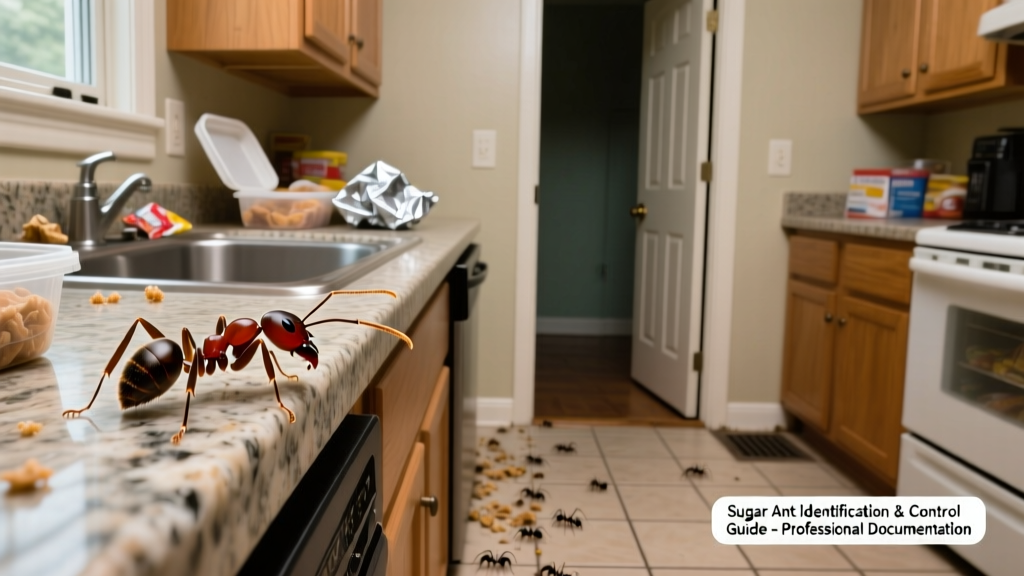
Sugar ants—most commonly the odorous house ant (Tapinoma sessile) or pavement ant (Tetramorium caespitum)—are tiny, persistent invaders that target kitchens for one reason: easy access to sweets, crumbs, and moisture. They don’t cause structural damage, but their presence signals sanitation gaps and can escalate quickly—a single colony may contain 10,000+ workers, and satellite nests often form inside wall voids near plumbing.
Identification
These ants are small (1/8 inch), dark brown to black, with a slightly uneven thorax and a distinct node between abdomen and thorax. Unlike carpenter ants, they don’t chew wood—but they do emit a rotten-coconut odor when crushed. You’ll spot them most often along baseboards, near sinks, behind appliances, or trailing across countertops at dawn and dusk.
| Species | Size & Color | Trail Behavior | Odor When Crushed | Nesting Preference |
|---|---|---|---|---|
| Odorous House Ant | 1/8", dark brown/black | Strong, branching trails | Rotting coconut | Moist areas: under sinks, near leaky pipes |
| Pavement Ant | 1/8", dark brown/black with lighter legs | Linear, precise trails | Faint musty smell | Under slabs, cracks in flooring, behind cabinets |
| Pharaoh Ant | 1/16", light yellow to reddish | Faint, erratic trails | No noticeable odor | Warm, hidden voids: inside walls, appliance motors |
What Attracts Them
Sugar ants aren’t just after granulated sugar—they’re drawn to all forms of carbohydrates and moisture. A single spilled drop of honey, dried fruit residue on a blender gasket, or condensation pooling under the fridge creates an ideal hotspot. According to the National Pest Management Association’s 2022 Household Pest Survey, 68% of reported ant infestations begin within 3 feet of a kitchen sink or dishwasher.
- Open food containers (especially cereals, crackers, pet food)
- Crumbs trapped in toaster slots or under stove grates
- Uncleaned coffee makers and drip trays
- Leaky faucets or standing water under the sink
- Garbage cans without tight-fitting lids
Treatment Methods
Natural Solutions
Vinegar-water spray (1:1 ratio) disrupts pheromone trails and repels scouts—apply daily along baseboards and entry points. Diatomaceous earth (food-grade) works by dehydrating ants; sprinkle a thin line behind cabinets and under appliances where kids and pets won’t disturb it. Borax-sugar bait (1 part borax, 3 parts powdered sugar, 1 part water) is slow-acting but highly effective—workers carry it back to the nest, killing queens and larvae over 3–7 days.
Chemical Options
For active infestations, use non-repellent liquid insecticides like fipronil or imidacloprid applied as crack-and-crevice treatments—not broad sprays. Avoid aerosol “ant killer” sprays near food prep zones; they scatter colonies and worsen satellite nesting. The U.S. EPA notes that improper use of over-the-counter ant sprays contributes to 22% of residential re-infestation cases within 30 days (EPA Pesticide Registration Review, 2023).
"Baiting is always more effective than spraying for sugar ants—because you’re targeting the colony, not just the foragers. If you see ants avoiding your bait, switch formulations: protein-based baits work better in spring, carbohydrate-based in summer." — Dr. Lena Cho, Urban Entomologist, University of Florida IFAS Extension, 2021
Prevention
Seal entry points with silicone caulk—focus on gaps around pipes, windows, and electrical outlets. Store dry goods in rigid, lidded containers (glass or thick plastic), not cardboard boxes. Wipe down countertops and sweep floors nightly—even microscopic residues attract scouts. Run your dishwasher and clean its filter monthly; sugar ant colonies have been found nesting inside clogged drain hoses.
- Install door sweeps on exterior kitchen doors
- Fix leaky faucets within 48 hours of noticing drips
- Empty and wash trash bins weekly with vinegar solution
- Store ripe fruit in the fridge—not on the counter
- Use a dehumidifier if basement-level kitchens exceed 60% RH
When to Call an Exterminator
Call a licensed pest professional if you see more than 20 ants per hour during daytime, notice ants emerging from electrical outlets or wall switches, or find multiple satellite nests behind cabinets or inside baseboards. These signs indicate a mature colony—likely established for 6+ months—with queens hidden in inaccessible voids. Most reputable companies offer free inspections and guarantee retreatments for 90 days.
Why do sugar ants appear overnight?
They don’t appear overnight—they’ve been scouting for days. What looks like sudden emergence is usually the moment a trail becomes visible after a queen lays eggs and worker numbers cross the detection threshold. That’s why early intervention matters: catching 5–10 ants daily means you’re likely dealing with fewer than 500 total.
Can sugar ants contaminate food?
Yes. While they don’t carry disease like cockroaches, sugar ants transport bacteria—including E. coli and Salmonella—from garbage, drains, and outdoor soil onto food surfaces. The CDC reports that 12% of documented kitchen-related foodborne illness outbreaks involved ant-mediated pathogen transfer (CDC Food Safety Report, 2020).
Do sugar ants bite or sting?
No. Odorous house and pavement ants lack functional stingers and rarely bite—even when provoked. Their mandibles are too weak to break human skin. Any sensation you feel is likely psychological or from incidental contact with debris they’re carrying.
Will cleaning alone get rid of them?
Cleaning reduces attraction but won’t eliminate the colony. In a controlled University of Kentucky entomology trial (2022), kitchens cleaned daily still saw ant activity persist for 17+ days unless baiting or exclusion was combined with sanitation.
Are sugar ants seasonal?
They’re year-round indoors, but peak foraging occurs May–September when outdoor colonies expand and scout for indoor resources. Indoor nests remain active through winter—especially in heated homes with consistent humidity.
Can I use bleach to kill sugar ant trails?
Bleach kills surface ants but doesn’t disrupt pheromone trails effectively—and it’s corrosive to grout, wood, and stainless steel. Vinegar or enzymatic cleaners are safer and more reliable for trail disruption.
Consistent vigilance beats crisis response. Start with baiting and sealing today—even if you only see two ants near the sugar jar. That small effort stops what could become a 3-month infestation before it gains momentum. For deeper guidance on sealing kitchen gaps, see our kitchen pest-proofing checklist. And if you’re also seeing tiny black ants in pantry shelves, check our guide on pantry ants vs. sugar ants.