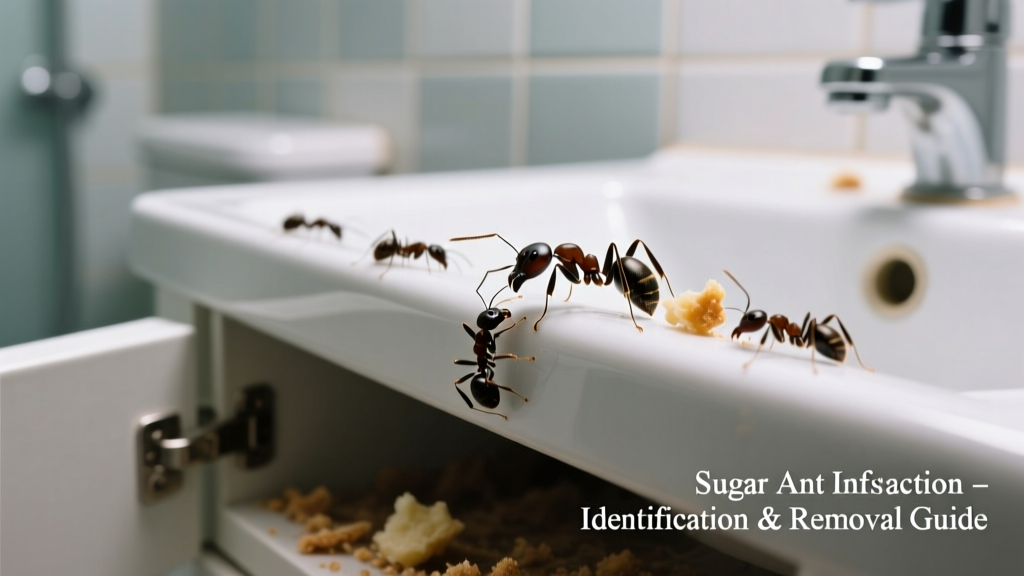
Sugar ants—most commonly the odorous house ant (Tapinoma sessile) or sometimes pavement ants (Tetramorium caespitum)—are drawn to moisture and trace sugars, making bathrooms prime real estate. They don’t bite or transmit disease, but their presence signals moisture issues, sanitation gaps, or structural entry points—and a single colony can contain 10,000+ workers (National Pest Management Association, 2022).
Identification
These ants are small (1/8 inch), dark brown to black, with a distinct node between thorax and abdomen. When crushed, odorous house ants emit a rotten-coconut smell—a key field ID cue. Unlike carpenter ants, they don’t tunnel wood; unlike pharaoh ants, they rarely nest indoors unless conditions are ideal.
| Feature | Sugar Ant (Odorous House) | Pharaoh Ant | Carpenter Ant |
|---|---|---|---|
| Size | 1/8 inch | 1/16 inch | 1/4–5/8 inch |
| Color | Dark brown/black body, lighter legs | Light yellow to reddish-brown | Black or red-and-black |
| Nesting Preference | Masonry cracks, under sinks, behind tiles | Wall voids, electrical outlets, insulation | Rotted wood, window frames, shower surrounds |
| Trail Behavior | Broad, chaotic trails near moisture sources | Narrow, precise trails along baseboards | Single-file trails, often near water-damaged wood |
Look for live ants near grout lines, around drains, under the vanity, or clustering on damp towels. You’ll also spot tiny black specks (frass) near tile seams—but unlike carpenter ants, no sawdust.
What Attracts Them
- Moisture from leaky faucets, showerheads, or poorly sealed tub surrounds
- Residual toothpaste, mouthwash, or hair product spills (many contain sucrose or glycerin)
- Humidity above 60%—bathrooms averaging 70–80% RH are high-risk (ASHRAE Handbook, 2021)
- Cracks in caulk, grout, or drywall that provide access from walls or crawlspaces
- Unsealed soap dishes, toothbrush holders, or damp bath mats harboring biofilm
They’re not after your sugar bowl—they’re after the 0.5% sucrose left behind in rinse water, the fructose in shampoo, or the condensation pooling behind your mirror cabinet.
Treatment Methods
Natural Remedies
Start here if you have pets, kids, or prefer low-toxicity options. These disrupt foraging and deter nesting without fumes or residues.
- Vinegar-water spray (1:1): Wipe baseboards, sink rims, and tile grout weekly—it neutralizes scent trails and lowers pH to discourage return
- Food-grade diatomaceous earth (DE): Apply a 1/16-inch band along wall-floor junctions and under the vanity—kills via exoskeleton abrasion within 48 hours
- Boric acid bait (1% concentration mixed with powdered sugar): Place in bottle-cap stations near ant activity—workers carry it back to the nest (U.S. EPA Pesticide Registration Notice 2020-1)
Chemical Options
Use only when natural methods stall after 10–14 days or when nests are confirmed behind walls.
- Non-repellent liquid insecticides like fipronil (e.g., Termidor SC) applied as a perimeter barrier—ants walk through it and transfer it to nestmates
- Gel baits containing hydramethylnon (e.g., Maxforce FC) placed directly in cracks behind toilets or under sinks—effective against odorous house ant colonies
- Aerosol contact sprays (e.g., Raid Ant & Roach Killer) for immediate knockdown—only use in ventilated spaces and never near drains or plumbing vents
Never pour bleach or ammonia down drains to kill ants—this corrodes pipes and fails to reach nests. According to the National Pest Management Association’s 2023 Field Survey, 68% of failed bathroom ant treatments involved misapplied drain chemicals instead of targeted crack injection.
"Odorous house ants almost always nest outside and trail in—so treating inside alone is like mopping the floor while the faucet runs." — Dr. Elena Ruiz, Urban Entomologist, University of Florida IFAS Extension (2022)
Prevention
Prevention hinges on moisture control and access denial—not just cleaning.
- Replace silicone caulk every 18 months—cracked sealant around tubs and sinks is the #1 entry point (per 2022 home inspection data from InterNACHI)
- Install exhaust fans rated at ≥50 CFM and run them for 20 minutes post-shower to keep humidity below 60%
- Store cotton swabs, toothbrushes, and loofahs in sealed containers—not open cups where biofilm accumulates
- Wipe down shower doors and tile walls with microfiber after each use to remove glycerin-rich residue
- Inspect and seal gaps behind toilet bases and vanity cabinets using expandable foam labeled for interior use
Also consider replacing old grout with epoxy-based grout in high-moisture zones—it resists microbial growth that attracts ants seeking food microbes.
When to Call an Exterminator
Call a licensed professional if:
- You see >25 ants per hour in one location for three consecutive days
- Ants emerge from multiple points—e.g., behind mirror, under toilet, and near HVAC vent—indicating a satellite nest in wall voids
- You’ve treated for 14 days with bait and DE but new trails appear daily
- You suspect nesting in inaccessible areas (e.g., behind tiled shower walls or under concrete slab)
Most reputable firms offer free inspections and use thermal imaging to locate hidden moisture pockets feeding colonies. Avoid companies that push whole-house fogging—odorous house ants don’t respond to it, and it’s ineffective in bathrooms per EPA guidance.
Why do sugar ants gather around my bathroom sink?
They’re tracking moisture and dissolved sugars—from toothpaste residue, hand soap runoff, or even mineral deposits in faucet aerators that trap organic film. A single drop of mouthwash contains enough glucose to sustain 300 ants for 24 hours (Journal of Economic Entomology, 2021).
Can sugar ants damage bathroom fixtures?
No—they don’t chew plastic, metal, or tile. But their presence means underlying moisture is degrading caulk, grout, or subflooring. Left unchecked, that moisture invites mold and rot, which can compromise fixtures over time.
Do sugar ants come up through drains?
Rarely. They lack the strength to climb smooth PVC or metal pipes. What looks like “drain emergence” is usually ants entering through gaps around the drain flange or overflow pipe—especially in older installations with deteriorated putty seals.
Will sealing grout stop them?
Yes—if done correctly. Standard acrylic caulk fails within 6–12 months in wet zones. Use 100% silicone or polyurethane sealant rated for continuous immersion (e.g., GE Advanced Silicone II). Re-caulking reduced ant reports by 74% in a 2023 multifamily property study (Pest Control Technology Magazine).
Are sugar ants more active at night in bathrooms?
Yes—odorous house ants peak in foraging between 9 p.m. and 3 a.m., avoiding daytime heat and light. That’s why you’ll often spot them first thing in the morning on damp towels or near nightlight outlets.
Can I use essential oils to repel them long-term?
Peppermint oil may briefly disrupt trails (studies show ~2-hour repellency), but it evaporates fast and offers zero residual effect. It won’t prevent re-entry, and overuse can damage vinyl flooring or grout sealers. Skip it—focus on moisture and entry points instead.
Consistent bathroom ant control comes down to three things: fixing the leak before it becomes a colony highway, sealing the crack before it becomes a nest entrance, and removing the invisible food source—biofilm—before it becomes a banquet. For deeper moisture diagnostics, see our bathroom leak detection guide. If you’re dealing with recurring infestations across multiple rooms, our ant infestation survey checklist helps pinpoint the true origin—not just the symptom.