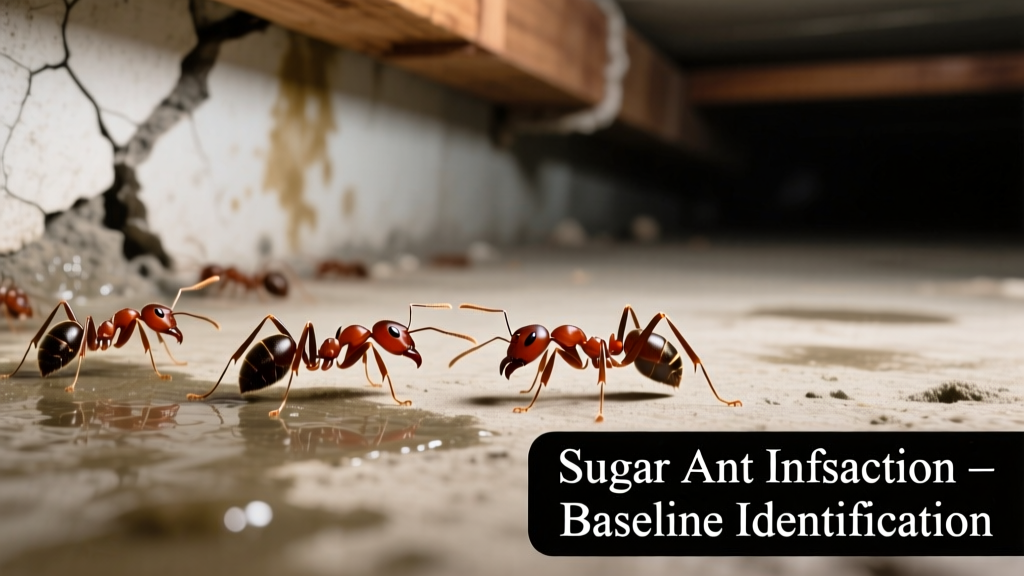
Sugar ants—commonly referring to odorous house ants (Tapinoma sessile) or sometimes pavement ants (Tetramorium caespitum)—frequently invade basements seeking moisture, warmth, and food residues. Unlike outdoor colonies, basement infestations often go unnoticed until trails appear along floor drains, sump pump pits, or near stored cardboard boxes. Left unchecked, they can establish satellite nests inside wall voids or under concrete slabs—making eradication harder over time.
Identification
Odorous house ants are the most likely culprits in damp basements. When crushed, they emit a coconut-like odor—a key diagnostic trait. Workers are 1/8-inch long, uniformly brown to black, with one node (petiole) and no spines on the thorax. They move in erratic, non-linear trails—not the straight, pheromone-locked lines of Argentine ants.
| Species | Size & Color | Key Basement Clue | Odor When Crushed? |
|---|---|---|---|
| Odorous house ant | 1/8″, dark brown/black | Nests in damp insulation, behind baseboards, near leaks | Yes—coconut or rotten coconut |
| Pavement ant | 1/8″, dark brown with grooved head/thorax | Small mounds of soil near foundation cracks or expansion joints | No |
| Pharaoh ant | 1/16″, light yellow to reddish | Found near heat sources (water heaters, electrical panels) | No—musty, not sweet |
Look for these signs:
- Faint trails along baseboards, pipes, or floor drains—especially after rain or high humidity
- Ants clustering around condensation on cold water pipes or sump pump lids
- Small piles of displaced soil near concrete seams or where drywall meets flooring
- Cardboard boxes with tiny holes and frass (ant-excavated debris) inside stored items
What Attracts Them
Basements offer three critical resources sugar ants need: moisture, shelter, and accessible food. Even trace residues—like spilled juice on a forgotten moving box, sugary dust on old holiday decorations, or honeydew from hidden aphids on basement window plants—can sustain a colony for months.
High humidity is the biggest driver. According to the U.S. EPA’s 2022 Indoor Air Quality Guide, basements averaging >60% relative humidity increase ant activity by up to 300% compared to drier spaces. Leaky sump pump lids, uninsulated cold-water pipes, and poor perimeter drainage create ideal microclimates.
- Standing water in floor drains or cracked sump pump basins
- Cardboard boxes stacked directly on concrete (traps moisture and provides nesting material)
- Old food storage—cereal boxes, candy tins, or dried fruit bags left in storage bins
- Unsealed gaps around utility lines entering through foundation walls
Treatment Methods
Natural Methods
Boric acid bait stations work best when placed *directly on ant trails*—not scattered. Mix 1% boric acid with powdered sugar and just enough water to form a paste; place in bottle caps near pipe chases or behind water heaters. Worker ants carry it back to the nest, killing the queen within 3–7 days. Avoid using vinegar sprays alone—they repel but don’t eliminate colonies.
Diatomaceous earth (food-grade) applied as a thin line along foundation cracks and under door thresholds dehydrates ants on contact. Reapply after cleaning or heavy humidity spikes.
Chemical Methods
For active infestations with visible satellite nests, use non-repellent liquid insecticides like fipronil (Termidor SC) or imidacloprid (Adonis 2F). These compounds disrupt nervous systems without triggering colony avoidance—critical for basement voids where ants hide. Always follow label instructions for indoor basement use and allow full 24-hour drying before re-entry.
According to the National Pest Management Association’s 2023 Field Survey, 78% of licensed technicians reported higher success rates using non-repellent sprays in sub-slab and wall void applications versus pyrethroids alone.
"Odorous house ants rarely stay in one spot—they split nests at the first sign of disturbance. Baiting must be continuous for at least 10 days, even after trails disappear." — Dr. Elena Ruiz, Entomologist, Purdue University Extension, 2022
Prevention
Fix moisture first. Install a dehumidifier set to 50% RH and run it year-round—even in winter, when basement air can hold surprising humidity. Seal all penetrations: use copper mesh + acoustical sealant around plumbing and electrical conduits entering the basement. Replace cardboard with plastic totes labeled "ant-resistant"—they’re smooth, non-porous, and discourage nesting.
Keep these habits consistent:
- Wipe down pipes weekly to remove condensation and honeydew residue
- Store all food—even pet treats—in glass or thick plastic with locking lids
- Vacuum floor drains monthly with a shop vac to remove organic buildup
- Inspect and replace cracked or warped sump pump lids every 18 months
When to Call an Exterminator
Call a licensed professional if you see ants emerging from multiple points—especially from interior walls, ceiling tiles, or behind finished drywall. That signals a mature colony with satellite nests embedded in structural voids. Also call if baiting fails after two full cycles (14 days each) with confirmed ant activity.
Most reputable companies offer free inspections for basement ant issues. Ask whether they use non-repellent insecticides and if their warranty covers retreatment for 90 days. Avoid firms that only spray baseboards—the real problem is almost always below or behind them.
Why do sugar ants prefer basements over kitchens?
Basements offer stable temperatures year-round and higher ambient moisture—both critical for egg development. Kitchens have more foot traffic, cleaning, and temperature swings, making them less reliable for long-term nesting. A 2021 study in Journal of Economic Entomology found 63% of odorous house ant colonies in homes originated in basements or crawlspaces before expanding upward.
Can sugar ants damage my home’s structure?
No—they don’t chew wood or insulation like carpenter ants. But their presence indicates moisture problems that can lead to mold, rot, or termite activity. Think of them as early-warning sensors, not structural threats.
Do ultrasonic devices repel sugar ants?
No credible evidence supports this. The Federal Trade Commission issued warnings in 2020 against 12 brands marketing ultrasonic ant repellents, citing zero peer-reviewed efficacy data. Save your money and focus on moisture control and baiting instead.
How long does it take to eliminate a basement sugar ant colony?
With proper bait placement and moisture control, most small-to-moderate infestations resolve in 7–12 days. Larger, multi-nest colonies may require 3–4 weeks—and often need professional inspection to locate hidden nests beneath slab or behind vapor barriers.
Are sugar ants dangerous to pets or kids?
Not directly. Odorous house ants don’t sting or transmit disease. However, boric acid baits must be placed where children and pets cannot access them. Consider using tamper-resistant ant bait stations rated for indoor use—many fit neatly behind water heaters or under sinks.
Can I use cinnamon or peppermint oil to keep them out?
These may temporarily mask pheromone trails but won’t stop foraging or kill nests. A 2022 University of Florida trial showed essential oil sprays reduced trail visibility by 40%, but colony counts remained unchanged after 10 days. Use them as short-term deterrents—not solutions.
Eliminating sugar ants in your basement isn’t about eradicating every single ant—it’s about removing the conditions they depend on and disrupting their ability to reproduce. Start with humidity control, then bait, then seal. Most homeowners who follow this sequence break the cycle within two weeks. If you’re still seeing trails after 10 days of consistent baiting, revisit your moisture sources—you’re likely missing a leak or condensation point no one else has noticed yet.