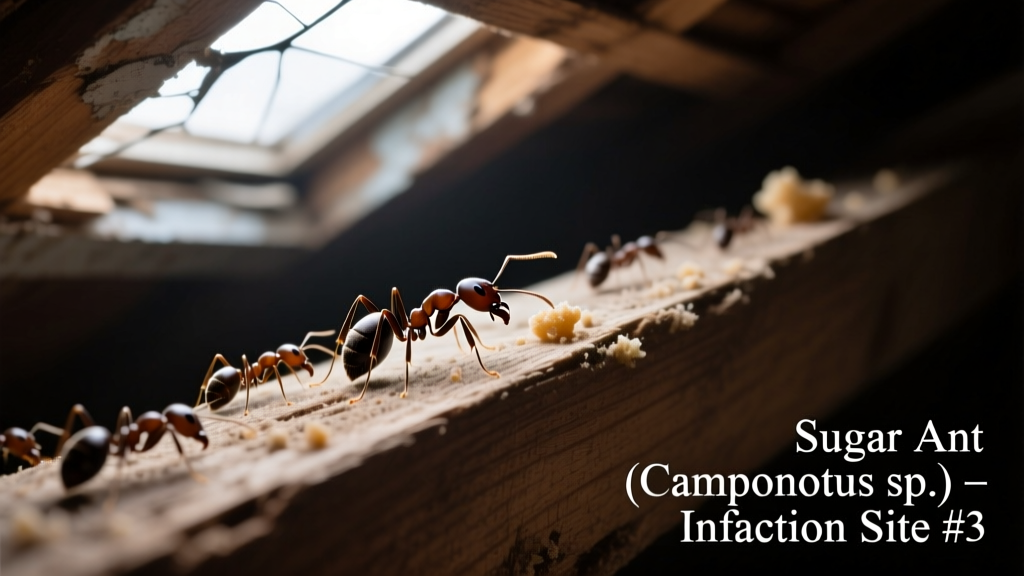
Sugar ants—commonly referring to odorous house ants (Tapinoma sessile) or sometimes acrobat ants (Crematogaster spp.)—are small, brown-to-black ants drawn to moisture and sweet residues. When they appear in your attic, it’s rarely just a foraging trail—they may be nesting in insulation, behind soffits, or inside rotted wood. Left unchecked, colonies can grow to 10,000+ workers and spread into living spaces within weeks.
Identification
Odorous house ants are 1/8-inch long, uniformly dark brown or black, with a single-segmented petiole (waist) and no visible spines. When crushed, they emit a rotten-coconut smell—a key diagnostic trait. Acrobat ants are slightly larger (up to 3/16 inch), heart-shaped abdomens that lift over their backs when disturbed, and often nest in damp, decaying wood.
| Feature | Odorous House Ant | Acrobat Ant | Carpenter Ant |
|---|---|---|---|
| Size | 1/8 inch | 1/8–3/16 inch | 1/4–1/2 inch |
| Color | Dark brown to black | Black head & thorax, reddish abdomen | Black, red, or bicolored |
| Nesting preference | Moist insulation, wall voids, under shingles | Rotted wood, foam board, insulation | Moist, decayed wood (no soil contact) |
| Distinguishing sign | Rotten coconut odor when crushed | Abdomen raised over back when alarmed | Sawdust-like frass near entry points |
What Attracts Them
Attics become ant magnets when three conditions converge: moisture, food residue, and shelter. Leaky roofs, poor ventilation, and condensation from bathroom exhaust vents create damp insulation—ideal for colony expansion. Forgotten holiday decorations with candy wrappers, rodent bait stations leaking peanut butter, or even birdseed stored in cardboard boxes provide high-calorie fuel. According to the National Pest Management Association’s 2022 Structural Pest Report, 68% of attic ant infestations involved at least one moisture-related structural defect.
- Roof leaks or ice dam damage softening plywood sheathing
- Unsealed HVAC duct joints dripping condensation into insulation
- Cardboard moving boxes stacked directly on joists (ants tunnel through corrugated layers)
- Old Christmas decorations with caramelized sugar residue on ornaments or tins
Treatment Methods
Natural Approaches
Start with non-toxic options if the colony is small (<50 visible ants/day) and confined to one area. Diatomaceous earth (food-grade) applied as a 1/8-inch band along rafters and soffit seams dehydrates ants on contact—but only works when dry. A 50/50 vinegar-water spray disrupts pheromone trails; reapply every 48 hours for 5 days. Boric acid mixed with powdered sugar (1:3 ratio) placed in bottle-cap stations near suspected entry points acts as a slow-transfer poison—workers carry it back to the nest. This method takes 7–10 days but has low mammal toxicity.
Chemical Options
For active nests in insulation or wall voids, dust formulations like deltamethrin or fipronil are most effective because they cling to fibers and remain active for 3–6 months. Apply using a hand duster through drilled 1/8-inch holes at rafter intersections—never spray liquid insecticides into insulation, as this wets material and encourages mold. The U.S. EPA notes that improperly applied liquid sprays in attics contribute to 22% of post-treatment moisture complaints in pest service reports (EPA Pesticide Registration Review, 2023).
"Dusting is the gold standard for attic ant control—sprays fail because they don't penetrate insulation, and baits won't reach deep nests. You need residual contact where ants walk, not where you hope they'll eat." — Dr. Lena Cho, Entomologist, University of Florida IFAS Extension (2021)
Prevention
Sealing and drying are non-negotiable. Replace wet or moldy insulation before treatment—ants won’t abandon a viable nest in compromised material. Install continuous soffit and ridge vents to maintain attic humidity below 55% RH year-round. Seal all penetrations: plumbing stacks, electrical conduits, and recessed light housings with expanding foam or copper mesh (ants can’t chew through metal).
- Install a vapor barrier beneath attic flooring if storage platforms exist
- Store seasonal items in sealed plastic totes—not cardboard or fabric bins
- Trim tree branches 6+ feet from roofline to block aerial bridges
- Inspect and replace cracked or missing gable vent screens annually
When to Call an Exterminator
Call a licensed professional if you see more than 25 ants per hour during daylight, find frass or sawdust near beams (possible carpenter ant overlap), or detect live ants inside interior walls downstairs. Also consult one if your attic has >12 inches of settled cellulose insulation—you’ll need specialized equipment to treat without disturbing contaminants. Most reputable firms offer free attic inspections; ask for thermal imaging to locate hidden moisture pockets before treatment.
Can sugar ants damage my roof structure?
No—they don’t chew wood like carpenter ants—but their presence signals underlying moisture problems that do cause rot. Left unaddressed, that rot weakens decking and fascia. Fix the leak first, then eliminate the ants.
Will attic sugar ants go away on their own?
Almost never. Colonies expand upward toward warmth and moisture. Indoor sightings typically increase 3–4 weeks after attic establishment. Without intervention, they’ll breach ceiling fixtures or light switches within 6–8 weeks.
Is it safe to use ant bait in the attic?
Only if placed in tamper-resistant stations mounted to rafters—not loose on insulation. Loose bait granules attract rodents and degrade in humidity. Avoid gel baits entirely: they dry out in hot attics and become ineffective within 48 hours.
Do sugar ants carry diseases?
Not directly, but they track bacteria—including E. coli and Salmonella—from gutters, compost piles, and dead insects across surfaces. In homes with immunocompromised residents, this cross-contamination risk warrants faster intervention.
How long does attic ant treatment take to work?
Dust treatments show reduced activity in 48–72 hours; full colony collapse usually occurs in 7–14 days. Bait-based approaches require 10–21 days. If activity persists beyond 17 days, suspect multiple satellite nests or untreated moisture sources—re-inspect with a moisture meter.
Can I treat attic sugar ants myself if I have a flat roof?
Yes—but access changes everything. Flat roofs often hide nests under membrane layers or in parapet wall voids. Use a borescope camera to inspect seams before drilling. For safety and precision, consider hiring someone trained in low-slope roofing protocols—flat roof pest access guidelines explain proper entry points.
Eliminating sugar ants from your attic isn’t about killing bugs—it’s about correcting the environment they exploit. Every ant you see is a symptom. Address moisture, seal entry paths, and monitor with simple sticky traps in corners for 30 days post-treatment. For ongoing help identifying ant species by photo, visit our ant identification guide. If you spot winged swarmers in late spring, check our carpenter ant vs. sugar ant comparison—swarmers change the game entirely.