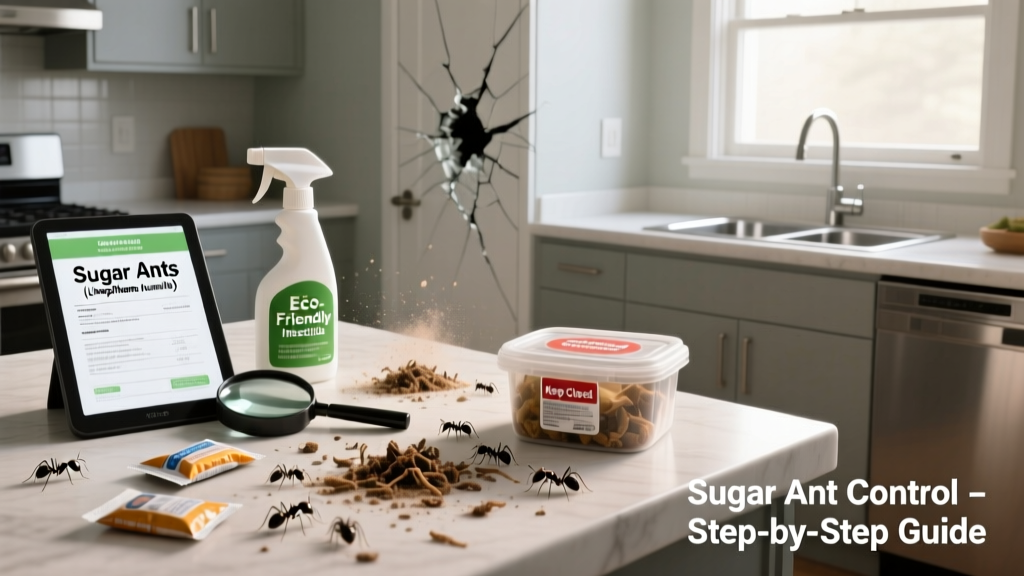
Sugar ants—most commonly the odorous house ant (Tapinoma sessile) or sometimes pavement ants (Tetramorium caespitum)—are tiny, persistent foragers drawn to sweet, sticky, and greasy residues. They don’t bite or damage structures, but their presence signals sanitation gaps and can escalate quickly: a single colony may contain 10,000+ workers, and satellite nests often form within wall voids or under appliances.
Identification
Sugar ants are typically 1/8 inch long, dark brown to black, with a segmented body and a faint coconut-like odor when crushed. Unlike carpenter ants, they lack a defined waist constriction and rarely swarm indoors. You’ll spot them most often along baseboards, near sinks, or trailing across countertops at dawn and dusk.
| Species | Size | Color | Distinguishing Trait | Nesting Preference |
|---|---|---|---|---|
| Odorous house ant | 1/8 inch | Dark brown/black | Releases coconut smell when crushed | Moist areas: under mulch, leaky pipes, insulation |
| Pavement ant | 1/8–1/16 inch | Light to dark brown | Parallel grooves on head and thorax | Cracks in driveways, under slabs, near foundations |
| Pharaoh ant | 1/16 inch | Light yellow to reddish | Two-segmented petiole; no odor | Warm, hidden spaces: wall voids, electrical outlets |
Signs of infestation include:
- Consistent ant trails—especially near sugar jars, fruit bowls, or pet food dishes
- Tiny piles of displaced soil or sawdust-like debris near baseboards or door thresholds
- Clusters of ants around damp spots, like under refrigerators or near leaky faucets
What Attracts Them
Sugar ants follow pheromone trails to reliable food and water sources—and they’re remarkably efficient at finding both. They prefer temperatures between 70–85°F and humidity above 60%, making kitchens, bathrooms, and laundry rooms prime real estate. Even minute residues—a spilled drop of syrup, dried juice film on a blender lid, or crumbs behind the toaster—can sustain a foraging line for days.
According to the National Pest Management Association’s 2022 Household Pest Survey, 68% of sugar ant infestations originated from unsealed pantry items or improperly stored pet food.
- Open or cracked containers of honey, jam, cereal, or dried fruit
- Uncleaned coffee makers, drip trays, and microwave interiors
- Overwatered houseplants or potted plants kept indoors (roots retain moisture and attract nesting)
- Leaky faucets, condensation under sinks, or HVAC drip pans
Treatment Methods
Natural Remedies
Start here if you have pets, kids, or prefer low-toxicity options. These disrupt foraging behavior and deter nesting—but won’t eliminate mature colonies alone.
- Vinegar-water spray (1:1 ratio): Wipe trails and entry points daily to erase pheromone paths
- Borax-sugar bait (1 part borax, 3 parts powdered sugar, 1 tsp water): Place in shallow bottle caps near trails—worker ants carry it back to the nest
- Food-grade diatomaceous earth (DE): Dust lightly along baseboards and behind appliances; dehydrates ants on contact
- Cinnamon or cayenne pepper lines: Create physical barriers at door thresholds and cabinet edges
Pro tip:
"Borax baits work best when placed where ants are actively foraging—but only after you’ve confirmed they’re taking the bait. Watch for 24 hours before deploying widely. If no activity, switch to a protein-based bait (like peanut butter + borax) for 3 days—some colonies shift preferences seasonally." — Dr. Elena Ruiz, Urban Entomologist, Purdue Extension, 2023
Chemical Options
Use targeted, EPA-registered products only when natural methods stall or infestations persist beyond 10 days. Always follow label instructions—and never spray repellent insecticides directly on trails, as this causes colony budding (splitting into multiple nests).
- Non-repellent liquid sprays (e.g., Termidor SC or Phantom): Apply as a perimeter barrier or crack-and-crevice treatment; undetectable to ants, so they track it back to the nest
- Gel baits (e.g., Advion Ant Gel or Maxforce FC): Place small dabs near trails—not on top of them—to encourage slow uptake and transfer
- Dust formulations (e.g., DeltaDust): For wall voids or behind outlets; use with a hand duster and avoid over-application
Prevention
Long-term control hinges on denying access and eliminating incentives. Focus first on your kitchen and pantry—where 92% of sugar ant activity originates (University of Florida IFAS, 2021). Seal entry points with silicone caulk, not just weatherstripping, since ants exploit gaps as narrow as 1/32 inch.
- Store all dry goods—including flour, oats, and pet kibble—in rigid, lidded containers (glass or thick plastic with locking seals)
- Wipe down countertops and stovetops immediately after cooking; run dishwashers and clean sponges nightly
- Inspect and replace worn door sweeps on exterior doors—especially garage and basement entries
- Trim tree branches and shrubs 2 feet away from the house to block aerial bridges
For ongoing monitoring, place double-sided tape strips along suspected trail routes. Count ants captured over 48 hours—if more than 25 appear, re-evaluate bait placement or consider hidden nesting.
When to Call an Exterminator
Call a licensed pest professional if:
- You see ants emerging from walls, outlets, or ceiling fixtures (indicates nesting inside framing)
- Multiple bait stations go untouched for 5+ days despite active foraging nearby
- You’ve treated for 3 weeks with no reduction—or numbers increase after treatment
- You suspect Pharaoh ants (which require specialized non-repellent protocols to avoid colony fragmentation)
Most reputable providers offer free inspections and will map interior and exterior entry zones before quoting. Ask about integrated pest management (IPM) plans—they prioritize exclusion and sanitation over blanket spraying. You’ll find more details in our ant control overview and kitchen pest prevention guide.
Why do sugar ants keep coming back after cleaning?
Cleaning removes food sources but doesn’t erase pheromone trails or address satellite nests. Ants re-establish trails within hours unless you disrupt the chemical path—use vinegar or enzymatic cleaners, not just soap and water. Also check behind large appliances: 40% of recurring infestations trace to nests under refrigerators or dishwashers (NPMA 2022).
Can sugar ants damage my home?
No—they don’t chew wood, wiring, or insulation. But their presence often coincides with moisture issues that do cause structural harm. If you find nests near plumbing leaks or rotting window sills, fix the water source first—then treat the ants. Learn more in our moisture problem troubleshooting guide.
Are sugar ants the same as carpenter ants?
No. Carpenter ants are larger (¼–½ inch), often reddish-black, and excavate galleries in damp or decaying wood. Sugar ants don’t tunnel or weaken structures. Confusing them delays proper treatment—carpenter ant infestations require different baits and inspection priorities.
Do sugar ants go away in winter?
They rarely disappear—they retreat deeper into wall voids or under slabs where temperatures stay above 50°F. Indoor heating creates ideal conditions year-round. In fact, indoor sightings often peak December–February when outdoor foraging drops and ants concentrate near heat sources.
Is boric acid safe around pets?
In bait form (mixed with sugar at ≤1% concentration), boric acid poses minimal risk if pets don’t consume large amounts—but it’s still toxic if ingested in quantity. Keep baits in inaccessible locations (e.g., inside empty soda cans taped upright behind cabinets). Safer alternatives include diatomaceous earth or commercial gels labeled “pet-safe” like Advion Ant Gel.
How long does it take to get rid of sugar ants?
With consistent baiting and sanitation, visible foraging usually drops in 5–7 days. Complete colony elimination takes 2–4 weeks—longer if satellite nests exist. Monitor with tape traps for 14 days after the last sighting to confirm eradication.
Sugar ants aren’t dangerous—but they’re a clear signal that something in your home environment is out of balance. Fix the conditions, not just the critters. A clean kitchen, sealed pantry, and dry perimeter make your space far less inviting than the neighbor’s. And if you’re dealing with other common invaders, check out our guides on cockroach control and silverfish prevention.