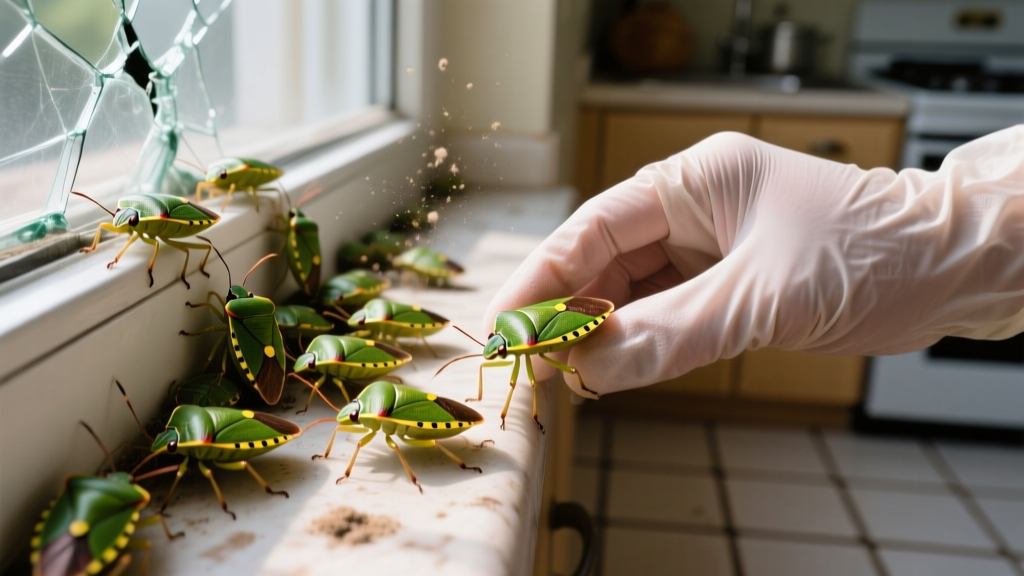
Stink bugs—especially the brown marmorated stink bug (Halyomorpha halys)—are seasonal invaders that seek warmth, light, and food sources. Kitchens attract them year-round but peak from late September through November, when outdoor temperatures drop and indoor lights and crumbs become irresistible.
Identification
Stink bugs are shield-shaped, about 14–17 mm long, with mottled brown-gray coloring, alternating light and dark bands on antennae, and a faint, cilantro-like odor when crushed or disturbed. In kitchens, you’ll often spot them near windows, above cabinets, or on countertops near fruit bowls.
| Pest | Size & Shape | Key Markers | Odor When Crushed? |
|---|---|---|---|
| Brown Marmorated Stink Bug | 14–17 mm; shield-shaped | Banded antennae, pale bands on dark abdomen edges | Yes — sharp, cilantro-like |
| Boxelder Bug | 12–14 mm; elongated oval | Red-orange markings on black body, no banding on antennae | No |
| Asian Lady Beetle | 5–8 mm; rounder, domed | Variable spots, 'M'-shaped mark behind head | Faint, acrid — but less pungent |
What Attracts Them
Kitchens offer three key draws: heat (from appliances and lighting), light (especially LED under-cabinet strips), and food residues. Overripe fruit left out, unwashed dishes with residue, and gaps around refrigerator or dishwasher seals create ideal entry points and feeding zones.
- Cracked window screens or gaps >1/8 inch near soffits or vents
- Unsealed gaps around plumbing lines entering walls behind sinks
- Open pantry doors near stored grains or dried fruit
Treatment Methods
Natural Removal
Vacuuming with a shop vac (not a household vacuum) is safest—prevents odor release and avoids crushing. Empty the canister outside immediately. For live capture, use a wide-mouth glass jar with a damp paper towel and a spoon to gently scoop bugs off surfaces. Release outdoors at least 100 feet from your home.
Essential oil sprays (10 drops peppermint + 1 cup water + 1 tsp dish soap) work as a short-term deterrent on baseboards and window sills—but do not spray near food prep areas. Reapply every 2–3 days.
Chemical Options
Pyrethroid-based aerosols like Suspend SC (deltamethrin) are EPA-registered for indoor stink bug control—but only apply along non-food-contact perimeter zones: behind cabinets, inside toe-kicks, and behind refrigerators. Never spray countertops, sinks, or near open food.
The U.S. EPA estimates that improper indoor pesticide use accounts for 23% of residential pesticide exposure incidents reported to poison control centers (EPA Pesticide Incident Data, 2022). Always wear gloves and ventilate during application.
Prevention
Seal all exterior entry points with silicone caulk—not acrylic or painter’s caulk, which shrink and crack. Focus on where pipes enter walls behind sinks, gaps around window frames, and spaces between soffits and fascia boards.
- Install fine-mesh (16-mesh or finer) window screen replacements
- Switch outdoor porch lights to yellow sodium vapor bulbs—less attractive to stink bugs than white LEDs
- Wipe down countertops nightly and store fruit in sealed containers or the fridge
- Check and replace weatherstripping on pantry and cabinet doors
When to Call an Exterminator
If you find more than 20 stink bugs indoors in a single week—or see clusters inside wall voids behind outlets or switch plates—it’s time for professional inspection. A licensed technician can perform targeted dusting in wall voids using DeltaDust (deltamethrin), which remains effective for up to 8 months.
"Stink bugs don’t build nests or reproduce indoors—but if they’re coming in by the dozens, it means your home has multiple unsealed thermal pathways. Fix those first, then treat." — Dr. Kim D. Lacey, Entomologist, Rutgers Cooperative Extension, 2023
Why do stink bugs gather on my kitchen ceiling?
They’re drawn to heat rising from cooking surfaces and interior lighting. Ceiling-mounted fixtures—especially recessed LEDs—emit infrared wavelengths that mimic warm sunlit surfaces. Install baffles or switch to lower-wattage bulbs to reduce attraction.
Can stink bugs contaminate food?
Not directly through pathogens—but their defensive secretion contains aldehydes that can taint flavor and smell if released near uncovered food. The USDA confirms no disease transmission, but recommends discarding any food they contacted while alive or dead (USDA Food Safety Fact Sheet, 2021).
Do stink bugs lay eggs in kitchens?
No. They only lay eggs outdoors on plant leaves—typically on tomatoes, peppers, beans, or ornamental trees. Indoor sightings are always adults seeking shelter, never breeding activity.
Is vinegar effective against stink bugs?
Vinegar sprays (1:1 white vinegar/water) may deter crawling but won’t kill or repel flying adults. It also risks etching granite or quartz countertops. Skip it—use physical removal instead.
How long do stink bugs live indoors?
Without food or mating opportunities, most survive 3–6 weeks. Their metabolism slows in cooler indoor temps, extending survival—but they won’t multiply or establish colonies.
Are stink bugs attracted to certain fruits?
Yes—especially ripening apples, pears, peaches, and tomatoes. Keep these in the fridge or in sealed glass containers. A bowl of overripe bananas on the counter? That’s basically a stink bug welcome mat.
Stink bugs won’t vanish overnight—but consistent sealing, nightly cleanup, and smart lighting choices cut kitchen sightings by 70–90% within three weeks. For persistent issues, pair DIY efforts with a brown marmorated stink bug control plan focused on exterior exclusion. And if you spot them near your pantry pests, check for overlapping infestations—though stink bugs don’t eat dry goods, their presence often coincides with poor overall sealing.