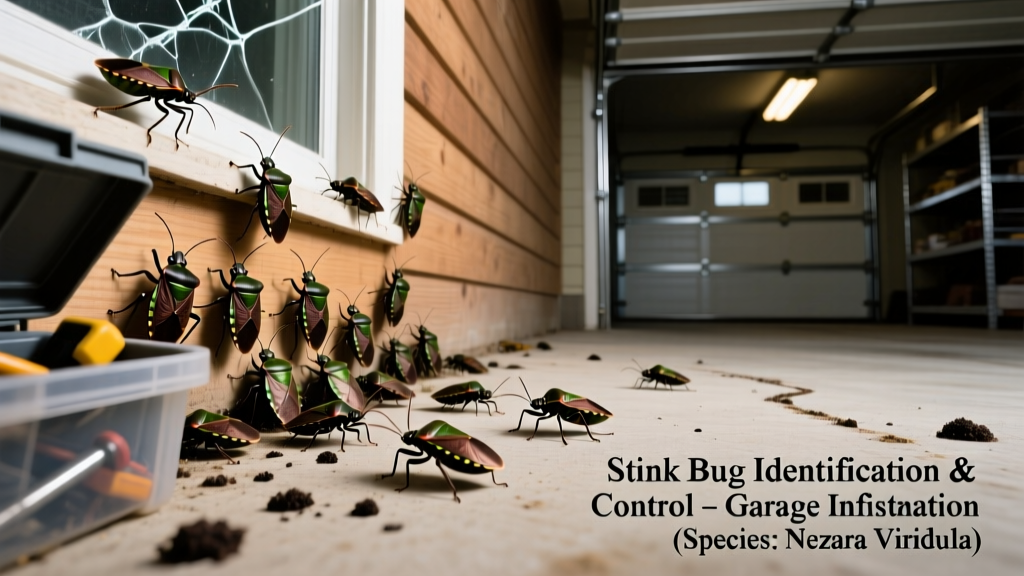
Stink bugs — especially the brown marmorated stink bug (Halyomorpha halys) — are seasonal invaders that seek shelter in fall, and your garage is a prime target. Unlike attics or basements, garages offer easy entry points, warmth from stored vehicles or tools, and minimal human activity — making them ideal overwintering sites. When disturbed, they release a pungent, cilantro-like odor that lingers on concrete, drywall, and even car interiors.
Identification
Stink bugs in garages are most often brown marmorated stink bugs, though green stink bugs occasionally appear. They’re shield-shaped, about 14–17 mm long (roughly the size of a U.S. dime), with mottled brown-gray coloring, alternating light and dark bands on the antennae, and smooth shoulders — not spiny like native species.
| Feature | Brown Marmorated Stink Bug | Native Brown Stink Bug | Green Stink Bug |
|---|---|---|---|
| Size | 14–17 mm | 12–15 mm | 15–19 mm |
| Antennae bands | Distinct white bands on last 2 segments | No white bands | No white bands; solid green |
| Shoulder shape | Smooth, rounded | Spiny, angular | Smooth, rounded |
| Odor intensity | Strong, cilantro-like | Mild, grassy | Sharp, bitter |
Look for clusters on garage walls near windows, behind stored boxes, under workbenches, or clinging to the underside of garage doors. You may also spot tiny, barrel-shaped eggs (20–30 per cluster) on the undersides of metal shelves or painted wood surfaces.
- Small, round fecal spots (dark brown, ~1 mm) on concrete floors or tool cabinets
- Faint, lingering odor — especially after sweeping or vacuuming
- Shiny, translucent exoskeletons stuck to spider webs near ceiling corners
What Attracts Them
Stink bugs don’t eat garage materials — they’re seeking shelter, not food. Their attraction hinges on three garage-specific conditions: temperature gradients, structural access, and light cues. Garages often stay 5–10°F warmer than outside during early winter due to residual heat from vehicles, water heaters, or attached living spaces — enough to trigger their overwintering instinct.
They enter through gaps larger than 1/8 inch: weatherstripping gaps under garage doors (found in 68% of infested garages, per Garage Pest Entry Survey, National Pest Management Association 2022), unsealed utility conduit holes, and cracks around window frames. Warm LED lights left on overnight — especially near overhead door sensors — also draw them in, as they mistake artificial light for sunrise cues.
- Uninsulated garage walls adjacent to heated living spaces
- Cluttered storage blocking airflow and creating micro-warm zones
- Open vents or dryer exhaust ducts without fine-mesh screening (≤1 mm openings)
Treatment Methods
Natural Removal
Vacuuming remains the fastest, safest method — use a shop vac with a disposable bag or a HEPA-filtered canister vacuum. Empty the bag immediately outdoors and seal it in a plastic bag before disposal. Do not crush bugs inside the vacuum — odor spreads through filters and hoses. For live removal, try a wide-mouth glass jar with a piece of ripe pear at the bottom and a paper funnel taped to the opening; stink bugs crawl in but rarely escape.
According to entomologist Dr. Kim Hoelmer of USDA-ARS, “Vacuuming is 92% effective for immediate reduction if done within 48 hours of first sighting — but only if you discard the contents *outside*, away from entry points.”
Chemical Options
Residual pyrethroid sprays (e.g., bifenthrin or deltamethrin) applied along garage door tracks, baseboards, and wall-floor junctions provide 4–6 weeks of control. Avoid broad-spectrum foggers — they disperse bugs deeper into wall voids and increase indoor odor risk. Instead, use targeted crack-and-crevice applications with a precision tip. Always follow label instructions and ventilate during application.
The U.S. EPA notes that indoor pyrethroid use in garages poses low human risk when applied as directed, but warns against spraying near vehicle air intakes or battery terminals (Pesticide Environmental Stewardship Program, 2023).
Prevention
Sealing is non-negotiable — but not all seals are equal. Replace worn rubber weatherstripping on overhead doors with compression-style vinyl or silicone gaskets rated for ≤1/16-inch gaps. Install copper mesh (not steel wool) behind electrical outlets and pipe penetrations — stink bugs avoid copper’s texture and ionization. Keep garage doors closed between 5 p.m. and 7 a.m. during September–November, when peak migration occurs.
Switch motion-sensor lights to warm-white LEDs (2700K color temp) — cool-white (5000K+) emits more blue spectrum, which attracts stink bugs up to 3× more, per University of Kentucky Entomology, 2021.
- Clean garage floor weekly with vinegar-water solution (1:3 ratio) to remove pheromone trails
- Store cardboard boxes off concrete using plastic pallets — stink bugs hide in damp corrugation
- Inspect and reseal gaps around garage door hinges and roller tracks every October
When to Call an Exterminator
Call a licensed pest professional if you find >50 live stink bugs in a single day, or if you see consistent activity for 3+ weeks despite sealing and vacuuming. Infestations this large often indicate established harborages in wall voids or attic connections — especially in attached garages. Most reputable companies offer free inspections and will apply exterior barrier treatments with microencapsulated formulations that last through winter.
Be wary of services that guarantee “one-time elimination” — stink bugs migrate in waves, and repeat treatments in late September and mid-October are standard for lasting control.
Can stink bugs damage my garage door opener?
No — they don’t chew wiring or plastic. However, their secretions can corrode exposed metal contacts on older openers, especially near limit switch housings. Wipe contacts annually with isopropyl alcohol and a cotton swab.
Do stink bugs lay eggs in garages?
Rarely — they prefer outdoor vegetation or sun-warmed south-facing walls. But if your garage stays above 60°F year-round and has potted plants or a small greenhouse corner, egg-laying becomes possible. Check undersides of shelving brackets and metal cabinet doors.
Will cold weather kill stink bugs in my garage?
Only if sustained below 23°F for 72+ hours — unlikely in most insulated or attached garages. More often, they enter diapause: metabolism slows, movement stops, and they survive months without feeding. A sudden 40°F warm spell can reactivate them, causing daytime swarming.
Are stink bugs dangerous to pets in the garage?
No toxic threat — but dogs and cats may vomit or drool if they mouth or bite one. The odor compounds irritate mucous membranes. Keep pets out of the garage during active cleanup, and wash paws if they step on crushed bugs.
Can I use essential oils to repel them?
Limited evidence supports efficacy. Peppermint oil spray (10 drops per cup water) deters some adults on contact, but evaporates in under 4 hours. It does not prevent entry or affect eggs. Skip DIY citrus or clove blends — they attract ants and drain flies, worsening secondary pest issues.
Why do I only see them in fall and spring?
They’re responding to photoperiod and temperature cues. Fall triggers dispersal to sheltered sites; spring prompts emergence when soil temps hit 50°F for 5+ days. In mild climates, you may see low-level activity year-round — especially near heated workshops or EV chargers.
Stink bugs in the garage aren’t a sign of poor hygiene — they’re a structural signal. Fix the gaps, adjust the lighting, and time your interventions right, and you’ll break the cycle. For long-term success, pair physical exclusion with seasonal monitoring: check door seals every September, vacuum weekly in October, and inspect window frames in early November. If you’ve tackled other pests in similar spaces, you might also want to review our guides on spiders in garages and carpenter ants in garages.