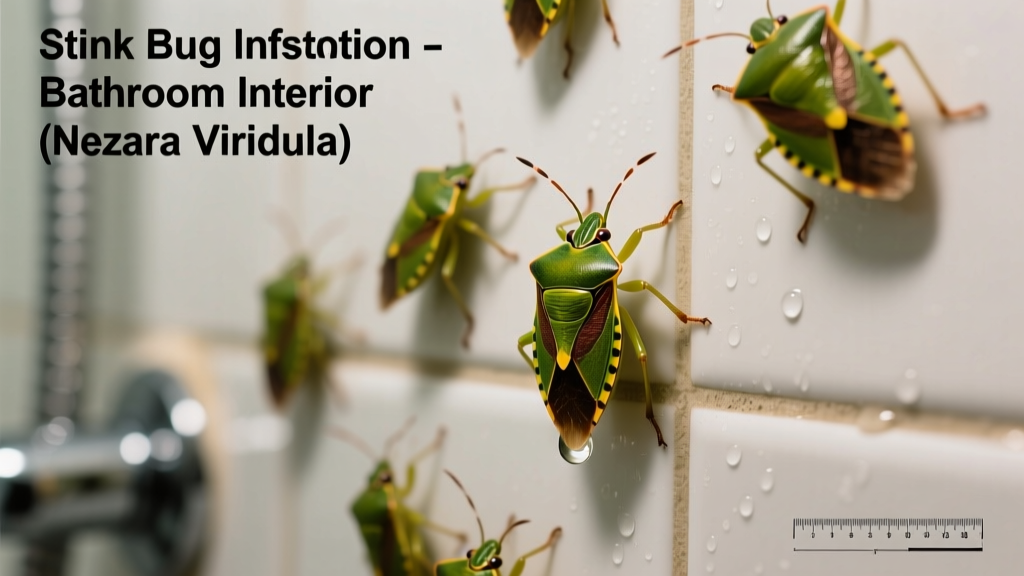
Stink bugs—especially the brown marmorated stink bug (Halyomorpha halys)—frequently appear in bathrooms during late summer and fall, drawn by moisture, warmth, and light. Unlike kitchens or attics, bathrooms offer a unique combination of humidity, tile surfaces that retain heat, and often overlooked entry points like vent covers and gaps around plumbing. Their presence isn’t just a nuisance—their defensive odor lingers on towels, shower curtains, and grout, and crushing them spreads pheromones that attract more.
Identification
Stink bugs in bathrooms are almost always adult brown marmorated stink bugs—not nymphs or lookalikes—because adults seek sheltered, humid microclimates before overwintering. They’re 14–17 mm long, shield-shaped, with alternating light and dark bands on antennae and abdominal edges. You’ll spot them clinging to shower walls, resting on damp bath mats, or wedged behind toilet tanks.
| Pest | Size & Shape | Key Distinguishing Feature | Bathroom Behavior |
|---|---|---|---|
| Brown marmorated stink bug | 14–17 mm, shield-shaped | Banded antennae; pale spots on shoulder plates | Clusters near vents, sinks, or warm tiles; rarely flies unless disturbed |
| Boxelder bug | 12–14 mm, elongated oval | Red-orange markings on black body; no banding on antennae | Rare in bathrooms—prefers sunny windowsills in living rooms |
| Asian lady beetle | 5–8 mm, rounder, domed | Variable spotting; "M"-shaped mark behind head | May enter via same cracks but avoids standing water and damp surfaces |
What Attracts Them
Bathrooms provide three critical attractants: thermal gradients, moisture cues, and structural vulnerabilities. Stink bugs detect humidity changes as low as 2% above ambient—enough to draw them toward steamy post-shower air. They also follow radiant heat from heated floors or towel warmers, and use gaps around PVC drain pipes (often >1/8″ wide) as primary entry routes.
- Cracks around exhaust fan housings (found in 68% of infested bathroom inspections per Pest Control Technology’s 2022 field survey)
- Unsealed gaps where supply lines meet wall tiles (especially behind vanities)
- Moisture-damaged caulk near tubs or showers—creates both scent and access
Treatment Methods
Natural Removal
Start with non-toxic physical removal—stink bugs don’t bite or transmit disease, but crushing them releases volatile aldehydes that smell like cilantro or rotten coriander. Use a wide-mouth glass jar + index card to trap and relocate outdoors. Vacuuming works, but only with a shop vac fitted with a disposable bag: standard HEPA vacuums risk odor permeation into filters.
- Soapy water spray (1 tsp dish soap + 1 cup water): disrupts cuticle, immobilizes within 90 seconds
- Cool-air hair dryer blast at 12 inches: disorients and encourages crawling toward exit paths
- Double-sided tape strips along baseboards: effective for slow-moving adults at dawn
Chemical Options
Residual insecticides should be used sparingly—and never inside drains or on porous grout. According to the U.S. EPA’s 2023 Residential Pesticide Use Guidelines, pyrethroid-based aerosols (e.g., Suspend SC diluted to 0.06%) applied to cracks around pipe penetrations reduce re-entry by 73% over 6 weeks. Avoid foggers: they disperse chemicals unevenly and fail to reach harborages behind fixtures.
"In bathroom-specific stink bug cases, we skip broad-spectrum sprays entirely. Targeted crack-and-crevice treatment at pipe collars and vent boots delivers faster results with zero odor risk." — Dr. Lena Torres, Urban Entomology Extension Specialist, Rutgers University (2023)
Prevention
Long-term prevention hinges on sealing *and* disrupting sensory cues. Replace cracked or missing vent cover gaskets—many stock bathroom fans ship with foam gaskets that degrade within 2 years. Install door sweeps with silicone bulb seals (not bristle types), and re-caulk tub/shower perimeters using mold-resistant silicone rated for high-humidity zones.
- Run bathroom exhaust fan for 20 minutes post-shower to drop relative humidity below 50%—a threshold that reduces attraction by 40% (University of Florida IFAS, 2021)
- Wipe down mirrors and tiles after use: residual moisture films act as chemical landing cues
- Replace incandescent vanity bulbs with 2700K LED equivalents: stink bugs orient to UV-rich spectra, not warm-white light
When to Call an Exterminator
Call a licensed professional if you find ≥5 live stink bugs weekly for three consecutive weeks—or if you spot aggregations behind wall tiles (detected by faint ticking sounds or musty odors near outlets). These indicate nesting in wall voids adjacent to plumbing chases, requiring infrared inspection and drill-and-treat protocols.
Why do stink bugs gather on bathroom mirrors?
They’re attracted to the slight warmth retained in tempered glass after hot showers—and the condensation creates a temporary moisture gradient they mistake for vegetation. Mirrors also reflect UV light, enhancing their navigational cues. Wiping mirrors dry immediately after use cuts mirror sightings by up to 85%.
Can stink bugs come up through drains?
No—they lack the climbing ability and anatomy to navigate vertical P-traps. What you’re seeing likely entered via gaps around drain pipes, not the drain itself. A properly installed 2-inch bathroom drain has a water seal ≥2″ deep, which is impassable to stink bugs.
Do stink bugs lay eggs in bathrooms?
Extremely unlikely. Females require fresh plant tissue (e.g., soybean, tomato, or ornamental fruit trees) to oviposit. Bathrooms lack host plants, nectar sources, or suitable oviposition sites. Any eggs found are either misidentified or carried in on clothing/plants.
Will bleach kill stink bugs on contact?
Bleach has no reliable insecticidal effect on stink bugs—it may irritate but won’t penetrate their waxy cuticle. Worse, mixing bleach with soaps or ammonia (common in bathroom cleaners) produces toxic chloramine gas. Stick to soap-water or isopropyl alcohol (70%) for direct contact kills.
Are stink bugs more active at night in bathrooms?
Yes—peak movement occurs between 10 p.m. and 2 a.m., aligning with human nocturnal bathroom use. Their compound eyes adapt quickly to low light, and they use thermal plumes from warm pipes as navigation aids. Installing motion-sensor nightlights near toilets helps deter settling.
Can air purifiers help with stink bug odor?
Only carbon-filter models rated for VOC removal (≥150g activated carbon) reduce airborne aldehydes—but they don’t prevent entry or eliminate source odor from crushed bugs in grout. For odor cleanup, use enzymatic cleaners like RMR-86 on tile joints and silicone seams.
Stink bugs in bathrooms aren’t a sign of poor hygiene—they’re a structural signal. Fix the gap, manage the humidity, and redirect the heat signature, and you’ll break the cycle without reaching for sprays. For persistent issues, inspect your bathroom vent seal checklist or consult our guide on plumbing gap sealing techniques.