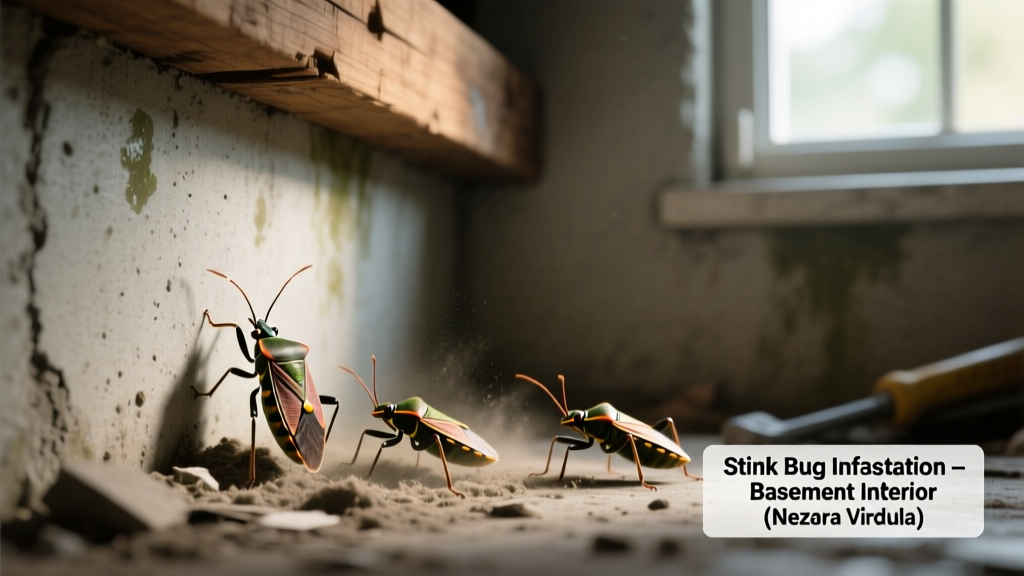
Stink bugs—especially the brown marmorated stink bug (BMSB)—frequently invade basements from late summer through early winter, seeking warmth and shelter. Unlike attics or garages, basements offer consistent humidity, cracks near foundations, and minimal light—ideal conditions for overwintering. Their presence isn’t just a nuisance; when crushed or disturbed, they release a pungent, cilantro-like odor that lingers for hours and can trigger allergic reactions in sensitive individuals.
Identification
Stink bugs in basements are most often brown marmorated stink bugs (Halyomorpha halys), an invasive species first documented in the U.S. in 1998. Adults are about 14–17 mm long, shield-shaped, with marbled brown-gray coloring, alternating light-and-dark bands on the antennae, and faint white bands on the abdominal edges.
| Insect | Size | Key Features | Odor When Crushed? |
|---|---|---|---|
| Brown Marmorated Stink Bug | 14–17 mm | Shield-shaped, banded antennae, smooth shoulders | Yes — strong, foul odor |
| Boxelder Bug | 12–14 mm | Red-orange markings, black body, no banding on antennae | No — mild, musty scent |
| Asian Lady Beetle | 5–8 mm | Rounder, variable spot count, orange-red base color | No — faint, acrid smell only when stressed |
Look for these signs in your basement:
- Clusters of motionless bugs along cold concrete walls or near sump pump pits
- Faint odor near window wells, foundation cracks, or HVAC intake vents
- Small, barrel-shaped, white-to-pale-green eggs (often in tight rows) on underside of basement window frames
- Shed exoskeletons (nymphal skins) near damp corners or behind stored boxes
What Attracts Them
Basements aren’t random stops—they’re targeted. Stink bugs follow thermal gradients and moisture cues. According to the USDA’s 2022 Pest Monitoring Report, 68% of BMSB basement infestations occur within 3 feet of foundation gaps or utility penetrations.
Key attractants include:
- Cracks >1/8 inch wide around basement windows, doors, and where pipes enter the foundation
- Relative humidity above 60%—common near leaky sump pumps or uninsulated block walls
- Warmth radiating from furnace rooms, water heaters, or ductwork during fall cooling
- Light leakage from basement egress windows at dusk (they’re weakly phototactic)
Treatment Methods
Natural Removal
Vacuuming is the safest, fastest method for immediate reduction—use a shop vac with a disposable bag or a vacuum lined with a nylon stocking over the hose end to trap bugs without releasing odor. Freeze collected bugs for 24 hours before disposal to ensure mortality.
DIY traps work best in cool, still areas: fill a shallow pan with soapy water (1 tsp dish soap per cup), add a desk lamp overhead, and place it near a suspected entry point. The light draws them in; the soap breaks surface tension so they drown.
Chemical Options
Residual insecticides should be applied only to non-porous surfaces like concrete floors or foundation walls—not drywall or insulation. Pyrethroid-based sprays (e.g., bifenthrin or deltamethrin) labeled for indoor perimeter use provide up to 8 weeks of residual control when applied as a 6-inch band along baseboards and entry points.
Caution: Never spray near sump pump pits or floor drains—the U.S. EPA estimates 14% of household water usage is from leaks, and chemical runoff risks groundwater contamination. Always follow label instructions and ventilate thoroughly after application.
Prevention
Long-term control hinges on exclusion and microclimate management. Start with a full perimeter seal: caulk all gaps >1/8 inch, install door sweeps on walkout basement doors, and replace damaged window well covers with rigid polycarbonate lids.
Reduce basement humidity to below 50% using a dehumidifier sized for your square footage (e.g., 50-pint unit for 1,200 sq ft). Insulate cold water pipes to prevent condensation—a known moisture source that attracts both stink bugs and mold.
Also consider:
- Trimming shrubs and vines within 2 feet of basement windows and foundation walls
- Removing leaf litter and stacked firewood within 3 feet of the house
- Sealing attic and crawlspace access points—stink bugs often migrate downward through interior walls
When to Call an Exterminator
Call a licensed pest professional if you find more than 50 live stink bugs in a single week—or if you see nymphs (smaller, wingless, often brighter green or pinkish) consistently after mid-October. Nymphs indicate breeding is occurring indoors, which is rare but possible in heated basements with high humidity.
According to the National Pest Management Association’s 2023 Field Survey, 31% of reported BMSB infestations requiring professional service involved basement-level nesting in homes with cracked cinderblock foundations and unvented laundry exhausts.
"Stink bugs don’t nest—but they do aggregate. If you’re finding clusters in multiple basement zones (not just near one window), you’ve got a structural entry pattern, not just seasonal drift." — Dr. Laura Ries, Entomologist, Penn State Extension, 2022
Do stink bugs damage property?
No. They don’t chew wood, wiring, or insulation. Their sole threat is odor and psychological distress. However, their presence often signals larger moisture or structural issues—like failing window well drainage—that require attention.
Can they get into living spaces from the basement?
Yes. They travel upward through wall voids, especially near plumbing chases and electrical conduits. You’ll often see them first on second-floor windows in spring—these are the same bugs that overwintered below.
Are stink bugs dangerous to pets?
Not toxic, but ingestion may cause drooling or vomiting due to defensive chemicals. Cats sometimes bat them playfully—then recoil from the odor. Keep vacuumed bugs sealed away from pet-accessible areas.
Why do I only see them in fall and spring?
They enter diapause (hibernation) in cooler months. Fall sightings reflect migration inward; spring sightings reflect emergence and dispersal. Basements with stable temps (55–65°F) can disrupt this cycle, causing sporadic activity year-round.
Does bleach kill stink bugs?
It can—but it’s unsafe and ineffective for control. Bleach doesn’t repel or prevent entry, corrodes concrete and metal, and produces hazardous fumes when mixed with organic matter. Use soapy water instead—it’s safer and just as lethal.
Will sealing my basement windows stop them?
Only if done comprehensively. A single unsealed utility conduit or gap behind a basement outlet box provides enough access. Focus on the entire foundation perimeter—including where gas lines, cable, and dryer vents penetrate.
Stink bugs in basements are rarely a sign of poor housekeeping—they’re a symptom of building envelope flaws. Fix the gaps, manage moisture, and monitor seasonally. For persistent cases, pair physical exclusion with targeted vacuuming—and remember: prevention starts at ground level, not the ceiling. If you’re also dealing with silverfish in basement or spiders in basement, address humidity first—it solves three problems at once.