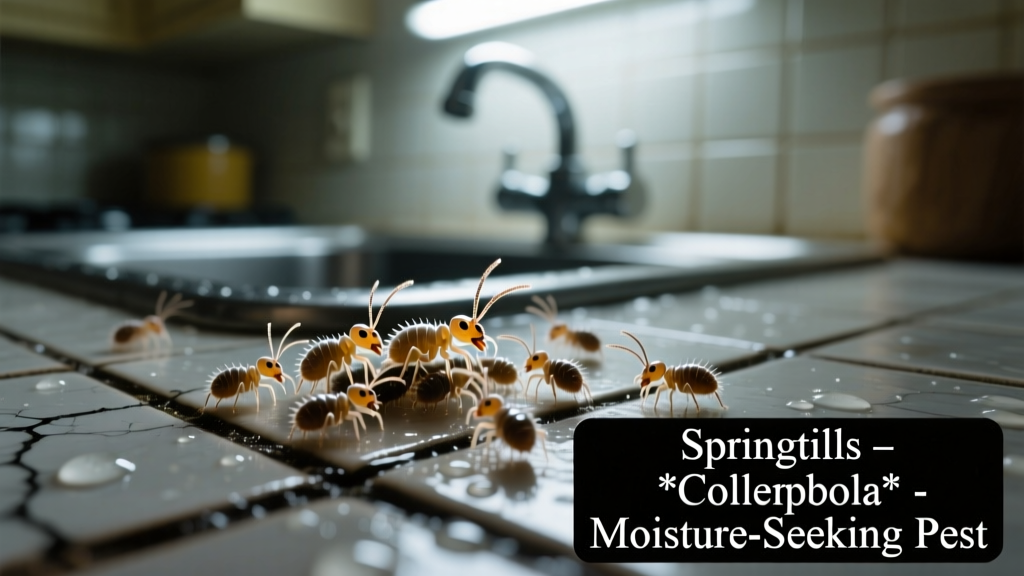
Springtails aren’t insects—they’re hexapods (Collembola), ancient soil-dwelling arthropods barely 1–2 mm long. Finding them clustered near sinks, under appliances, or on damp countertops signals excess moisture—not a structural infestation—but their presence can alarm homeowners who mistake them for mold mites, flea larvae, or even bed bug nymphs.
Identification
Springtails are often misidentified because they jump (using a forked 'furcula' under their abdomen) and appear en masse in humid spots. They’re wingless, oval-shaped, and range from white and gray to bluish-black. Unlike pests such as silverfish or kitchen sink ants, they don’t chew food, bite, or transmit disease—but their sudden appearance raises red flags.
| Pest | Size & Color | Behavior | Key Clue |
|---|---|---|---|
| Springtail | 0.2–2 mm; gray, white, or purplish | Jump erratically when disturbed; avoid light | Clusters on wet surfaces; vanish when area dries |
| Mold mite (Tyrophagus) | 0.3–0.5 mm; translucent white | Crawl slowly; found on moldy food or walls | Associated with visible mold growth, not just moisture |
| Flea larva | 1.5–5 mm; creamy white, hairy | Crawl; avoid light; feed on organic debris | Rarely seen in kitchens—more common in pet bedding or carpets |
| Booklice (psocids) | 1–1.5 mm; pale brown/gray | Crawl; cluster in high-humidity areas | Feed on starchy mold—not water itself—often near flour or cereal |
What Attracts Them
Springtails don’t invade homes to feed or breed indoors—they follow moisture gradients. Their presence means relative humidity is consistently above 75% in that zone, often due to:
- Leaking faucet or supply line under the sink (U.S. EPA estimates 14% of household water usage is from leaks)
- Condensation behind refrigerators or dishwashers
- Poor ventilation in cabinets or crawlspaces beneath flooring
- Water-damaged drywall or subflooring harboring fungal growth
They’re drawn to microbial films—bacteria and fungi thriving in damp microenvironments—not crumbs or grease.
Treatment Methods
Natural Remedies
Because springtails lack true pest status, chemical intervention is rarely needed. Start with desiccation and habitat disruption:
- Wipe down affected areas with 70% isopropyl alcohol—kills on contact and evaporates fast
- Apply food-grade diatomaceous earth (DE) in cracks and under appliances (reapply after cleaning)
- Use silica gel packets inside cabinets where condensation pools
- Vacuum with a HEPA filter, then immediately discard the bag or empty the canister outdoors
Chemical Options
Insecticides are unnecessary and ineffective long-term unless moisture is resolved first. If localized treatment is insisted upon, pyrethrin-based aerosols (e.g., MGK PyGanic) may suppress visible clusters—but only for 2–3 days. According to the National Pesticide Information Center’s 2022 review, no EPA-registered product targets springtails specifically, and overuse risks contaminating food prep zones.
"Springtails are bioindicators—not invaders. Finding 50+ in your kitchen sink means your moisture control failed, not your pest control." — Dr. Elena Ruiz, Entomologist, University of Florida IFAS Extension (2023)
Prevention
Long-term prevention hinges entirely on reducing humidity and eliminating standing water sources. Focus on these four zones:
- Check under the sink weekly for drips, swollen cabinet bases, or musty odors
- Install a hygrometer in the kitchen; maintain RH below 60% using exhaust fans or a dehumidifier
- Seal gaps around pipes with silicone caulk—not expandable foam, which retains moisture
- Replace water-damaged particleboard shelving or baseboards; use marine-grade plywood in high-moisture cabinets
Also inspect adjacent rooms: springtails often migrate from leaky bathrooms or basements through shared wall cavities.
When to Call an Exterminator
Call a licensed pest professional only if:
- You’ve corrected all moisture issues for 10+ days but springtails persist in the same location
- You find evidence of structural water intrusion (e.g., efflorescence, buckling tiles, soft drywall)
- Clusters exceed 100+ per square foot daily—and you’ve ruled out mold mites via magnification
Note: Most exterminators won’t treat springtails alone. A reputable service will conduct a moisture audit first—and charge accordingly. Avoid companies offering ‘springtail spray packages’ without inspection.
Are springtails dangerous to humans or pets?
No. Springtails cannot bite, carry pathogens, or infest skin or fur. They’re harmless detritivores. The U.S. CDC has zero documented cases linking them to human illness.
Can springtails live in dry food or pantry items?
Not directly—but they’ll congregate near spilled oatmeal, rice, or flour if those areas absorb ambient moisture and develop surface mold. They feed on the fungi, not the grain. Discard any food with visible mold, regardless of springtail presence.
Why do I see them more in spring and fall?
Seasonal spikes align with outdoor humidity surges and temperature shifts that drive migration indoors. In spring, saturated soil pushes them toward foundations. In fall, cooling air increases indoor relative humidity—especially in poorly ventilated kitchens.
Do springtails mean my home has mold?
Not necessarily—but they do indicate conditions favorable for mold. Look for fuzzy discoloration on grout, behind kickplates, or under rubber mats. If you find mold, test it with a DIY kit (like Mold Armor) before assuming it’s Stachybotrys.
Will bleach kill springtails on countertops?
Bleach may kill individuals on contact, but it’s unsafe for food surfaces and doesn’t address the root cause. Worse, bleach residue can corrode stainless steel and degrade grout. Use diluted vinegar (1:1 with water) for disinfection—or better yet, just dry the area thoroughly.
Can springtails come up through drains?
Rarely. They lack the strength to navigate vertical drain pipes. More likely, they’re emerging from damp floor drains with organic buildup—or crawling in from adjacent wet subfloors. Pouring boiling water down the drain won’t help; snaking and drying the trap area will.
Springtails are nature’s tiny moisture meters—not pests to fear, but signals to heed. Fix the damp, and they’ll disappear within days. Keep your kitchen dry, well-ventilated, and routinely inspected—and you’ll rarely see them again. For persistent moisture issues, consider pairing a kitchen leak detection checklist with a portable dehumidifier rated for 30–50 pints/day.