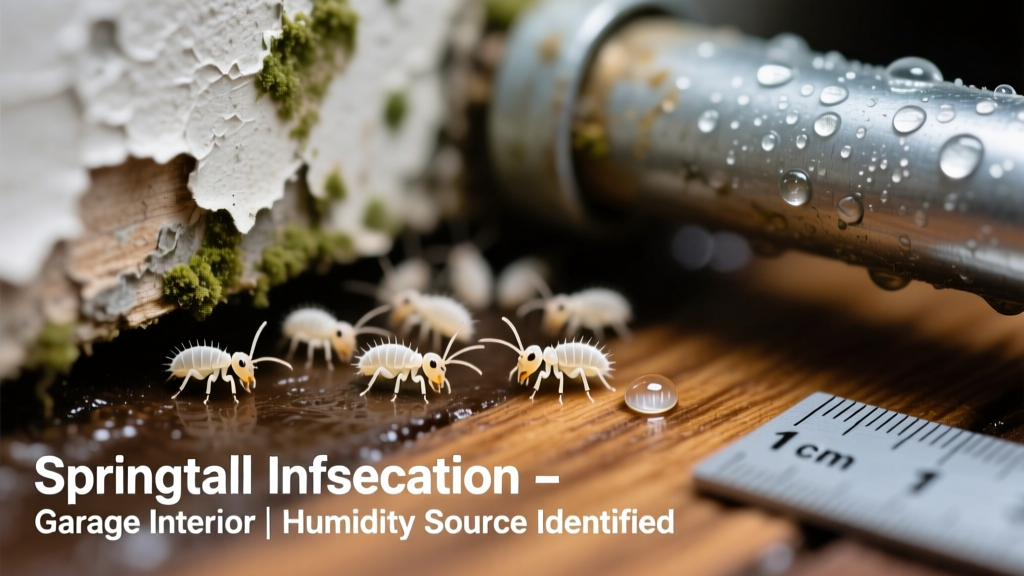
Springtails are tiny, wingless hexapods—not insects, but close relatives—that jump when disturbed using a forked appendage called a furcula. In garages, they rarely bite or damage property, but their sudden appearance in clusters on damp floors, near drains, or around stored cardboard signals serious moisture issues—and sometimes mold growth beneath concrete slabs.
Identification
Springtails range from 0.25 to 2 mm long—most common garage invaders are gray, white, or bluish-black, oval-shaped, and visibly 'jump' (not fly) when nudged. They’re often mistaken for mold mites or flea larvae, but unlike fleas, they lack piercing mouthparts and never infest pets or humans.
| Pest | Size | Color | Key Behavior | Garage Hotspots |
|---|---|---|---|---|
| Springtail | 0.25–2 mm | Gray, white, or bluish | Jump 3–4 inches when disturbed; avoid light | Floor cracks, under mats, near sump pumps |
| Mold mite | 0.3–0.5 mm | Translucent or pale yellow | Crawl slowly; cluster on damp drywall or insulation | Behind baseboards, in wall cavities |
| Flea larva | 1–5 mm | Off-white, hairy | Wriggle sideways; found near pet bedding | Under rugs, in floorboard gaps where pets rest |
What Attracts Them
Springtails don’t seek food—they seek moisture. Your garage likely offers three key attractants: condensation on cold concrete floors (especially in spring), organic debris like leaf litter tracked in on tires or shoes, and hidden water sources such as leaking hoses, faulty gutters dripping near the garage door, or poor grading that pools water against the foundation.
- Relative humidity above 75% for >48 hours triggers rapid reproduction (they can lay 20+ eggs per day)
- Decomposing cardboard boxes, old carpet remnants, or wet drywall scraps serve as fungal food sources
- Cracks in concrete slabs wider than 1/16 inch provide shelter and access to sub-slab moisture
Treatment Methods
Natural Methods
Start with desiccants and physical removal. Diatomaceous earth (food-grade) applied as a thin line along baseboards and crack edges dehydrates springtails on contact—reapply after sweeping or rain exposure. A shop vac with a HEPA filter removes visible clusters instantly; empty the canister outside immediately. Ventilate aggressively: run a fan pointed at the garage door for 2–3 hours daily until indoor humidity drops below 60%.
Chemical Options
If populations persist beyond 10 days of natural intervention, targeted insecticidal dusts work best. DeltaDust (deltamethrin) lasts up to 8 months in dry areas and is labeled for crack-and-crevice use indoors—including garages. Avoid liquid sprays: they increase humidity and may spread spores from underlying mold. According to the National Pesticide Information Center’s 2022 review, deltamethrin dusts achieve >92% mortality in springtail field trials when applied correctly to entry points.
"Springtails aren’t pests you ‘eradicate’—they’re bioindicators. If you kill them but ignore the leak behind the water heater or the 3-inch gap under your garage door, they’ll be back in 72 hours." — Dr. Lena Cho, Urban Entomologist, Purdue Extension, 2023
Prevention
Long-term control hinges on moisture management—not pesticide rotation. Seal all cracks in concrete floors and walls with polyurethane caulk (not silicone). Install a vapor barrier under new garage floor coatings. Keep stored items elevated on plastic pallets—not cardboard or wood—and inspect monthly for dampness underneath.
- Install a dehumidifier rated for 70+ pints/day if garage is attached or below grade
- Redirect downspouts at least 5 feet from foundation walls
- Replace rubber weatherstripping on garage doors annually—cracked seals let in humid air and soil moisture
- Remove organic debris (leaves, grass clippings, mulch) within 2 feet of garage exterior walls
When to Call an Exterminator
Call a licensed pest professional if springtails appear inside your home’s living space within 48 hours of garage sightings—or if you find them emerging from electrical outlets, HVAC vents, or bathroom grout lines. These indicate structural moisture migration, not just a garage issue. Also consult one if you’ve addressed all moisture sources and still see >50 springtails per square foot after two weeks of treatment.
Do springtails mean my garage has mold?
Not necessarily—but they strongly suggest conditions favorable for mold. Springtails feed on fungi and bacteria thriving in damp microenvironments. If you spot them near drywall seams or under cabinets, test for hidden mold with an ERMI (Environmental Relative Moldiness Index) kit or hire a certified IICRC inspector.
Can springtails damage my car?
No. They don’t chew rubber, wiring, or upholstery. However, their presence signals high humidity that can accelerate corrosion on brake lines and rust on undercarriages—especially in coastal or salt-treated regions.
Why do I only see them after rain?
Rain saturates soil and pushes springtails upward through foundation cracks and utility conduits. They migrate toward drier air—often ending up on garage floors or parked vehicles. This surge typically peaks 12–36 hours post-rainfall.
Will bleach kill springtails on the floor?
Bleach may kill individuals on contact, but it evaporates quickly and doesn’t penetrate cracks or organic matter where eggs and adults hide. Worse, mixing bleach with ammonia (e.g., from urine-soaked rags) creates toxic chloramine gas. Use vinegar-water (1:1) for surface cleaning instead—it lowers pH and disrupts fungal food sources.
Are springtails harmful to pets or kids?
No known cases of disease transmission, bites, or allergic reactions exist. The U.S. CDC lists springtails as non-hazardous to human and animal health. Their main risk is psychological—startling jumps can cause minor stress in sensitive individuals.
Can I use foggers for springtails in my garage?
Avoid total-release foggers. They disperse chemicals ineffectively in open, drafty spaces and fail to reach the moist, protected zones where springtails live—like under floor drains or behind insulation. Foggers also pose fire risk near vehicle batteries or solvent storage.
Springtails won’t vanish overnight—but they will recede steadily once humidity drops and organic debris is removed. Focus first on the slab, second on the seal, third on the storage system. For more on related moisture pests, see our guides on silverfish in basement and booklice in attic. If your garage shares a wall with living space, also review condensation on walls solutions.